- Place
- Kaunas, Kaunas City Municipality
- Region
- Kaunas
- Type
- brick castle, museum, and historic defensive site
- Address
- Pilies g. 17, LT-44275 Kaunas
- Coordinates
- 54.89920, 23.88600
Kaunas Castle Museum
A castle at two rivers
Kaunas Castle stands in a strategically obvious place: at the confluence of the Nemunas and Neris rivers, in the historic core of Kaunas. VLE describes it as the remains of a thirteenth- to fourteenth-century enclosure castle and a fourteenth- to seventeenth-century military-architecture monument.
The site matters beyond the surviving red-brick tower. The castle's position explains why Kaunas became important for defence and trade: river routes, old-town streets, and the confluence landscape meet here.
What survives today
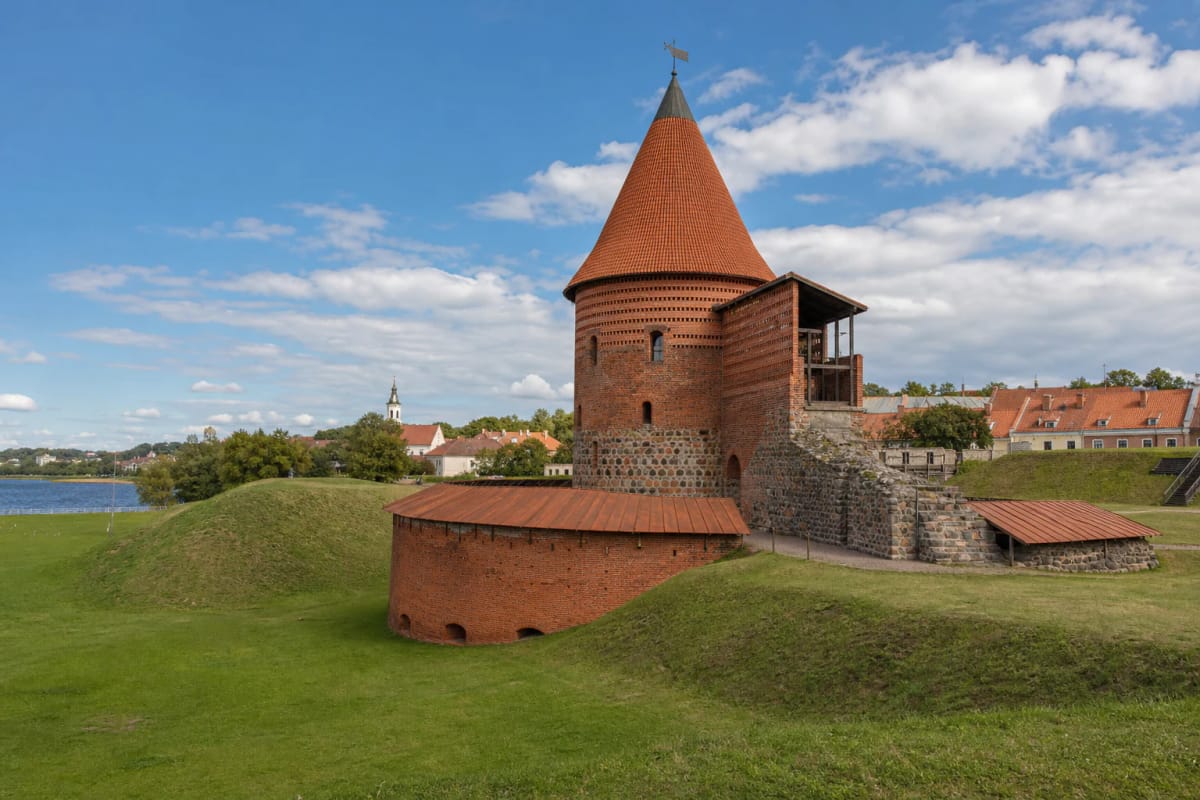
The present castle is partly reconstructed. VLE notes a semi-enclosed courtyard, the lower part of a square tower in the south-western corner, and a round south-eastern tower restored to the fourth floor and roof.
At the base of the round tower is a bastion. Its firing position is connected by a tunnel to the tower's first floor, while a deep ditch surrounds the remains from the south and east. That helps visitors see the castle as a defensive system, not only a photogenic tower.
The 1362 siege and the second castle
VLE writes that defensive structures existed in the castle area already in the fourth to fifth centuries, and that the first brick castle was probably built in the second half of the thirteenth century. It had a roughly 0.5 ha courtyard, thick defensive walls, a fore-wall, shooting openings, and wooden fighting galleries.
In 1362, the Teutonic Knights destroyed the castle defended by a garrison led by Vaidotas. A second brick castle was built before 1368, with walls about 3.5 m thick and 10 m high and flanking towers at the corners.
From fortress to museum
In the second half of the fourteenth century, Lithuanians and the Teutonic Knights fought repeatedly over the castle. In 1404 it finally passed to the Lithuanians and became a support point during the 1409 Samogitian uprising and the 1410 war. After the Battle of Grunwald, its military importance declined and it became the residence of the Kaunas elder.
VLE also records later damage: in 1601-1611 the Neris washed away parts of the castle, and in the first half of the eighteenth century water brought down the northern wall and two towers. Later the site held a prison, noble assemblies, and barracks; twentieth-century research and conservation followed. In 1992 the castle was entered into the Cultural Property Register of the Republic of Lithuania.
In 2009-2011, partial reconstruction of the south-eastern tower, eastern defensive wall, and castle-site outline was carried out. Since 2011, the castle has housed a branch of Kaunas City Museum, and in 2012 the Kaunas Castle history exhibition opened.
Visiting Kaunas Castle
Kaunas City Museum presents the castle as the city's oldest historic object and one of Lithuania's oldest brick castles. The address is Pilies g. 17, LT-44275 Kaunas.
Combine the visit with Santaka Park, Kaunas Town Hall, and the old town. Give time not only to the tower and exhibition but also to the ditch, bastion, courtyard shape, and confluence relief, because they explain the castle's defensive logic.
At the time of review, the museum branch was usually closed on Mondays and most public holidays, except February 16, March 11, and July 6. Check exact hours and ticket prices on the Kaunas City Museum page; the courtyard, ditch, and exterior can be viewed freely.