- Place
- Vilnius City Municipality
- Region
- Vilnius
- Type
- civic square, memorial space, and public garden square
- Address
- Gediminas Avenue at Vilniaus Street, opposite 11 Gedimino Avenue, Vilnius
- Coordinates
- 54.68757, 25.28060
- Visit duration
- 30-60 minutes; 1.5-2.5 hours when combined with a Gediminas Avenue walk between Cathedral and Lukiškės squares
- Best time
- a dry morning or late afternoon in spring, summer, or early autumn, after checking the fountain and event schedule
Vinco Kudirkos aikštė, Savivaldybės aikštė, Ivan Chernyakhovsky Square, St George's Square
What belongs to the square and what merely borders it
Vincas Kudirka Square lies in central Vilnius at the junction of Gediminas Avenue and Vilniaus Street. The coordinates 54.6875721, 25.2805981 identify the exact Google Maps listing in the open area beside the monument. A Vilnius Tech urban study calculated the space at approximately 1.4 hectares while also noting that no separate plot had been formed for the square, so this is not a ticketed or fenced visitor boundary.
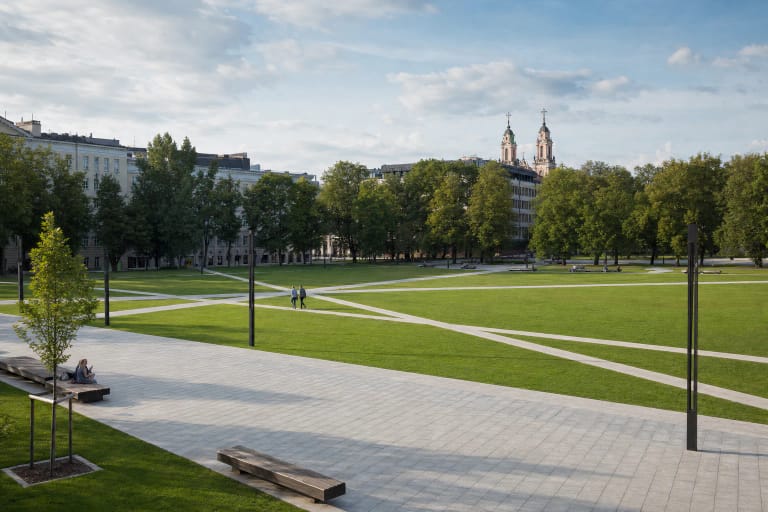
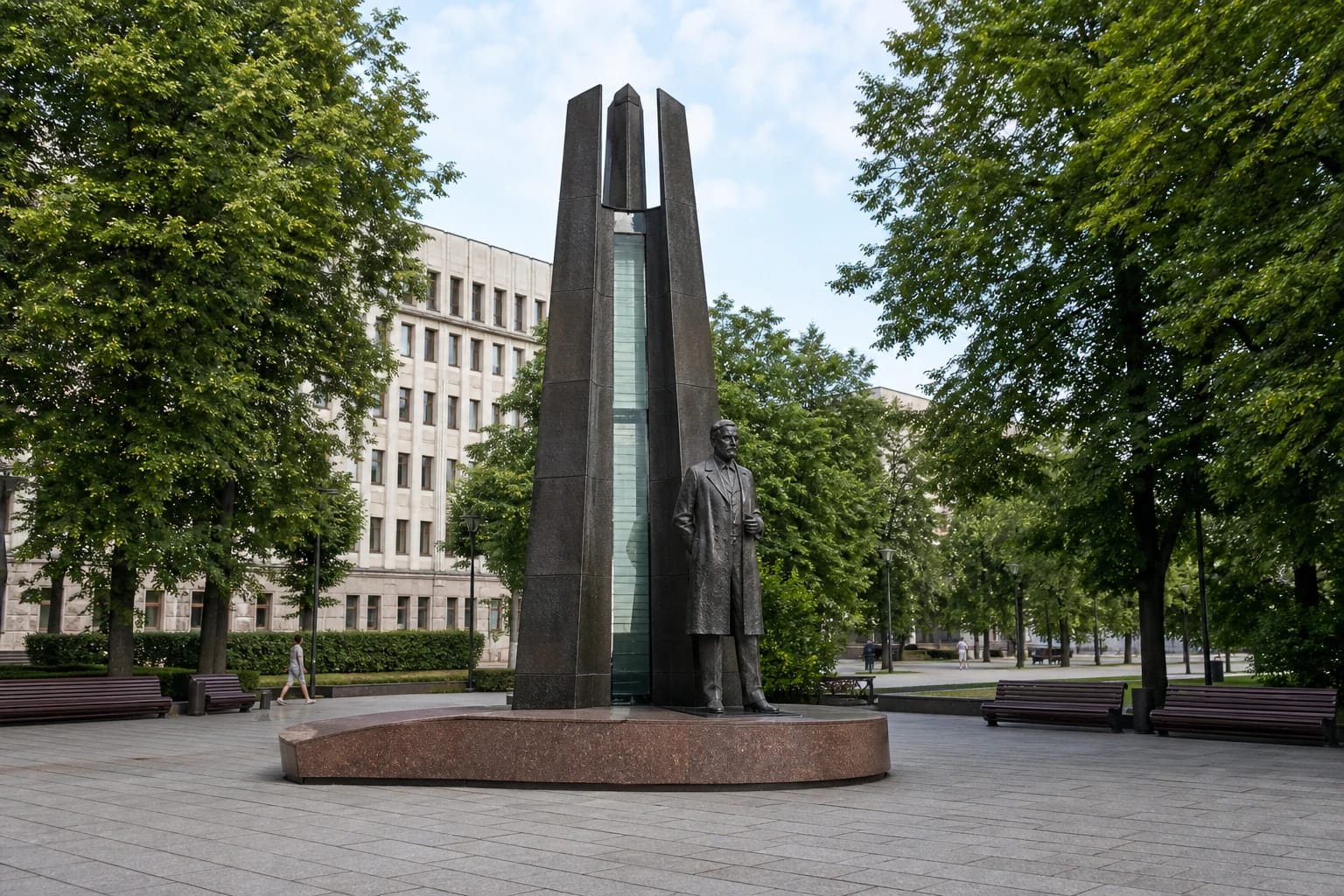
The present space has two readily legible parts. A more open paved area beside Gediminas Avenue contains the Vincas Kudirka monument, while mature deciduous trees, paths, and benches soften the larger northern and side sections. This wooded perimeter makes the square function in everyday life more like a public garden and meeting place than a purely ceremonial plaza.
The Government Palace at 11 Gediminas Avenue forms the northern backdrop but is not part of the square's visitor infrastructure. The Government states that the building was constructed in 1977-1982 to a design by Vytautas Edmundas Čekanauskas, initially housed the Central Committee of the Lithuanian Communist Party, and became the seat of the Government in January 1992. Entry follows the institution's own event, tour, work, and security rules.
From an imperial chapel to the Chernyakhovsky monument
In the nineteenth century, the space was known as St George's Square. In 1865, Governor-General Mikhail Muravyov initiated the construction of the Chapel of St Alexander Nevsky, designed by Nikolai Chagin. Dedicated to those who had suppressed the 1863-1864 Uprising, it served not only as a place of worship but also as a conspicuous symbol of Russian imperial power in the city centre.
The chapel was demolished in 1919 after the Red Army occupied Vilnius. Names and uses changed again over the following decades, yet the most persistent strand of the square's history remained the same: political authorities repeatedly selected this visible site for their own commemorative marker.
A monument to Soviet Army general Ivan Chernyakhovsky was unveiled here in 1950. Nikolai Tomsky created the bronze figure, while Lev Golubev designed the architectural setting. The monument and the ideologically charged name endured until 1991, when the sculpture was removed after Lithuania restored independence. Neither it nor the nineteenth-century chapel survives in today's square.
Municipality Square and the route to the 2009 monument
After the Chernyakhovsky monument was removed, the space became Municipality Square, reflecting the city administration then based in this section of Gediminas Avenue. Once the municipal offices moved to Konstitucijos Avenue, the name no longer described the place. Vilnius City Council renamed it Vincas Kudirka Square on 3 October 2007.
Construction of the monument unfolded in stages. A foundation stone was laid in what was still Municipality Square on 6 July 2007. The stylised National Anthem Bell Tower was installed in 2008 for the 150th anniversary of Kudirka's birth, but casting the bronze figure took longer. The complete composition was unveiled on 5 July 2009, the eve of Statehood Day.
Vilnius Old Town heritage documentation identifies the monument as a 2009 work in granite and bronze by sculptor Arūnas Sakalauskas and architect Ričardas Krištapavičius. It is one artwork assembled from several parts, not a standalone Kudirka statue beside an unrelated tower. The figure, anthem text, bell tower, and water were conceived as a single narrative.
How to read the National Anthem Bell Tower
A stylised bell tower almost 13 metres high rises from a red-granite base approximately 12 metres in diameter. Open slots separate its three vertical sections at the crown, and the words of the Lithuanian anthem are recorded on the central glass panel. A 3.7-metre bronze figure of Vincas Kudirka stands in front. Water runs around part of the base when the seasonal fountain is operating.
The bell-tower image connects several parts of Kudirka's work. He was a physician, writer, journalist, translator, composer, and leading figure in the Lithuanian national movement who began publishing Varpas, meaning The Bell, in 1889. VLE records that Tautiška giesmė appeared with its music in Varpas on 15 September 1898, became a national hymn in the early twentieth century, and was confirmed as the state anthem in the 1992 Constitution.
The monument rewards attention to the complete composition rather than portrait likeness alone. Red granite draws a low horizontal circle, the vertical bell tower lifts the anthem above the square, and the human figure restores a scale familiar to the passer-by. Evening light changes the appearance of glass and polished stone, but laser illumination, fountain jets, and festive lighting should not be treated as a guaranteed daily programme.
Free access, arrival, and facilities in 2026
The square is an open public outdoor space with no gate or admission ticket. On 21 July 2026, its exact Google Maps listing marked it as open 24 hours, although a concert, market, demonstration, Government security measure, or maintenance work may temporarily change how part of the space can be used. Allow 30-60 minutes for the monument itself, or continue along Gediminas Avenue towards Cathedral or Lukiškės Square.
The Vinco Kudirkos aikštė public-transport stop is beside the square on Vilniaus Street. Beneath the area, JUDU's car park at 9A Gediminas Avenue has 262 spaces, operates around the clock, and has two lifts, one by Vilniaus Street and another inside the G9 shopping centre. The official rate in July 2026 was EUR 2.50 per hour, but check both price and availability on the day of travel.
The principal paths and open square are level and paved, so the monument can be viewed without climbing steps. On 19 June 2026, Grinda reopened the refurbished underground public toilet: it is free, open around the clock, accessible to disabled visitors, and includes a baby-changing table. On 21 July 2026, the exact Google Maps card showed 4.6 out of 5 from 7,487 reviews; both figures will change.