- Place
- Turgeliai, Šalčininkai District Municipality
- Region
- Vilnius Region
- Type
- active historicist Roman Catholic church with Neo-Baroque and Neoclassical features and surviving wall paintings
- Address
- Bažnyčios a. 2, LT-17285 Turgeliai, Šalčininkai District
- Coordinates
- 54.45515, 25.50831
- Visit duration
- 30-50 minutes for the churchyard, architecture, and interior when open; follow the liturgy if attending Mass
- Best time
- Sunday, coordinated with 09:00 Mass or the officially listed 11:45-13:45 opening; the Assumption feast on 15 August is meaningful but busy
Turgelių Švč. Mergelės Marijos Ėmimo į dangų bažnyčia, Church of the Assumption of the Blessed Virgin Mary in Turgeliai, Turgeliai Assumption Church
Today's church combines the 1837 and 1897-1909 phases
VLE dates the first timber church in Turgeliai to 1500, while Šalčininkai District heritage accounts give 1511. Both place the parish tradition at the beginning of the sixteenth century, but choosing one precise date requires further archival support. That timber sanctuary burned and was rebuilt in 1722.
Priest Povilas Ksaveras Bžostovskis, creator of the Paulava Republic and parish priest of Turgeliai from 1798 to 1824, supported the idea of a new masonry church. Public accounts say he set aside funds, but political and financial disruption delayed construction. The core of today's masonry sanctuary was built in 1836-1837, after his death.
The building had become too small by the late nineteenth century. Aleksejus Polozovas prepared the enlargement in 1896-1897 and the principal work followed in 1900-1909; VLE and some heritage lists therefore date the visible church as a whole to 1897-1909. The most accurate reading treats this as the design and construction interval of an enlargement that retained part of the 1837 masonry.
Polozovas's Neo-Baroque envelope and distant twin towers
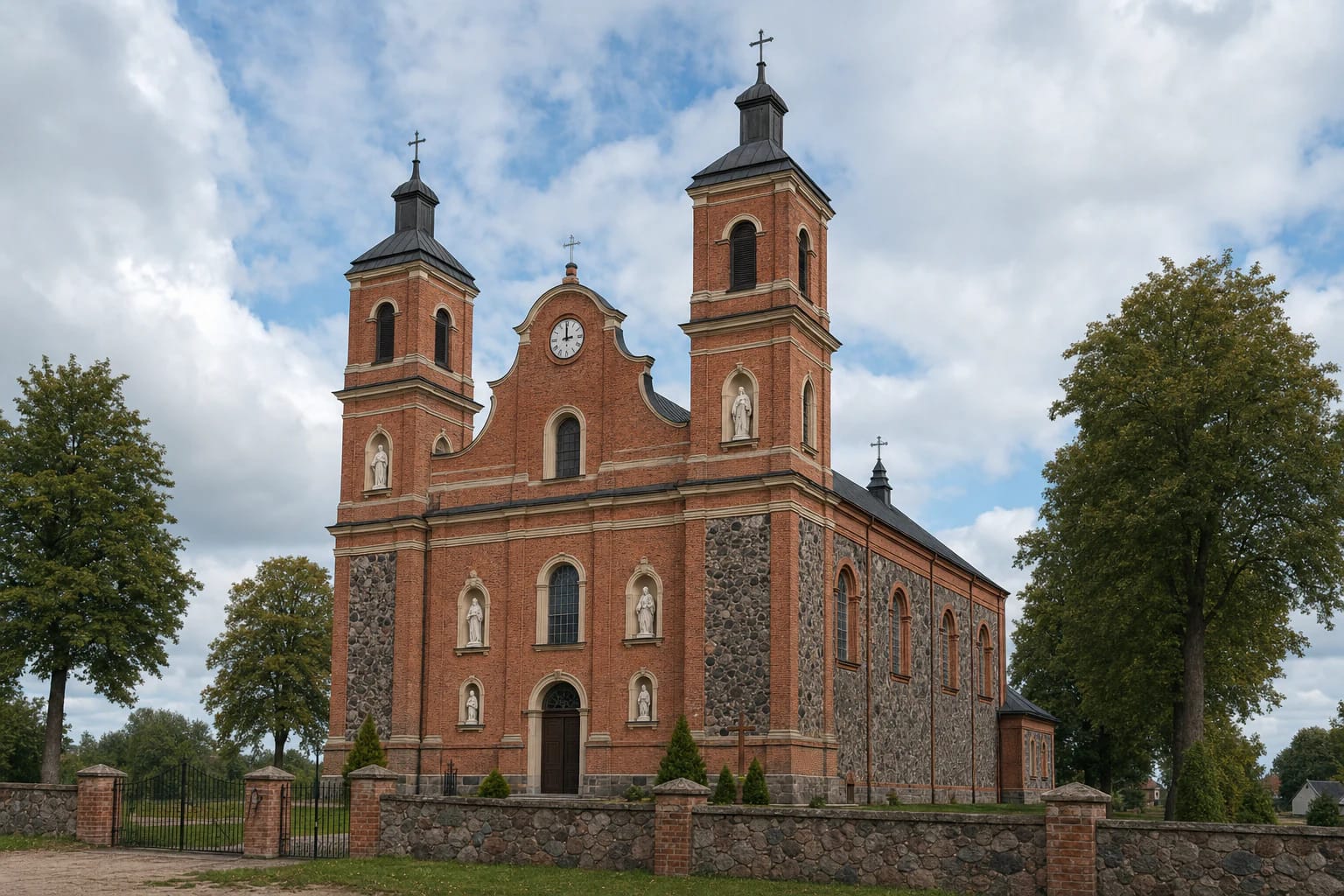
Vilnius Governorate architect Aleksejus Polozovas transformed the older church into a much larger three-aisled sanctuary. Retaining substantial earlier walls, he added side aisles, an apse, a porch, and two façade towers. Archbishop Romuald Jałbrzykowski of Vilnius consecrated the church in 1930.
The symmetrical red-brick front is the first view from the town square. Tall arched windows, pilasters, statue niches, and a central clock gable articulate it, while two cross-topped towers rise at the corners. Red brick is combined with dark stone rubble, giving the side walls a particularly textured surface.
The church stands where roads from Tabariškės, Akmenynė, Rudamina, and Jašiūnai meet. Municipal planning material in 2026 identified its towers as the defining feature of the Turgeliai skyline, visible from the southern road at roughly 3-3.5 kilometres. Churchyard trees sometimes screen the full volume, so circle the stone-and-masonry boundary wall.
The 1928-1930 wall painting extends beyond the sanctuary
A broad wall-painting programme followed the architectural enlargement in 1928-1930. Šalčininkai District heritage material names Valdemaras Kačinskis and Skvarčinskis as painters and associates Konstantinas Čarneckis with the decorative work. Spellings of these names vary in Lithuanian and Polish accounts.
Look for compositions on the vaults, above the organ loft, over the pillars of the central aisle, in the side aisles, and across the presbytery. This is a programme encompassing the whole space, not one image above the altar. Upper scenes can be difficult to read in uneven light; binoculars or a phone zoom reveal detail without flash.
Surviving elements include early twentieth-century fittings, Neoclassical side altars, plant ornament across the presbytery wall, a restrained organ case with an angel figure, and a carved timber pulpit. The heritage register also records individual works of sacred art. Not every object is guaranteed to remain in the same position while conservation or secure storage is under way.
Bžostovskis, Paulava, and a living Assumption tradition
Bžostovskis's connection with the church should be distinguished from his better-known work at Paulava. He acquired the Merkinė estate in 1767, began reforming its peasant community in 1769, and became parish priest of Turgeliai only in 1798. Claims that he led the parish from 1767 conflate the purchase of the estate with the start of his ministry here.
The parish was a religious and educational centre: an eighteenth-century parish school is recorded, while Lithuanian, Polish, and Belarusian experiences met around the town. Today every regular Mass on the official archdiocesan page is marked as Polish, and visitors should respect this living local language tradition.
The church is dedicated to the Assumption of the Blessed Virgin Mary, celebrated in Lithuania as Žolinė on 15 August. Municipal accounts record the continuity of indulgence celebrations, concerts, and community events in Turgeliai. It is a meaningful day to encounter living tradition but not the quietest choice for an architectural visit.
Polish Mass, Sunday opening, and two address numbers
On 27 July 2026, the Archdiocese of Vilnius listed Mass at 17:00 on Monday, Wednesday, and Friday; 09:00 on Tuesday, Thursday, and Saturday; and 09:00 on Sunday. Every service was marked PL, meaning Polish. Schedules can change around feasts and clergy appointments, so check the official page before travelling.
The archdiocesan page separately listed the church as open on Sunday 11:45-13:45 and a priest on duty Monday-Saturday 10:00-12:00 and Sunday 08:00-11:00. No tourist admission charge is published. Doors may be locked outside worship or the stated opening; arrange a group visit through +370 682 51311.
The Archdiocese uses Bažnyčios a. 2, while some maps and older catalogues use number 1. The entrance coordinates 54.4551479, 25.5083104 and exact Google place card identify the church more reliably than the street number alone. No official step-free access description is published, so discuss gates, thresholds, and assistance with the parish.