- Place
- Šalčininkai District Municipality
- Region
- Vilnius Region
- Type
- fragments of Merkinė Manor and the historic site of an Enlightenment-era self-governing peasant community that operated from 1769 to 1795
- Address
- Merkinė village, Turgeliai eldership, Šalčininkai district
- Coordinates
- 54.45623, 25.47382
Paulavos Respublika, Pavlovo respublika, Paulava, Merkinė Manor in Šalčininkai district
The Republic of Paulava is at Merkinė near Turgeliai, not the better-known Merkinė in Dzūkija
The historic core lies in Merkinė village in Šalčininkai district, beside road 3937 on the right bank of a loop in the Merkys, at coordinates 54.4562309, 25.4738245. Do not confuse it with the town of Merkinė in Varėna district; select the full Maps name Republic of Paulava or check for the Turgeliai eldership.
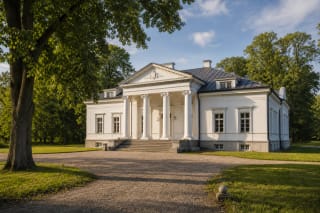
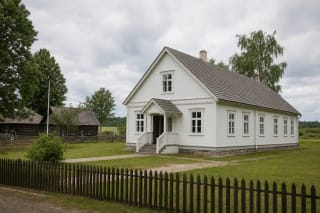
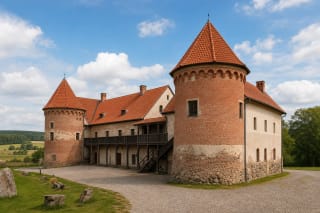
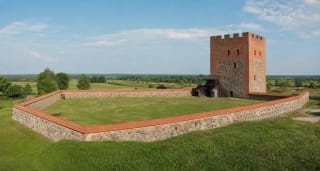
Visitors encounter neither a reconstructed eighteenth-century settlement nor a single museum building. The present site is the dispersed Merkinė Manor complex: palace, office, stable, and gate masonry stands across a meadow, alongside a chapel containing Christ Carrying the Cross and a restored icehouse. Interpretation boards reconnect these separate remains to the historic plan.
The phrase state within a state captures Paulava's symbols and self-government but can mislead. It was not an internationally independent country separate from the Polish-Lithuanian Commonwealth. It was a community on a private estate, regulated by statutes and granted an exceptional degree of peasant self-rule.
Brzostowski bought Merkinė in 1767 at the age of 28 and began reform within two years
Priest, canon, and Grand Duchy of Lithuania official Paweł Ksawery Brzostowski was born in 1739 and studied theology in Rome. He returned from Italy with social and agricultural ideas of the Enlightenment. He bought the small Merkinė estate from the Korsak family in 1767, renamed it Paulava after himself, and joined it to the Turgeliai parish farm.
The initial estate comprised 140 voloks, or approximately 3,040 ha, and 34 peasant farms. The first Paulava statutes, adopted by voluntary agreement between Brzostowski and the community in 1769, began the republic. By the early 1790s it had grown to more than ninety farms and about 800 inhabitants.
Brzostowski became president, so this was not a modern republic of equal citizens. Even so, the written rules, elected representatives, and rights granted to estate peasants had no direct precedent in the serf-based societies of Central and Eastern Europe at the time.
A two-chamber parliament, courts, civic symbols, and militia made self-government operational
Under the statutes of 1769 and 1791, power was shared between the president and a peasant parliament. An upper chamber consisted of about twelve estate officials of noble and peasant origin, some elected and some appointed. The lower chamber began as a general peasant assembly and was replaced in 1781 by a commission of eight elected deputies.
The community had a two-stage court, treasury, banking or mutual-aid functions, a coat of arms, flag, seal, and its own monetary tokens. These were not merely decorative attributes of a miniature state: they helped administer dues, settle disputes, provide loans, and define public obligations.
An armed and uniformed peasant militia maintained order and defence with muskets and several cannon. Sources give totals ranging from 137 to approximately 150 men, making about 150 the safest description. In 1791 the Four-Year Sejm formally confirmed Paulava's revised statutes.
Personal freedom and cash rent changed the estate relationship, but peasants did not gain complete ownership of the land
From 1769 Brzostowski granted peasants personal freedom and hereditary use of land, allowed them to manage property freely, trade, and practise crafts. Labour dues were gradually replaced with cash rent, and direct cultivation for the manor ended fully in 1786. The cash obligation encouraged farms to produce for the market.
The reform is often shortened to the abolition of serfdom, but peasants did not receive full modern ownership of their holdings. Their rights and hereditary use were far broader than on a conventional estate, yet the land remained within the manor system. Brzostowski also demanded improved farming, orchards, livestock husbandry, and industrial crops.
A communal grain store, mutual-aid fund, several mills, a fulling mill, distillery, and inns operated here. From 1784 Paulava had a medical practitioner, pharmacy, and primary school that also taught agriculture and military skills. Estate income more than doubled by 1784, giving Brzostowski an economic argument for reform.
The militia repelled Cossacks in 1794, but the model did not survive partition
During the uprising of 1794, Paulava's peasant militia repelled three Cossack attacks, and Jakub Jasiński, commander of the uprising in Lithuania, stayed at the estate in June. The episode shows that an armed community cultivated over almost three decades existed in practice rather than on paper alone.
After the uprising failed and the third partition approached, Brzostowski left for Saxony in 1795 and exchanged the estate with Count Fryderyk Moszyński for property in Saxony. The republic's self-government ended in the political system of the Russian Empire, and the essence of reform disappeared when a serf-based order returned to the estate.
Octave de Choiseul-Gouffier acquired the manor in 1799; later owners included the Kobyliński, Zabiełło, von Delwig, and, from 1912, Wagner families. Much of the surviving Classicist palace and farm masonry dates from the first or second half of the nineteenth century, so not every visible brick belongs to the republic's own period of 1769-1795.
The restored icehouse explains the ruins, and climbing on any palace masonry is strictly prohibited
After the Second World War the estate buildings served agricultural purposes, suffered a fire, and gradually became ruins. The municipality took over the site in 2012 and improved the grounds and paths. Restoration of the best-preserved icehouse began in 2017: walls and foundations were strengthened, the roof and stairs were restored, and a three-metre-deep stone-lined ice pit was uncovered. An exhibition on Paulava opened inside in 2024.
The outdoor grounds can be visited without a ticket, but no regular opening schedule for the icehouse exhibition was published on official pages in 2026. Contact the Šalčininkai District Tourism and Youth Centre or arrange a guide if entering it matters. The always-open label on Google Maps describes the outdoor ruin site, not a museum guaranteed to be unlocked.
Do not climb or enter any unstable palace, office, or stable masonry. In 2024 the municipality stressed that warning signs prohibit this and that violations can bring a fine; KPD's 2026-2028 plan schedules further conservation of the stable remains. On 13 July 2026, Google Maps rated the site 4.8 out of 5 from 925 reviews.