- Place
- Aleksandrija eldership, Skuodas District Municipality
- Region
- Samogitia
- Type
- hydrogeological natural-heritage site and natural spring
- Address
- Truikinai village, by the Skuodas-Mažeikiai road, Skuodas District
- Coordinates
- 56.27521, 21.66902
- Visit duration
- 30-60 minutes
- Best time
- in daylight on a dry day; the hollow's slopes and timber walkways can be slippery after rain
Truikinų šaltinis, Truikinų šaltinėlis, Šmitos šaltinis
Šmitos Spring and the Truikinai Spring: one place, several names
Šmitos Spring is the name used in encyclopaedic and geological sources, while Truikinų šaltinis and Truikinų šaltinėlis are common visitor names. All of these names refer to the same spring in Truikinai village, Aleksandrija eldership, Skuodas District.
The spring lies by the Skuodas-Mažeikiai road, with a local sign directing visitors roughly a kilometre to the site. The coordinates 56.275210, 21.669016 mark the spring itself, not the Farmers' Museum or another visitor destination elsewhere in Truikinai.
A suffosion cirque and two differently coloured spring eyes
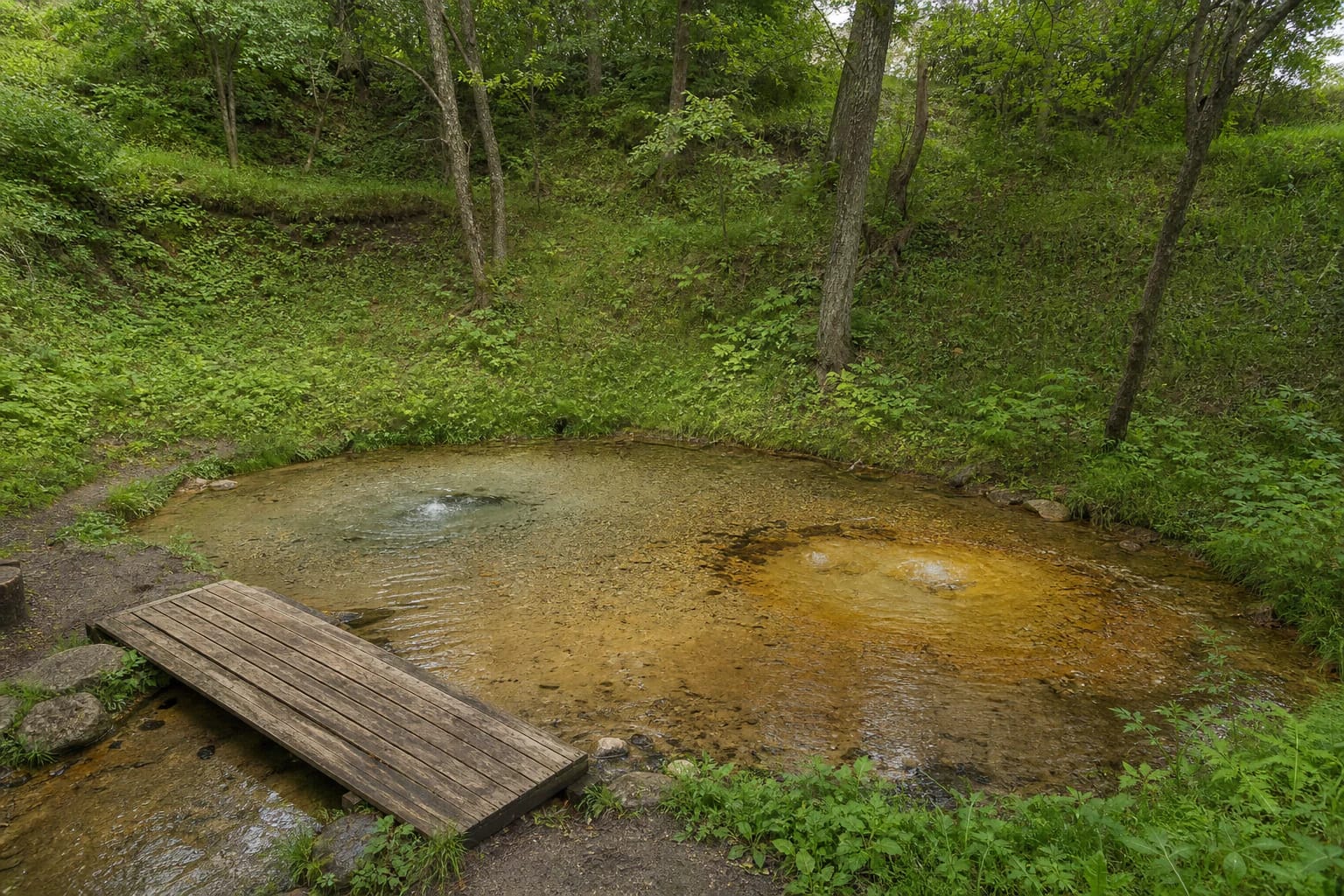
The spring emerges from the lower part of a suffosion cirque. This wooded hollow is about 15 metres across, with slopes rising up to roughly 5 metres. The oval basin at the bottom is about 6 metres long and 4.5 metres wide, so the place is more like a shallow natural pool than an ordinary pond.
The basin floor is sandy, locally muddy, and marked by iron-rich deposits. Two main bubbling spring eyes are visible: one appears yellowish-brown and the other light grey. The difference reflects the sand and mineral deposits visible at the bottom, not two separate water bodies.
The water is generally described as about 10-25 cm deep. Watch the bubbling eyes from the footbridge or path; wading into the basin, disturbing the floor, and scrambling on the slopes are neither safe nor helpful to the site.
Šaltupis, Guntinas, and the spring water
Overflow from Šmitos Spring runs into the Šaltupis, which reaches the Guntinas stream about 170 metres farther on. The small basin is therefore part of a larger local water network: the spring water continues through the woodland and valley rather than ending at the pool.
The encyclopaedic description calls the water clear and cold and records a temperature of about 8.4 °C and a discharge of 11.8 litres per second. Geological data also emphasise the iron-rich deposits. These details explain the spring but do not by themselves confirm that the water is safe to drink.
Visitors should not collect water simply because it looks clear. If using the water matters, look for a recent official quality test and an on-site indication that collection is allowed; the sources checked do not give a current everyday drinking recommendation.
A natural monument with local stories
The spring is protected as a natural-heritage site, with its value linked to active groundwater discharge, the suffosion hollow, and the clearly visible spring eyes. Lithuanian Geological Survey descriptions use the hydrogeological-site designation, while encyclopaedic sources describe its protection as a natural monument.
Local accounts say that flax was once soaked here, making the woven linen especially white. Other stories mention animals, a chapel that stood here in the early twentieth century, and beliefs in the spring's healing powers. This is local folklore, not a modern medical or water-quality conclusion.
In 1974 a stone bridge was built across the stream, with benches and steps, and a storybook house stood on the slope. These older accounts show why local people understood the spring as more than a hydrological feature: it was also a place for meeting and storytelling.
Access and responsible visiting
A path, timber footbridges, and benches lead around the spring, and car parking is described nearby. Municipal and protected-area accounts mention improvements including steps, paths, rest elements, and an information board. The sources checked do not publish specific services or opening hours for a particular day.
The hollow's slopes and timber structures can be slippery after rain, and the route from the main road descends to the spring. Wear shoes with good grip, keep children close, and assess whether the approach suits you if step-free movement is important.
Stay on the installed path and footbridges, do not enter the spring basin, disturb the sand or iron deposits, or leave rubbish. If a temporary barrier, warning, or newer on-site notice is present, follow it because infrastructure conditions can change.