- Place
- Skuodas District Municipality
- Region
- Samogitia
- Type
- Neo-Romanesque Catholic church with a churchyard bell tower
- Address
- Gedimino g. 12, Skuodas
- Coordinates
- 56.26981, 21.52183
Skuodas Holy Trinity Church, Skuodas Most Holy Trinity Parish Church
A twin-towered church in the centre of Skuodas
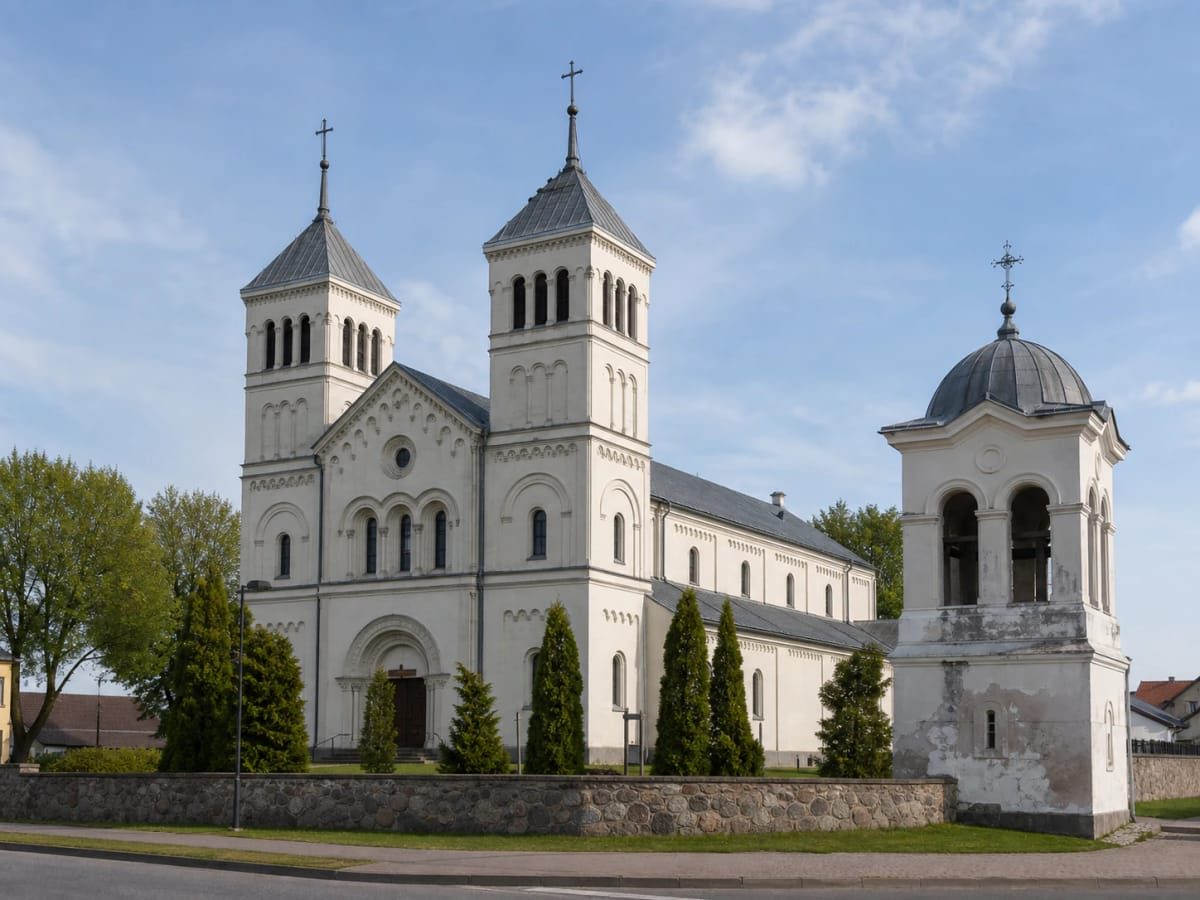
Skuodas Church of the Most Holy Trinity stands on Gedimino Street in the town centre. It is easy to recognize by its two low quadrangular towers with bell-shaped helmets and its masonry mass, which differs from the smaller wooden churches often associated with Samogitia.
It is a Neo-Romanesque, rectangular-plan, hall-type, three-nave church with a semicircular apse. Semicircular arched windows run along the side facades and the apse, and plastered corner rustication, pilasters, cornices, and window surrounds stand out against the stone and rubble. A 19th-century brick bell tower stands in the churchyard, which is enclosed by a stone wall.
From the 1614 church to the 1844-1847 masonry building
A Catholic church has existed in Skuodas since the 17th century: in 1614 one was built by the Vilnius voivode Jonas Karolis Katkevičius (Chodkiewicz), together with a parish school. In 1725 Prince Kazimieras Sapieha built a new church, consecrated by the Samogitian Bishop Antanas Domininkas Tiškevičius, but it burned down in the city fire of 1835.
The present stone-and-brick church was built in 1844-1847 on the initiative of Skuodas priest Tamošius Sudintas (1799-1851). VLE's article on Skuodas dates the church to 1847, and on 15 July 1850 it was consecrated by the Samogitian Bishop Motiejus Valančius - so it belongs to the churches of the Valančius era.
Three 19th-century bells
The church preserves three authentic bells that survived the wars, cast in 1891-1896 with funds from farmers of Luknai village. The small bell is about 111 cm in diameter and 52 poods in weight (1891, funded by Kazimieras Dirkštis), the middle one about 120 cm and 73 poods (Motiejus Girdžiūnas and Juozapas Paulauskas), and the large one about 141 cm and 102 poods (1896).
The bells are valued as very fine and original, decorated with relief images, ornamental bands, and inscriptions. Together with the churchyard bell tower, they form a coherent, authentic sound-and-sight setting for the church.
War damage and tower restoration
VLE and parish information state that in 1944 the church was damaged and both towers were knocked down. The priest Stanislovas Vaitelis (1906-1990), appointed in 1945, repaired the church, but the towers were only partly restored - so the present view is not solely the result of 19th-century construction.
Father Vaitelis's fate also reflects Soviet-era pressure: he was arrested and sentenced on 9 October 1949, returned to Lithuania in 1956, and from 1974 served as a Skuodas altarist. In churches like this it is worth reading not only the style, but the history of repairs and community resilience.
Interior, churchyard, and visiting
The interior is dominated by the main and side altars, decorated with saints' paintings, sculptures, and columns; the carved pews with geometric ornaments and decorative sculptures are especially ornate. VLE mentions valuable paintings in the church, among them an 18th-century image of the Virgin Mary.
This is an active parish church, so the rules of a sacred space come first, and schedules change - check the official parish or Telšiai Diocese page before travelling. Architecture usually needs 20-40 minutes, and a wider Skuodas route can be combined with Skuodas Museum, Apuolė Hillfort, and Mosėdis Stone Museum.