- Place
- Tauragė District Municipality
- Region
- Tauragė Region
- Type
- seasonal private adventure and family leisure park with six treetop courses, a net playground, and separately charged activities
- Address
- 1 Tauragės Dvaro Street, Tauragė 72134 - in Taurai village and the former manor area
- Coordinates
- 55.23382, 22.25101
- Visit duration
- 2-4 hours for treetop courses including registration and briefing; longer when combining activities or holding a celebration
- Best time
- a dry morning from May to September, with a reservation and same-day confirmation that the selected courses and activities operate
Taurų nuotykių parkas, Taurų Park, Taurai ropes park
The park is in Taurai, about 3 km from central Tauragė
The official address, 1 Tauragės Dvaro Street, is often shortened to Tauragė, but the site is in Taurai village on the south-western approach to town. Coordinates 55.23382, 22.25101 mark a representative point within the park rather than the administration door or the start of one particular course. For navigation, use the full park name, address, and Google place ID ChIJeXEhiSA-5EYRs8Z774dzrZI.
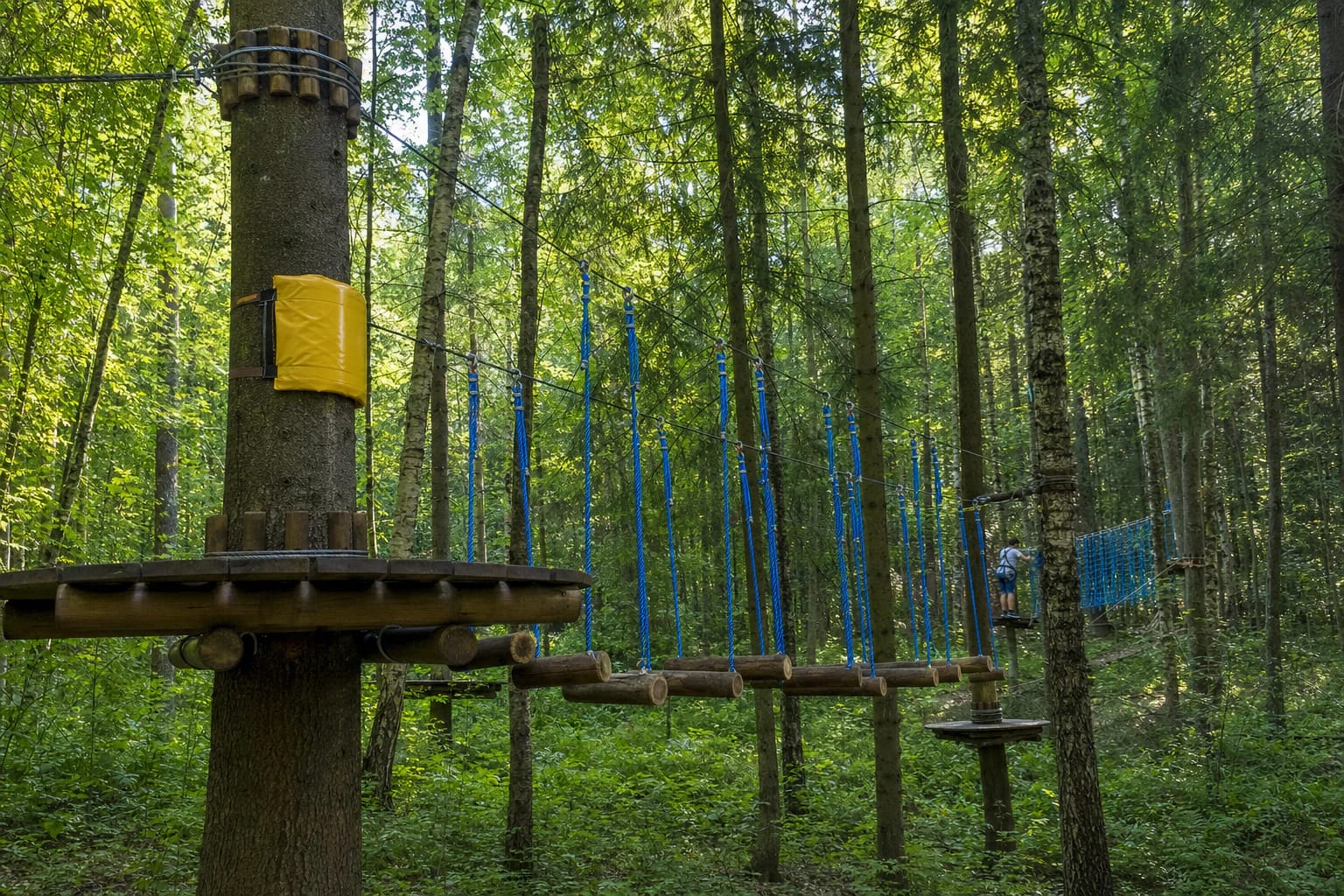
The park website describes ten hectares of woodland as an oak grove, although the actual setting is a mature mixture of broadleaf and coniferous trees. Timber platforms wrap around trunks, with cables, nets, moving logs, and zip-line sections between them. This is not one observation platform: registration, course starts, and other activities are spread across a larger site.
A public copy of Google rating data dated 14 March 2026 showed 4.7 out of 5 from roughly 1,500 reviews. That signals substantial use and broad popularity, but it is neither an official safety audit nor proof that every activity described in an old source will operate on the day of a visit.
Six colours correspond to specific age and height thresholds
The yellow course is for children aged five and over 110 cm. It introduces the main obstacle types and safety equipment, with parents supervising their children themselves. The orange course starts at age eight and above 130 cm; the operator presents it as an easy warm-up before more demanding routes.
The green course also starts at age eight but requires a height above 140 cm and is intended for visitors climbing higher for the first time. Blue starts at age 11 and above 150 cm. It requires more physical effort, concentration, and time, so meeting the age and height rule alone does not make skipping the easier course a good idea.
Red is for ages 11 and over 155 cm. It is long and difficult and includes five zip-line flights. Black keeps the same height rule, above 155 cm, but raises the minimum age to 14; the operator stresses stamina and correct obstacle technique. The full six-course system is officially described as 6 km long and between 1 and 16 metres high, not as a route that every visitor must complete in full.
Booking, briefing, and the last starting time require advance confirmation
The main 2026 page labels advance booking as mandatory, while the climbing page asks visitors to register at least one day before arrival. The safest approach is to book by telephone on +370 614 43449 or by email at info@tauruparkas.lt and obtain clear confirmation, particularly at weekends, for a group, or when travelling a long distance.
Published general opening hours are 11:00-19:00 on weekdays and 10:00-19:00 at weekends. The same page says that the last customers are admitted at 19:00, although the treetop ticket allows up to three hours. It would therefore be unsafe to assume that 19:00 is the final climbing start: confirm the actual last admission to the courses when booking. The administration may alter hours during the cold season.
Before climbing, visitors must attend the local staff briefing, fit the issued safety equipment correctly, and follow the attachment method demonstrated on site. The official public pages give no universal weight limit, comprehensive medical contraindication list, or promise that an instructor accompanies every person along an entire course. Discuss those questions, previous injuries, pregnancy, and other health limitations before buying a ticket.
The 2026 tariff distinguishes weekdays, weekends, and a single course
On 21 July 2026, the official climbing page listed a three-hour adult ticket at EUR 16 on weekdays and EUR 18 at weekends. The school-age visitor tariff was EUR 14 and EUR 16, while one selected course cost EUR 8 and EUR 10. The children's yellow-course line showed EUR 8 on weekdays and EUR 10 at weekends.
Weekend prices apply on public holidays. A 15 per cent discount was advertised for groups of six or more, but confirm the group size, ages, and services covered when reserving. These prices are a dated snapshot and can change, so check the official page before travelling.
There is no general admission charge for entering the grounds: the official FAQ says that only selected activities cost money. This permits a companion to walk below, but free access does not include the courses, Tinklų kiemas, trampolines, or rented spaces. The website also states that card payment is accepted on site.
The current offer extends beyond the treetop courses, but old lists need checking
The official 2026 menu still includes two hill-tubing runs presented as usable year-round: one ends with a jump onto an air cushion, while the other descends the slope. Tinklų kiemas rises to ten metres and has three levels; on the check date, 30 minutes cost EUR 6 on weekdays and EUR 7 at weekends. The sensory trail has been renewed and supplemented by a nature-photography exhibition.
ORE is a 250 sq m children's trampoline and play space. Its page requires advance registration and slippers or warm socks, and says that in the cold season it opens only at weekends and for pre-booked celebrations, with extra opening days announced separately. These conditions are not the same as the treetop season or the park's general hours.
Current accommodation consists of five four-person summer cottages on the ground, while the 2026 addition Giliukas is a celebration room rented for three hours. Gazebos are also available. Older tourism pages mention a tree hotel, safari rides, a reconstructed castle, and other activities absent from the current official menu; do not plan around them without direct confirmation from the operator.
The park founded in 2011 occupies only part of the old Tauragė manor site
The park website says that Taurų Park, founded by Antanas Venckus, opened in 2011 with five treetop courses. It now lists six, while services and payment details are published under the operator IĮ Autoežeruona, company number 179760649. This is a private leisure business, even though its woodland also belongs to a much wider historical landscape.
Tauragė District Municipality includes the Tauragė manor site in its cultural-heritage list. Municipal material about the Dvaro Street quarter explains that old trees, ponds, and several significant buildings survive in the former estate area, which later became a military settlement. The adventure-course structures are not reconstructions of manor architecture, so the heritage and contemporary attractions should be kept distinct.
Drivers should approach via Tauragės Dvaro Street and follow signs on site rather than relying only on the representative map point. The operator publishes neither a guaranteed number of free parking spaces nor a comprehensive accessibility statement for the entire park. Wheelchair users, visitors with limited mobility, and large groups should ask in advance about surfaces, toilets, viewing locations, and the closest safe drop-off point.