- Place
- Kėdainiai District Municipality
- Region
- Kėdainiai District
- Type
- timber Catholic church, belfry, and historic churchyard
- Address
- Bažnyčios g. 2, Šventybrastis, Vilainių eldership, Kėdainiai District
- Coordinates
- 55.42147, 24.04994
- Visit duration
- 30-60 minutes; depending on whether the church interior is open
- Best time
- during Sunday Mass, after checking the parish information in advance
Šventybrastis Church, Šventybrastis Church of the Transfiguration complex
The church and its setting
Šventybrastis Church of the Transfiguration stands at Bažnyčios g. 2 in Šventybrastis, within Vilainiai eldership. The coordinate 55.421472, 24.049943 marks the church complex itself rather than the general centre of the settlement. It is best understood as a distinct sacred-heritage site on the left bank of the Nevėžis.
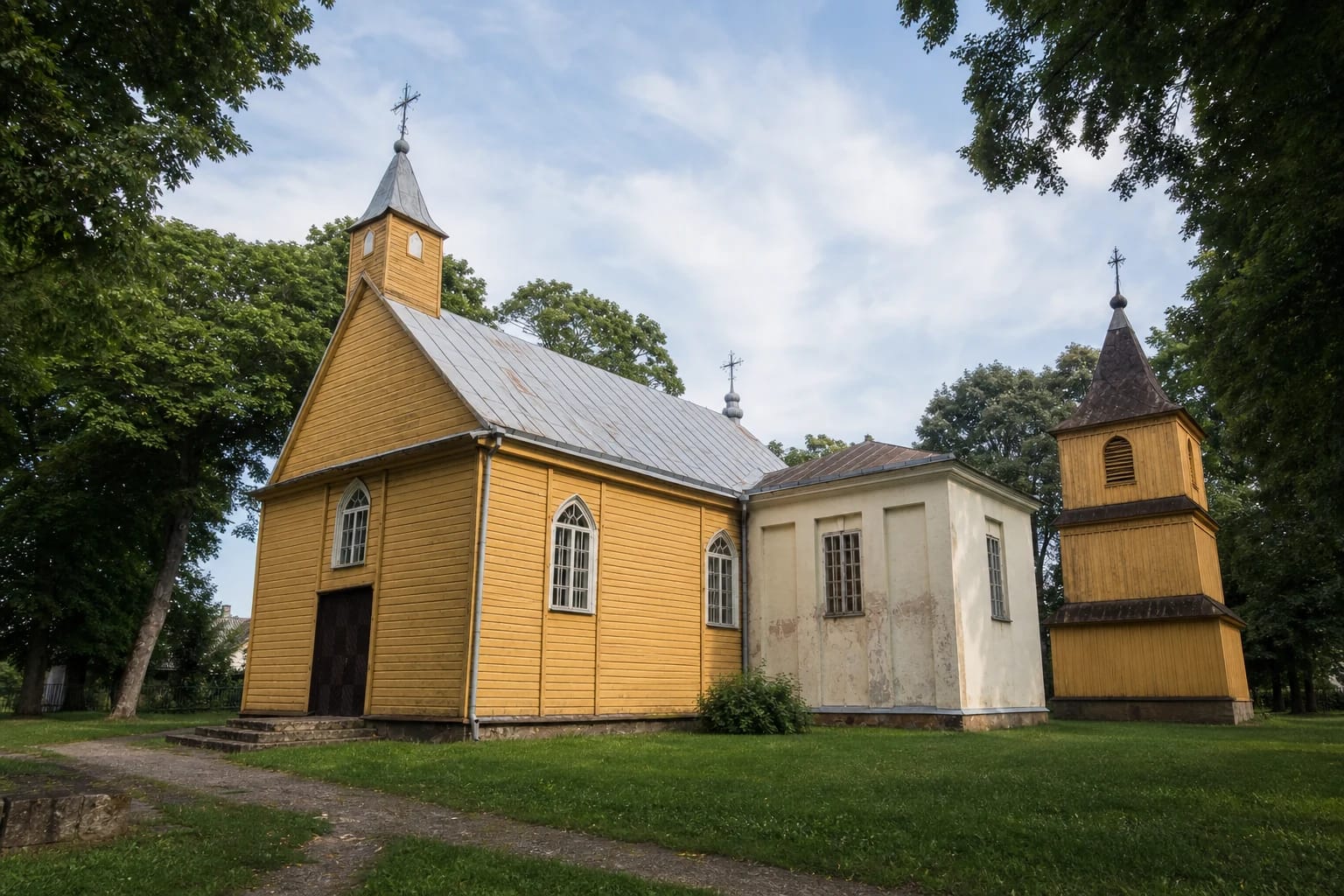
The yellow-painted timber volume, modest front tower, and separate two-tier wooden belfry are the clearest features from outside. Mature trees, memorials, and the churchyard give the stop a local historical layer as well as an architectural one, so it does not read like a generic village chapel.
This is an active parish church, so enter during services or after arranging access with the parish. At the same time, look at the detached belfry, mature oaks, and memorials in the churchyard.
The 1774 timber church and later additions
The present timber church was built around 1774. Its construction is traditionally attributed to Ignas Zaviša.
Masonry side wings were added to the timber volume in 1880. They contain two chapels and a sacristy, explaining why the present exterior combines different materials and why the complex is more than a small rural wooden chapel.
The church was repaired in 1928, while the belfry is generally dated to 1873. Dates for the separate parts of the complex are not always presented identically.
Architecture and churchyard memory
The church combines vernacular timber construction with restrained Classicist and Baroque details. The facade is divided into three similar pilaster bays and topped by a modest pediment, while the rear ends in a three-sided apse. These details reward a slower look than a quick roadside photograph.
The separate belfry is an important part of the composition and should not be confused with the small tower on the main facade. Two large bells were taken away for Russian authorities in 1915, adding a wartime loss to the story of the surviving complex.
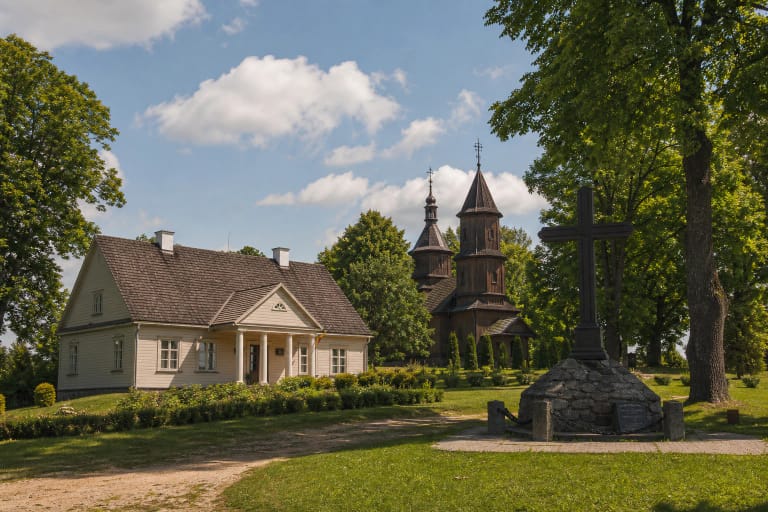
Protected oaks and memorials to independence and the insurgents remain in the churchyard. The Miłosz family connection adds cultural context to the area, but it should not be simplified into a claim that this particular building was the writer's residence.
Parish life and careful planning
The church is an active parish, so seeing the interior depends on services, parish arrangements, and the conditions on a particular day. A Sunday schedule published by the diocese lists opening at 11:30, confession from 11:40 to 11:55, and Mass at 12:00.
The schedule can change, so check the parish or diocesan notice before travelling, especially around feast days, repairs, or other changes to the liturgical calendar.
If you arrive outside a service, an exterior visit is the safest plan, and you should enter only when the doors are open and the congregation is not being disturbed. Arrange photography or a group visit with the parish in advance.
Šventybrastis in a Kėdainiai itinerary
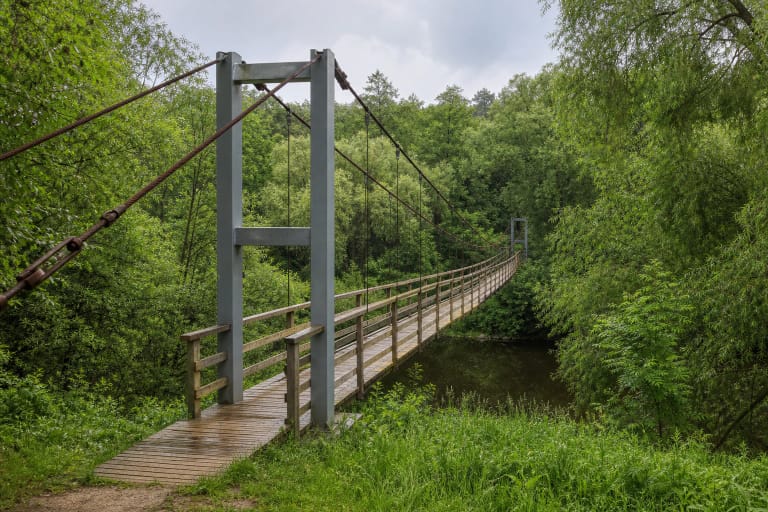
The church makes a compact stop on a Nevėžis-region itinerary, but the plan should not rest on a map pin alone. Šeteniai, the Surviliškis suspension bridge, Kėdainiai Regional Museum, and Paberžė are separate destinations with their own distances and visitor arrangements.
The churchyard's quiet scale and timber architecture are easiest to appreciate without rushing. Look at the main facade, detached belfry, masonry additions, and memorials while respecting the boundaries of a cemetery and the privacy of a liturgical space.
Because access follows the church's religious use, there is no permanent museum-style tour. Plan your visit around a current service time, a realistic approach to the site, and respectful behaviour on church grounds.