- Place
- Pervazninkai village, Sudargas eldership, Šakiai District Municipality
- Region
- Suvalkija
- Type
- private ethnographic rural-tourism homestead with old timber buildings, household objects, and programmes arranged in advance
- Address
- Pervazninkai village, Sudargas eldership, Šakiai District
- Coordinates
- 55.04514, 22.73022
- Visit duration
- about 1 hour for a booked introductory programme; longer if an activity, meal, or private stay has been arranged
- Best time
- only by prior agreement with the host; the broad yard, orchard, and timber ensemble are easiest to appreciate in the warmer months
Etnografinė Suvalkiečio sodyba, Suvalkiečio sodyba, Suvalkietis Homestead
This is a living private homestead, not an everyday public museum
The Suvalkietis Ethnographic Homestead lies in Pervazninkai, within the Sudargas eldership and close to the Nemunas and Sudargas hillforts. It functions simultaneously as a private property, a rural-tourism venue, and a setting for booked ethnographic interpretation. The word ethnographic does not turn it into a public museum that may be entered unannounced on any day.
For pre-arranged groups, the host gives an approximately one-hour introduction to the layout, Suvalkija's daily life and festivities, and old household objects. Additional activities, spit-cake baking, meals, accommodation, or exclusive venue hire are separate commercial services that must be agreed individually. They should not be assumed to accompany a basic tour.
The coordinates 55.045139, 22.730224 identify the property rather than a precise gate, reception point, or parking bay. The published address has no street or building number, so obtain confirmation and detailed arrival instructions before setting out. Do not enter other private yards or neighbouring plots while searching for it.
Late-nineteenth-century timber buildings enclose a broad planted yard
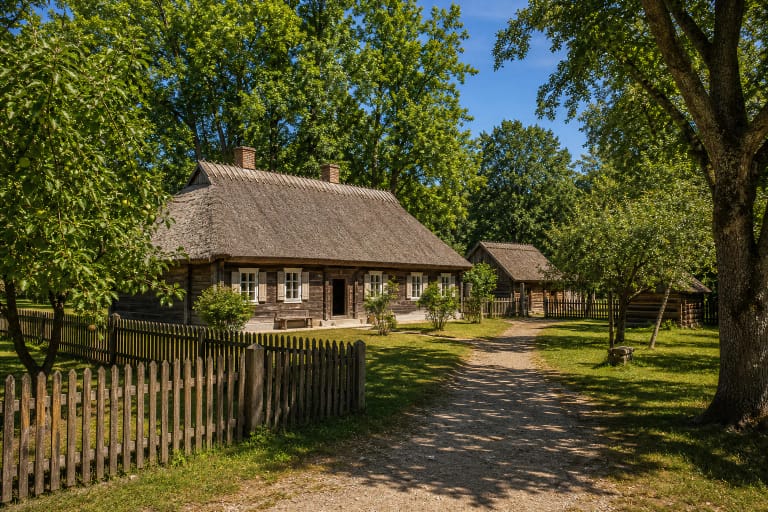
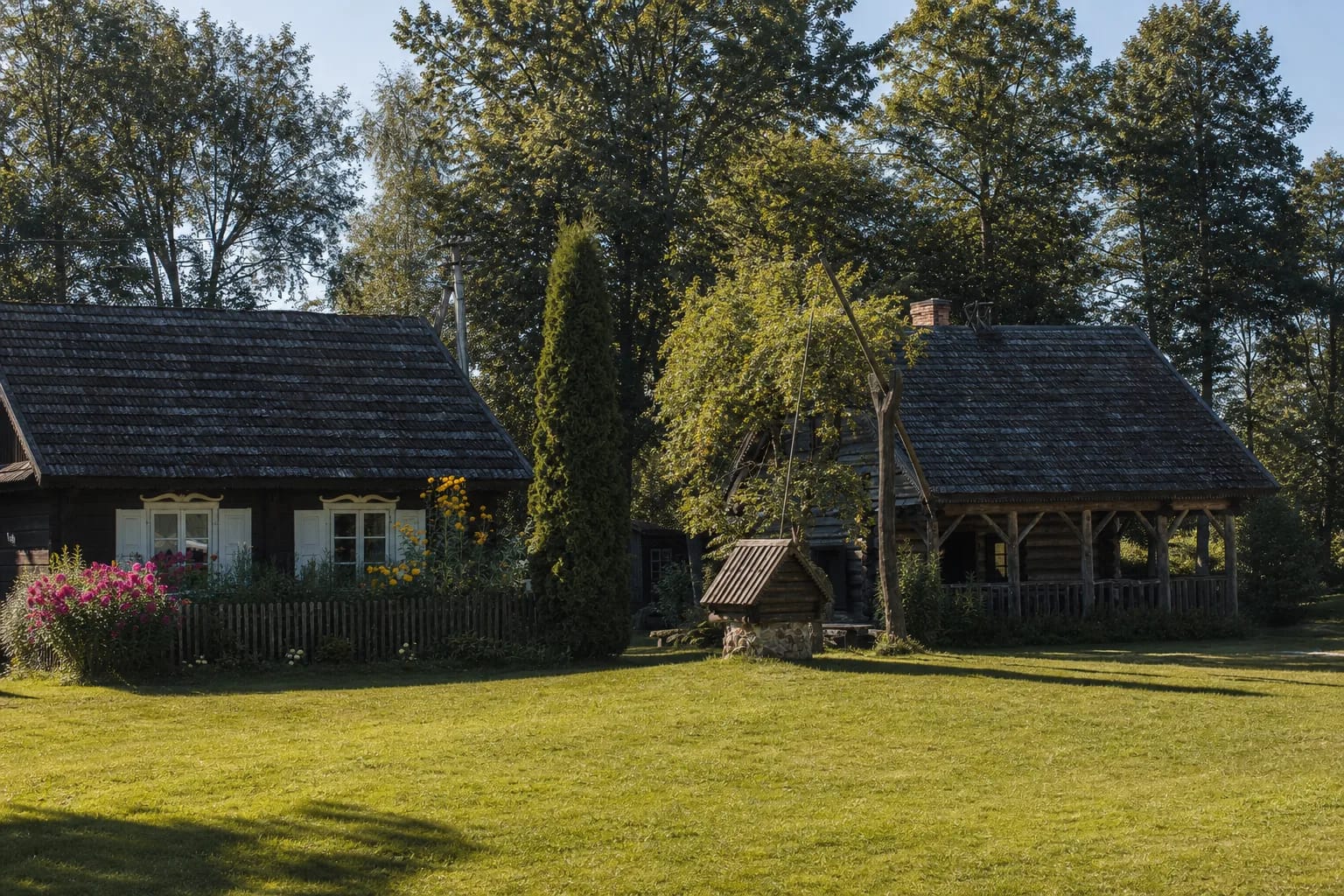
The public venue description dates the ensemble to the late nineteenth century. Dark-log buildings, a klėtis storehouse, old farm structures, and a barn are presented today, surrounded by a large yard, orchard, and small body of water. White shutters and window trim, low flower beds, and mature trees stand out against the dark timber.
The Lithuanian Ethnographic Museum explains that Suvalkija's fertile plains made it practical to form broad rectangular yards and arrange farm buildings around their perimeter. The same broad logic can be read at Pervazninkai in its open centre, relationship between domestic and working zones, and planted edge. Without a building survey, however, visitors should not claim that every structure occupies an unchanged nineteenth-century position.
Reliable public sources provide neither a construction date for every building nor a complete ownership chronology or KVR statement of valuable properties for this homestead. The promotional word authentic is therefore best understood as describing the survival of an old farmstead character, not as proof that every board, roof covering, and interior detail is unchanged from the late nineteenth century.
The klėtis, barn, and well reveal how the farmstead worked
A klėtis in a traditional Lithuanian farmstead stored grain, clothes, dowry goods, and more valuable belongings; it could also provide summer sleeping space. The barn held and processed crops and accommodated larger implements. At Pervazninkai these buildings matter not as decorative scenery but as evidence that the household was a system of connected working spaces.
Look beyond the façades. The old timber well apparatus, flower plot beside the dwelling, fruit trees, and paths between buildings suggest where water was drawn, how a more presentable domestic yard was distinguished, and how people moved between living, storage, and agricultural zones.
Parts of the barn and other spaces now accommodate events or guests. New uses can support maintenance, but they also mean this is not a frozen nineteenth-century display. Ask the host which structures or objects remain in place and which have been moved, renewed, or adapted.
Household objects are interpreted through use, not accession numbers
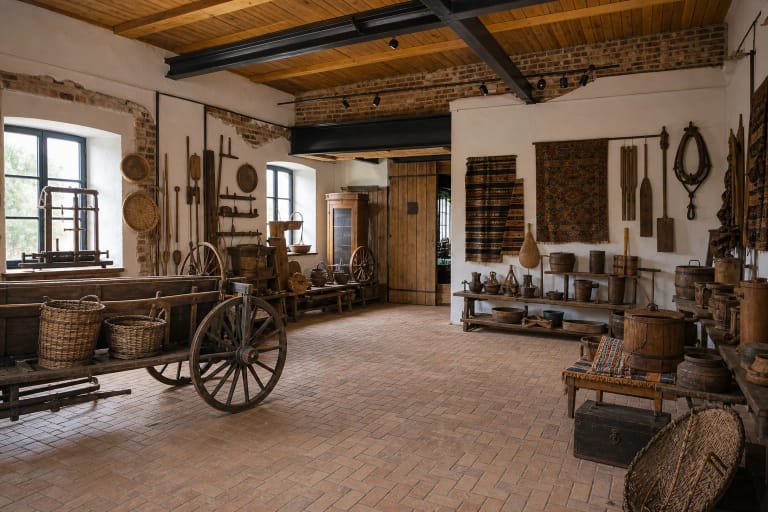
Old domestic and working implements are displayed around the homestead. Public photographs show a spinning wheel, an old sewing machine, timber vessels, and other everyday objects, while the guided narrative connects them with work, family life, and celebrations in Suvalkija. Their value emerges through explanation and demonstration.
This is not a publicly inventoried museum collection, so no fixed object count, permanent layout, or fully documented provenance for every item can be promised. If you are travelling for one particular craft or artefact, ask whether it is currently shown and whether the booked programme includes hands-on work.
Šakiai planning documents associate spit-cake baking with a wider rural-tourism route, and current tourism descriptions mention bookable activities. The programme, group minimum, duration, and tasting must nevertheless be confirmed at reservation; admission to the property alone does not guarantee a culinary workshop.
Official plans record a once-popular attraction, not today's visitor volume
The analysis supporting Šakiai District's 2018-2024 development plan placed the Suvalkietis Homestead among the district's most visited attractions in 2016 and reported about 10,000 visits. Separate tables counted accommodation guests and overnight stays, so these different indicators must not be added into one supposedly exact tourist total.
An official 2020 situation analysis reported 6,654 visitors in 2019 and 110 in 2020, attributing the sharp decline to pandemic restrictions and cautious reception by hosts in a higher-risk group. The figures illuminate former activity and an exceptional disruption; they provide no reliable measure of visitor volume in 2026.
A 2020-2022 strategic plan grouped the property under rural-life tourism and included it in routes with Zanavykai Museum, Sudargas hillforts, and other activities. That confirms its place in regional tourism planning, but a planning document is neither a current opening schedule nor a guarantee that every programme advertised several years ago still operates.
Published prices conflict, making direct confirmation essential
On 19 July 2026, the main Šakiai tourism listing displayed EUR 5.50 per person for a one-hour tour and EUR 2 for a children's activity, while a separate older activity page still showed EUR 3 for a tour. Because the publication dates and update method are unclear, none of these figures should be treated as a guaranteed tariff.
Visitors are accepted only by prior agreement and no permanent weekly hours are advertised. The former official homestead domain no longer resolved on 19 July 2026, so use the host telephone number published by the tourism office, +370 686 10574, and confirm the date, price, payment, group size, programme, and meeting point during the call.
The tourism listing marks the property as not adapted for disabled visitors, and research found no recent official step-free audit. Discuss uneven ground, thresholds, old door widths, toilet access, assistance, pushchairs, and vehicle access before paying or confirming a group.