- Place
- Ožkabaliai, Vilkaviškis District Municipality
- Region
- Suvalkija
- Type
- birthplace of a National Revival leader and Suvalkija farmstead museum
- Address
- Gimtinės g. 17, Ožkabaliai I village, Vilkaviškis District
- Coordinates
- 54.48792, 23.00099
Jono Basanavičiaus gimtinė, Ožkabaliai Birthplace
Birthplace in Ožkabaliai
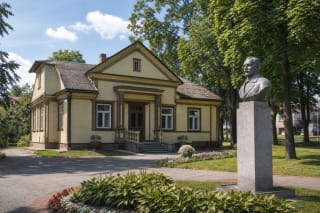
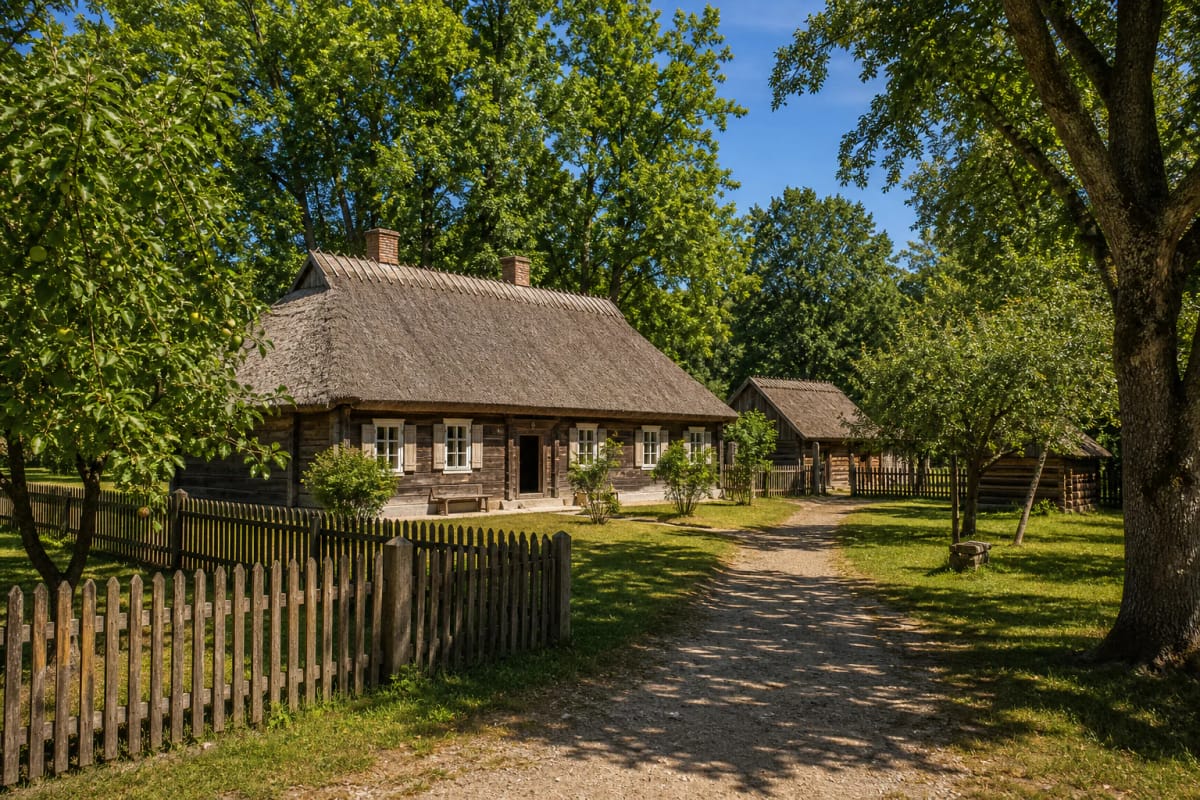
Jonas Basanavičius Birthplace is in Ožkabaliai village, Vilkaviškis District. It is a reconstructed Suvalkija farmstead where personal memory is joined with rural architecture, an agricultural setting, and symbols of the Lithuanian National Revival. It is the only reconstructed native farmstead of a signatory of the Act of February 16 and one of three National Museum of Lithuania branches outside Vilnius.
The site is important not because all original buildings survived. Its meaning comes from reconstruction: in the late twentieth century, a conscious decision was made to restore the visual world of the birthplace so Basanavičius' story would have a physical setting. The farmstead was reconstructed in 1991-1998 to a design by architect Ž. Mačionienė.
Jonas Basanavičius and state memory
Visuotinė Lietuvių enciklopedija presents Jonas Basanavičius (1851-1927) as a physician, public figure, and one of the central leaders of the Lithuanian National Revival. He was born in Ožkabaliai, died in Vilnius on February 16, 1927, and is buried in Rasos Cemetery. In 1883 he prepared the first issues of the newspaper Aušra, and he spent a long part of his professional life in Bulgaria.
On February 16, 1918, Basanavičius chaired the Council of Lithuania meeting that adopted the Act of Independence. At the birthplace he is not presented only as a monumental name. The farmstead environment helps visitors understand the cultural and social world from which the later signatory emerged. His relative, folklorist Vincas Basanavičius, also came from Ožkabaliai.
Reconstructed Suvalkija farmstead
National Museum of Lithuania and Cultural Heritage Register sources connect the site with reconstructed buildings of a prosperous Suvalkija farmstead: dwelling house, granary, cattle shed, barn, pigsty, and other farm elements. The Cultural Heritage Register lists the complex as 12 objects, including the old Ožkabaliai cemetery and the March 11 Grove.
At the museum, pay attention not only to the exhibition but also to the placement of buildings, the yard, materials, roof forms, and farm logic. Displays include Basanavičius' publications on Lithuanian folklore and mythology, personal belongings, and late nineteenth- to early twentieth-century Suvalkija furniture, so biography becomes a concrete environment rather than a textbook paragraph.
Lithuanian National Revival Oak Grove
Beside the farmstead lies the Lithuanian National Revival Oak Grove, a separate Cultural Heritage Register object and part of the memorial museum. Research sources give an area of about 40 ha, almost 7,000 oaks, often cited as 6,676, and 14 groves. Planting began in 1989, and the March 11 Grove was planted in 1990.
This is not a decorative park but a living symbol of national revival. The groves are dedicated to important dates and people in Lithuanian history: the Sąjūdis Seimas, book smugglers, victims of January 13 and Medininkai, signatories of February 16 and March 11, and named oaks for Lithuania's presidents.
Opening hours and tickets
During source review, the National Museum of Lithuania page gave seasonal hours: May-September, Tuesday-Friday 9:00-18:00, Saturday 10:00-18:00, Sunday 10:00-15:00; October-April, Monday-Friday 9:00-17:00, Saturday 10:00-17:00, and Sunday closed except the last Sunday of the month, 10:00-15:00.
At the same time, listed ticket prices were EUR 5 for adults, EUR 2.50 reduced, and family tickets at EUR 8 and EUR 13. The museum also noted that ticket sales stop 30 minutes before closing. Check the official page before travelling.