- Place
- Sudargas Eldership, Šakiai District Municipality
- Region
- Šakiai District
- Type
- complex of five hillforts on the left bank of the Nemunas
- Coordinates
- 55.04800, 22.64100
Sudargas hillforts, Burgaičiai and Grinaičiai hillforts
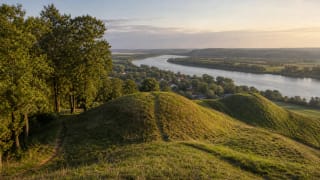
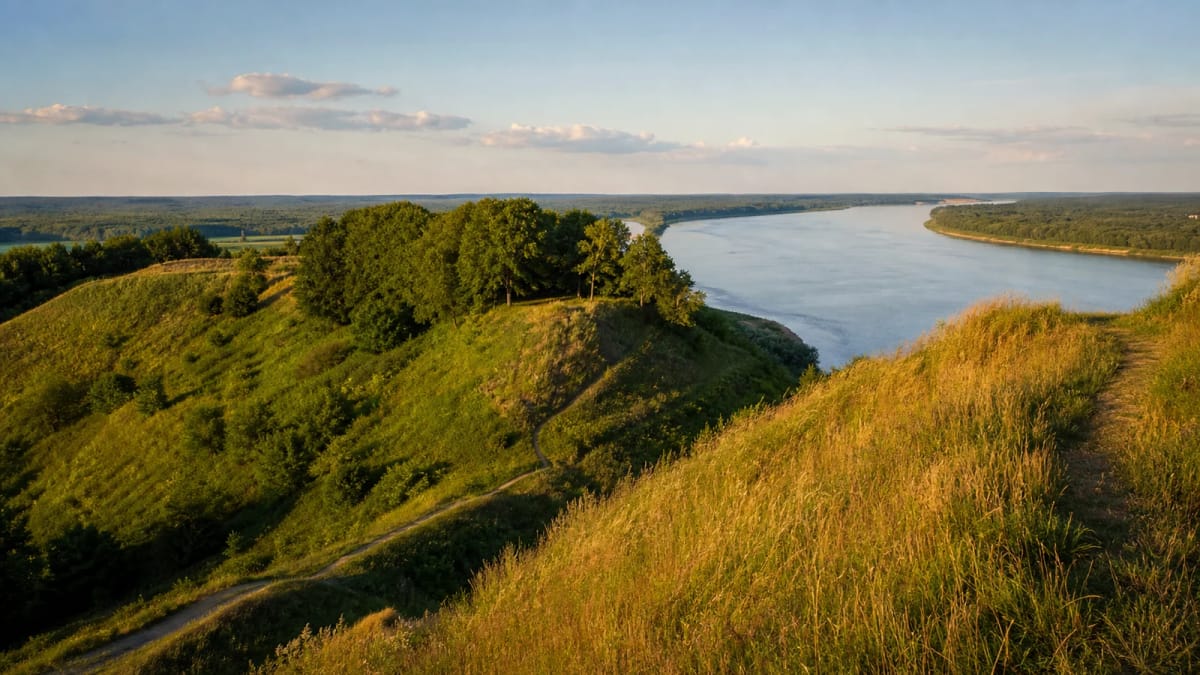
Sudargas Hillfort Complex: five hills by the Nemunas
VLE describes the Sudargas hillforts as five hillforts in Šakiai District, Sudargas Eldership, near Sudargas, Grinaičiai, and Burgaičiai villages. They are dated to the first millennium and the beginning of the second millennium, and form the Sudargas hillfort complex on the left bank of the Nemunas.
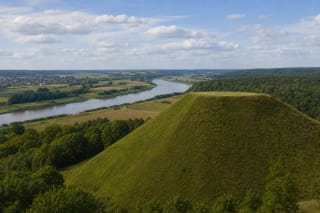
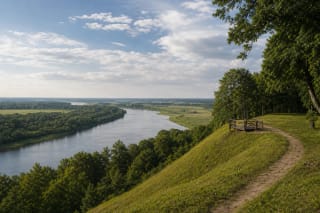
This is one of Lithuania's most impressive hillfort groups because the visitor sees not a single mound but a whole system of relief. The Nemunas valley, steep slopes, interrelated hillforts, and foot-settlement areas make the scale of a defensive landscape clear.
Burgaičiai hillforts: Vorpilis, Pilaitė, and Bevardis
VLE identifies three Burgaičiai hillforts: Vorpilis, Pilaitė, and Bevardis. Burgaičiai Hillfort I, called Vorpilis, lies about 0.55 km east of Burgaičiai village. Its slopes are steep, up to 40 m high; the summit platform is round, 30 m in diameter; and on its southern edge is a rampart 30 m long, 0.8 m high, and 25 m wide, with a ditch 15 m wide and 1 m deep beyond it. South and southwest of the hillfort extends a 1.5 ha foot settlement, showing that this was not only a defended place but also a lived-in one.
Burgaičiai Hillfort II, called Pilaitė, stands 100 m east of Vorpilis. Its triangular platform measures 11 by 15 m, natural defensive features appear on the southern side, and its steep slopes reach up to 33 m. Burgaičiai Hillfort III, also called Bevardis, lies southeast of Pilaitė and is unusual because investigations in 2005-2006 found neither defensive fortifications nor a cultural layer. VLE notes that in 2007, marking the 690th anniversary of the burning of Sudargas Castle, a monument to the defenders of Sudargas Castle was unveiled near it; the sculptors were Vidas and Aldas Cikanos.
Grinaičiai hillforts: Balnakalnis and Žydkapiai
The other two hillforts in the complex are in Grinaičiai. VLE describes the Grinaičiai forework, or Balnakalnis, whose platform is trapezoidal, measuring 7 by 15 by 35 m. On the northeastern edge is a rampart 0.5 m high and 5 m wide, while on the southwestern side is a rampart 1.8 m high and 20 m wide, with a ditch 16 m wide and 2 m deep beyond it. Such fortifications point clearly to the defensive role of a fore-castle.
Grinaičiai Hillfort II, called Žydkapiai, has a quadrangular 30 by 40 m platform, steep slopes up to 25 m high, and a rampart on the southwestern side 30 m long, 2 m high, and 23 m wide. VLE emphasizes that the hillfort was damaged in the eighteenth to twentieth centuries when cemeteries were established and in 1944 when trenches were dug, so the name Žydkapiai and the cemetery history require especially respectful visiting.
Archaeological research and finds
VLE writes that the Sudargas hillforts were investigated in 1970 by a Vilnius University expedition led by P. Kulikauskas and R. Kulikauskienė, and in 2006-2008 by Lithuanian Institute of History expeditions led by Vida Kliaugaitė and Elena Pranckėnaitė. At Vorpilis, in an area of about 570 sq m and a cultural layer up to 32 cm deep, researchers found post holes, tools, ornaments, pottery fragments, and animal bones.
In the Grinaičiai hillforts, the 1970 investigation covered 130 sq m and found burnt remains of wooden fortifications, tools such as a knife, awl, and quern fragments, weapons including a spearhead and axe, and pottery fragments. VLE states that these finds are kept at the National Museum of Lithuania, allowing the complex's history to be tied to concrete archaeological material rather than landscape alone.
Duke Sudargas and the castle burned in 1317
The complex's name and memory are associated with Sudargas, a Samogitian noble and military leader of the first half of the fourteenth century. VLE presents him in a separate article: Sudargas is mentioned several times in Peter of Dusburg's early-fourteenth-century chronicle of the Teutonic Order. In 1308, together with another Samogitian leader, Manstas, he led about 5,000 warriors across the Curonian Spit into Sambia in Prussia, then under Order control, and ravaged the Pavandenis and Rūdava areas.
VLE states that in 1301, at Aukaimis Castle, the Teutonic Order captured an unnamed son of Sudargas, hoping for ransom. In 1317, when the Order's army devastated the Pagraudė land in Samogitia, Sudargas's holding was ravaged, his castle destroyed, and his wife, children, and entire household taken captive. The 690th anniversary of that castle burning was marked in 2007 by the monument near Bevardis Hillfort. It is important to separate the documented history of Sudargas from the later place name: sources do not identify the exact hillfort on which his castle stood, so the link with the duke is historical and traditional more than archaeologically proven.
How to visit the Sudargas hillforts
Allow at least 1.5-2.5 hours for the whole complex. If you visit only the main views, you will need less time, but you will miss the most important quality of the place: the relationships between the individual hillforts.
Slopes and gullies can be slippery after rain, so wear comfortable footwear and do not climb straight up the slopes. The name Žydkapiai and the cemetery history call for respectful behaviour: this is not only a viewpoint or a photo location.