- Place
- Panevėžys City Municipality
- Region
- Aukštaitija
- Type
- historic city park in a Nevėžis bend with the Žagienis stream, ponds, and renewed walking and cycling paths
- Address
- Entrances from Ukmergės Street, Panevėžys
- Coordinates
- 55.73325, 24.37784
- Visit duration
- 1-1.5 hours for the principal paths, ponds, and bridges; 2-3 hours with the 12-stop route or an event at Pragiedruliai
- Best time
- May-October for greenery and a longer walk; after heavy rain, check conditions on the lower Nevėžis valley paths
Skaistakalnio parkas, Skaistakalnis, Jasnogurka Park, Vytautas Park
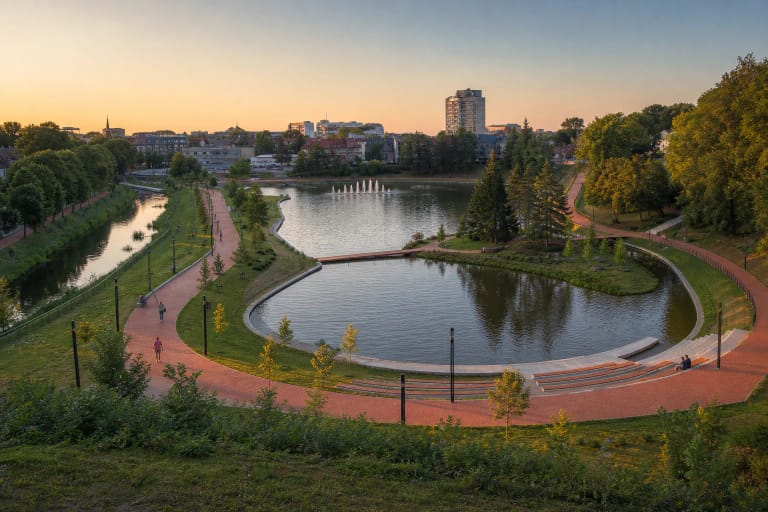
Read the 29.7 ha park as a system of Nevėžis, Žagienis, ponds, and woodland spaces
Skaistakalnis is not a rectangular lawn or a short loop around one pond. It occupies a bend of the Nevėžis, while the Žagienis stream crosses its wooded terrain and forms ponds, lower wet meadows, and steeper slopes. The municipal project delivered from 2016 to 2024 covered 29.7 ha of infrastructure, so a first visit makes more sense as a water, bridges, and Pragiedruliai route than an attempt to follow every path.
The coordinate on this page, 55.73325, 24.37784, marks a representative point within the park, not a single official gate or parking bay. From Ukmergės Street, visitors can begin beside the Juozas Čerkesas-Besparnis homestead and continue towards the ponds. Approaching from central Panevėžys uses pedestrian connections across the Nevėžis. With several entrances, the practical starting point depends on how you arrive.
The main route combines asphalt walking and cycling paths, long timber bridge and balustrade structures, reopened views of the Nevėžis, play and sports areas, and quieter forest clearings. Reliable sources provide no single official distance for an all-encompassing loop, and the path network has many branches. One to one and a half hours covers the principal landscape features, but not every part of the 29.7 ha site.
The city's oldest park formed on former Skaistakalnis manor land in the late nineteenth century
Histories prepared by Panevėžys Local Lore Museum staff identify Skaistakalnis as the city's oldest park. It was established beside a manor in a scenic Nevėžis bend during the late nineteenth century. The land is associated with the Karp family and the name Jasnogurka used in their period. Manor buildings disappeared or were demolished over time, but the foundation of the planted landscape and river terrain survived.
Popular visitor descriptions sometimes present the name as proof of an ancient Baltic sanctuary or sacred hill. The documented park history prepared by museum historians does not establish that origin, so this page does not turn the name legend into fact. The known sequence of manor land, Jasnogurka, and the later public park provides firmer ground.
The natural structure explains the site's lasting attraction. A Nevėžis bend, a stream valley, mature trees, and transitions between open meadow and woodland produce several landscapes within one walk. Today's infrastructure is new, but the park itself was not created from an empty field in 2023.
In the interwar years it hosted a stadium, exhibitions, sports festivals, and gatherings of intellectuals
After Lithuania regained statehood, manor land was nationalized, with part assigned to the Lithuanian military and part to the municipality. The Pavasarininkai organization leased a large ground for 99 years and created a stadium. An agricultural exhibition took place in 1924, followed by Riflemen's May festivals, Scout gatherings, song and sports celebrations, football, and matches from the formative period of Lithuanian basketball.
On October 22, 1929, as the country prepared to mark the Year of Vytautas the Great, Skaistakalnis was renamed Vytautas Park. Paths were levelled in 1930, yet access still depended on the river: residents crossed footbridges that spring floods sometimes carried away. Two hundred trees were planted at the Pavasarininkai stadium in 1932, and two modern tennis courts followed in 1935.
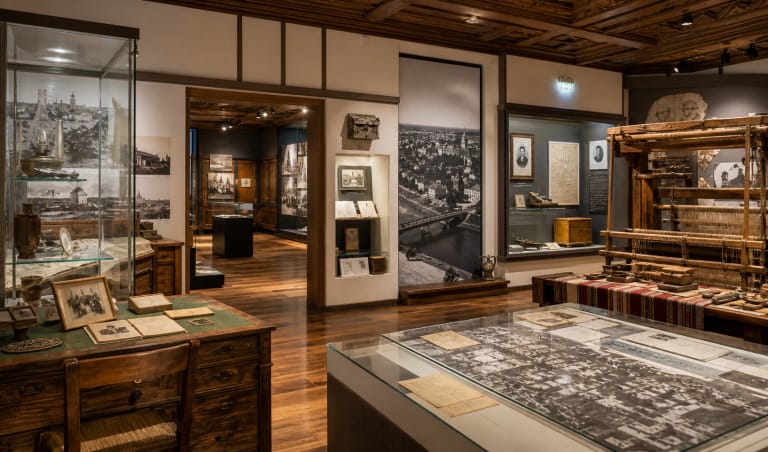
A separate cultural layer is the homestead of poet, lawyer, and public figure Juozas Čerkesas-Besparnis. In 1926, he built a modern red-brick house called Pragiedruliai on part of the former manor land, and members of the Panevėžys intelligentsia gathered there. The restored house now operates as a creativity center, but its event times, registration, and indoor access are distinct from a free walk through the park.
Postwar expansion left traces of both mass recreation and military pollution
After 1944, the former manor land was assigned to a Soviet state farm, while the park remained one of Panevėžys's main places for leisure and public celebrations. It included a stadium, swimming pool, weightlifting arena, volleyball, and ice-hockey areas. In 1955, the park expanded to 12 ha and several hundred chestnuts, ashes, maples, poplars, and other trees were planted.
When the Nature Protection Committee inventoried Lithuanian parks in 1958, Skaistakalnis was among 194 declared state-protected. A 1962 reconstruction proposal already argued for conserving its scenic natural setting and improving planting and water features. The park was reconstructed in 1972, when the existing beach, market stalls, and stage were removed and building ruins were levelled.
Not every postwar intervention served recreation. In 1947, Soviet military aircraft-engine repair workshops were established in one of the park's finest areas, accompanied by barracks, garages, and stores. A museum historian's account records both the noise of engine testing and environmental pollution. This helps explain why later regeneration had to combine landscape work with returning damaged territory to public use.
The project completed in 2024 retained the woodland character and created new links across water
The renewal began in 2016 and is marked complete in the municipal record on July 3, 2024. An acceptance certificate for the principal paths, smaller bridge, recreation areas, planting, and lighting was signed on March 27, 2023, while reconstruction of the pedestrian bridge across the Nevėžis concluded on December 20, 2023. That is why 2023 is often given as the visitor reopening, while 2024 is the administrative completion of the whole project.
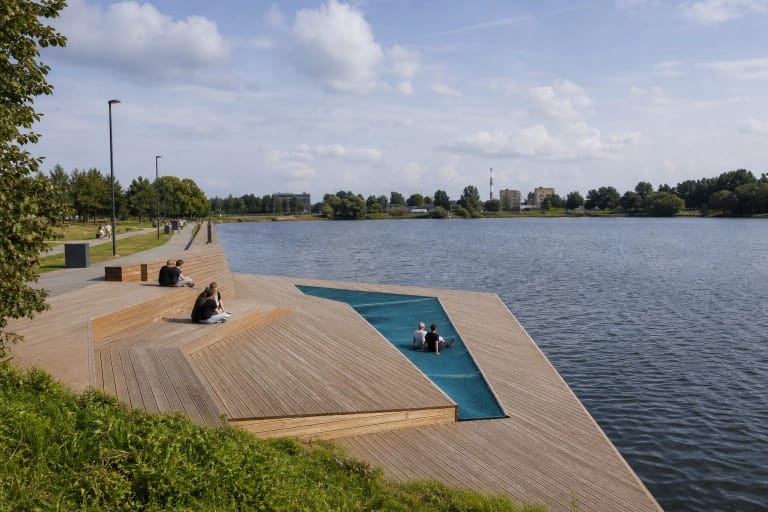
The work cleared pond banks and the Žagienis valley, reopened the Nevėžis waterfront, and provided walking and cycling paths, sports, play, parking, and event areas. The pedestrian bridge was renewed with disabled access in mind; lighting was modernized, and benches, bicycle stands, information boards, and surveillance cameras were installed.
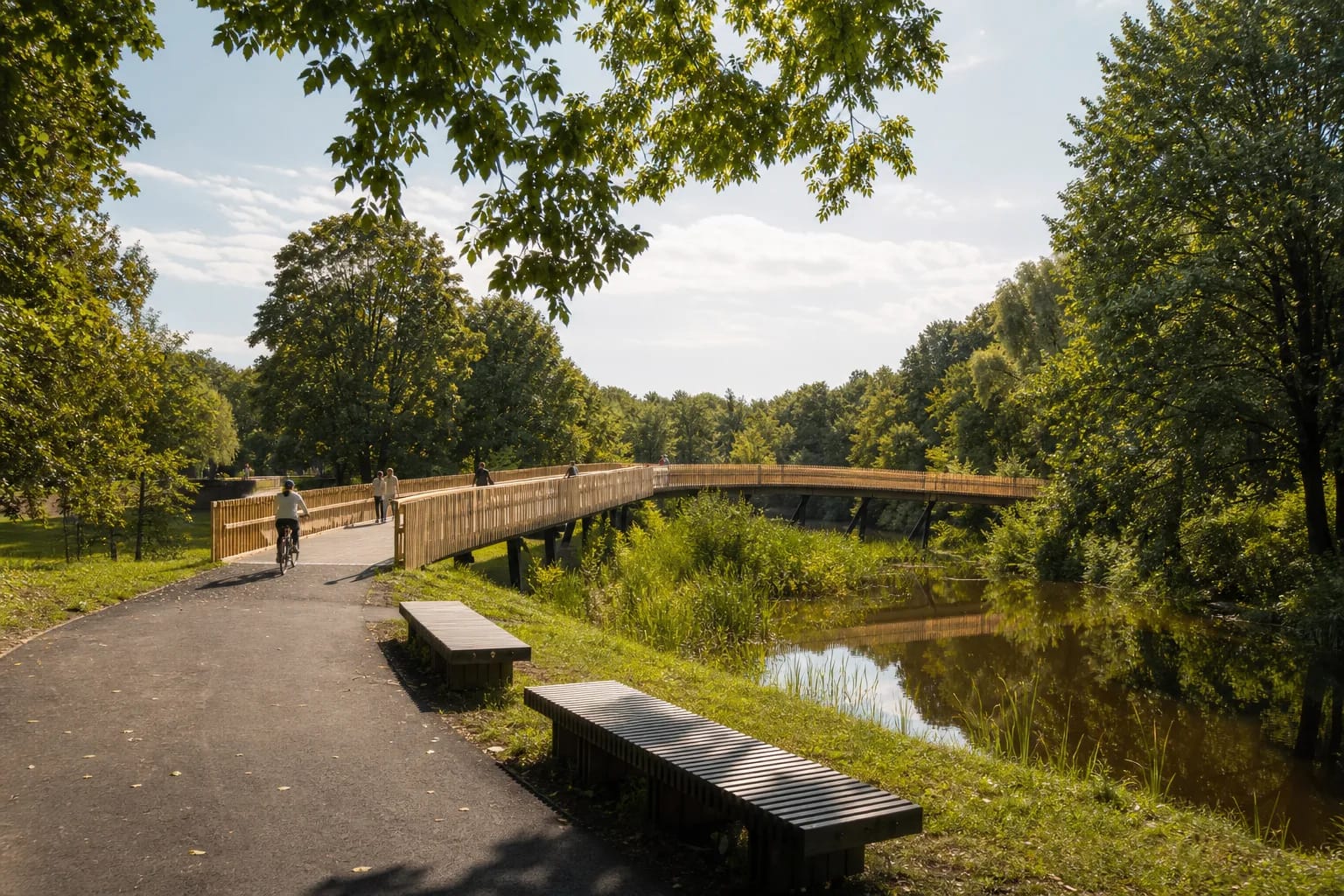
The strongest architectural element is a long, gently curving structure edged by closely spaced vertical slats of pale timber. It serves as bridge, balustrade, and route marker through the watery valley. An accessible bridge does not mean every woodland branch, slope, or damp bank has an equally step-free surface. Stay on the principal hard-surfaced paths for the easiest movement.
The park is free, while the 12-stop route and Pragiedruliai follow their own visitor logic
The municipal park has no ticket office, general admission charge, or gated opening time. Public paths are free to use, preferably in daylight. Workshops, guided visits, concerts, and indoor exhibitions at the creativity center may operate at set times, require registration, or have separate conditions, so check Pragiedruliai's official channels for those activities.
On August 8, 2025, the municipality launched a 12-stop augmented-reality route in the park. Its stations are arranged around the Pragiedruliai homestead and interpret Juozas Čerkesas-Besparnis, his created environment, and the wider cultural setting of the park. It is an additional interpretive layer, not 12 compulsory points covering all 29.7 ha. Follow the current markers and, if the digital content is your main reason for visiting, check the latest phone and internet instructions.
The Skaistakalnis ponds and Žagienis are not presented here as an official bathing site. The historical beach was removed during the 1972 reconstruction, so an attractive water edge does not establish permission to swim. Lower parts of the Nevėžis valley can be wet after heavy rain or spring thaw, and winter ice should never be entered without an official safety assessment.