- Place
- Radviliškis District Municipality
- Region
- Aukštaitija
- Type
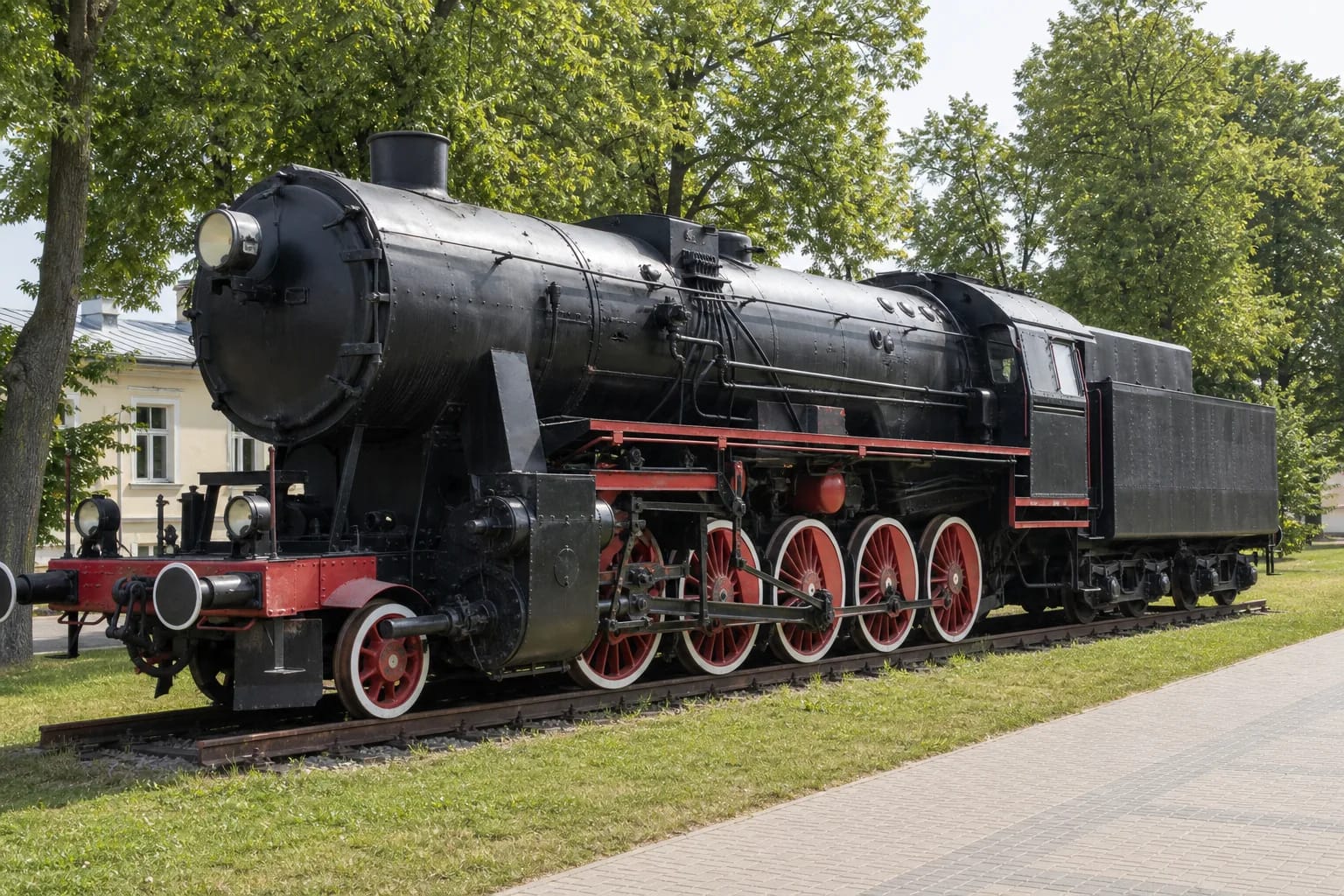
- Second World War-era BR 52-type steam locomotive displayed beside the railway station as a protected monument to engineering
- Address
- 15A Laisvės Avenue, beside Radviliškis railway station
- Coordinates
- 55.80611, 23.53664
- Visit duration
- 15-30 minutes for the exterior; allow longer to explore the station surroundings and other town sites
- Best time
- a bright, dry day when the five coupled driving axles, valve gear, and tender are clearly visible from the public pavement
Radviliškis Steam Locomotive, TE-4567 Steam Locomotive, TЭ-4567 Steam Locomotive, The Steam Locomotive Symbol of Radviliškis
A real steam locomotive on a short display track, not a decorative replica
The locomotive stands at 15A Laisvės Avenue in a landscaped strip beside Radviliškis railway station. Coordinates 55.806115, 23.536635 mark the exhibit itself. They do not indicate a station platform, car park, or permission to cross operational tracks. Approach from the town side along the public pavement; there is no reason, and no safe justification, to look for a shortcut across the railway.
Seen in profile, the running gear begins with one smaller leading axle followed by five large coupled driving axles. Long steel rods link the red spoked wheels beneath a black cylindrical boiler, and a large water-and-fuel tender follows the cab. The front buffer beam is red and carries the TE-4567 marking. The municipality's cultural strategy also records LG letters at the front of the engine.
Local official sources call this a captured and relic locomotive from the Radviliškis depot, not a replica manufactured in 2004. It is no longer operational and is not an open exhibit with unrestricted cab access. Its interest lies in reading a surviving machine: compare the wheel diameters, steam cylinders, coupling rods, pipework, boiler fittings, cab, and tender rather than treating it as playground equipment.
BR 52 and KDL 1 explain the five coupled axles and wartime construction
Specialist rolling-stock registers classify TЭ-4567 as German Class 52 and factory type KDL 1. These were heavy freight steam locomotives with five coupled driving axles. Their wheel arrangement is written 1'E in the German system and 2-10-0 in English-language notation: one leading axle, ten driving wheels, and no trailing axle. Visitors can count precisely that arrangement on the Radviliškis engine.
DB Museum explains that Class 52 was a simplified development of the earlier Class 50 and that more than 6,000 examples of this wartime locomotive class were built between 1942 and 1945. Simplification allowed faster production with fewer scarce materials for wartime logistics. The Radviliškis engine should therefore be read not only through the romance of steam travel but also as material evidence of Second World War industry and the violent reorganisation of European railways.
After the war, large numbers of Class 52 locomotives entered Soviet ownership as captured equipment or reparations and were adapted to the wider 1,524 mm gauge. In 1952 they received the Cyrillic class mark TЭ: T referred to captured equipment, while Э linked them to the Soviet E class of broadly comparable power. Lithuanian sources often transliterate Cyrillic Э as Latin E, so TE-4567 and TЭ-4567 refer to the same locomotive in this context.
Berlin in 1944 or Poznań in 1945: two origin records survive
A Radviliškis District Municipality visitor publication says that the locomotive was made in Berlin in 1944. The municipality's cultural strategy also dates it to 1944 but gives the place of manufacture more broadly as Germany. This account has become the established local official narrative and is widely repeated in descriptions of the landmark.
Two mutually consistent specialist European rolling-stock registers give a different identity card: Deutsche Waffen und Munitionsfabriken AG in Poznań, 1945, works number 884, and the intended German railway number 52 4567. One records delivery to the Polish State Railways on 18 June 1945, with Ty42-32 planned as its Polish number, followed by transfer to the Soviet railway administration later that year.
No publicly accessible original acceptance certificate or full official heritage passport was located during this research, so neither account can responsibly be declared conclusive here. The local description may have merged the general German origin of Class 52 with Berlin and the wartime year, while the specialist register follows an individual works number. Visitors should keep the records separate: Berlin in 1944 is the official local version; Poznań in 1945 is the detailed rolling-stock register version.
From the post-war railway system to a monument beside Radviliškis station
The specialist chronology says that the engine formally received the TЭ-4567 designation in 1952 and passed to Lietuvos geležinkeliai in 1992. It was still recorded in storage at Subačius station in 2000. These details show that its present position in Radviliškis is only the final visible chapter. Public sources do not reconstruct every depot assignment, route, overhaul, or last working journey, so a complete service biography should not be invented.
Municipal sources place the locomotive beside the station from 2004 and credit folk artist Eugenijus Arbušauskas with the idea, supported by the district municipality. A specialist register instead dates installation to 2005 and relates it to the 135th anniversary of the Radviliškis depot. These may reflect closely spaced project and commemoration stages, but no document found for this guide resolves the one-year difference precisely.
The municipal cultural strategy identifies TE-4567 as a movable engineering monument entered in the Register of Cultural Property for historical, technical, and technological value. It must be distinguished from the adjacent Radviliškis railway-station building complex, which entered the Register in 2005. Locomotive and station form one visitor scene, but they are not the same legal or historical object.
Why the locomotive became the emblem of Lithuania's railway town
The Radviliškis junction began shaping the town long before TE-4567 reached Lithuania. The municipality's strategy dates the locomotive depot to 1870 and the opening of the station to 4 September 1871. VLE records the Liepāja-Romny line through Radviliškis in 1871, a branch towards Daugavpils in 1873, and the construction of a masonry station and railway repair works.
The junction generated workshops, depots, employment, and the daily rhythm that earned Radviliškis the informal title of Lithuania's capital of railway workers. Local cultural documents preserve a colourful saying that even the town's sparrows turned black in smoke from coal-fired locomotives. This is an expression of local identity, not a measured biological fact. In 1997, artist Darius Kazokas brought black sparrows, rails, and reeds together in the town composition Akcentas.
TE-4567 condenses that long history into one immediately recognisable silhouette. The station, depots, and complex rail junction remain active around it, while the steam locomotive occupies everyday urban space rather than a closed museum hall. Its setting creates a visible line from steam traction to modern diesel services and the electrification now reshaping Lithuanian rail transport.
Exterior viewing is free, but the locomotive is not climbing equipment
As checked on 20 July 2026, municipal documents published neither separate opening hours nor an admission ticket for the locomotive. It stands outdoors beside a public pavement and is normally viewed from the exterior. That does not permit climbing onto the buffers, wheels, rods, tender, or cab. Any occasional guided access to the operational railway area would be a separate, pre-arranged activity and does not create permanent public access.
A comparatively level pavement provides a broad view without stepping onto the ballast, so a wheelchair user or a family with a pushchair may be able to see most of the profile from firm ground. No official accessibility audit, tactile interpretation, or dedicated parking bay for the exhibit was found. Close inspection of the lower machinery would involve uneven ballast and display rails and should not be treated as part of a step-free route.
Photograph from the pavement or another clearly public position without blocking pedestrians or road traffic. Keep children away from metal rods, steps, and the street. Never cross active station tracks for another camera angle, and do not touch railway equipment. Park only where current signs permit, while station toilets, waiting-room access, and parking arrangements should be checked as separate services that can change.