- Place
- Radviliškis District Municipality
- Region
- Aukštaitija
- Type
- Mid-twentieth-century masonry parish church with one central tower, a separate old wooden belfry, and a late-twentieth-century rebuilding layer
- Address
- 8 Maironio g., Radviliškis
- Coordinates
- 55.80639, 23.54261
- Visit duration
- 30-45 minutes; about 1 hour before or after Mass if you want to examine both the church and the belfry calmly
- Best time
- before or after the published Mass times; the parish is busier around the titular feast on September 8
Radviliškis Church, Radviliškis Catholic Church, Radviliškis Parish Church of the Nativity of the Blessed Virgin Mary
The present church: a white urban sanctuary with one tower
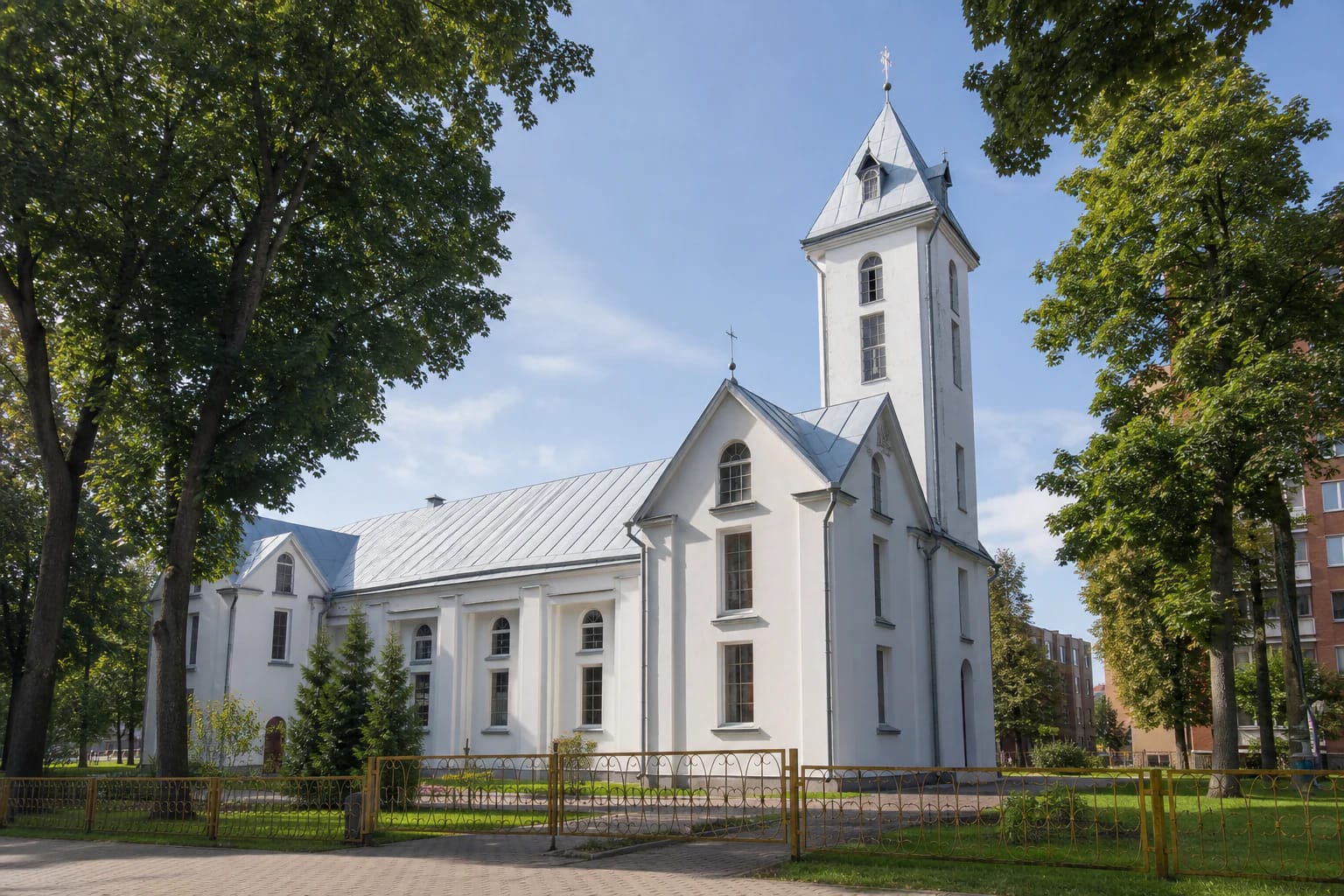
Radviliškis Church of the Nativity of the Blessed Virgin Mary stands at 8 Maironio g. in the town centre. It is an active Catholic parish in the Diocese of Šiauliai, not a cemetery chapel and not the nearby Evangelical Lutheran place of worship. Its present silhouette is a white rendered masonry church with one tall central tower beneath a pointed metal roof, a long pale metal roof, and lower side volumes with triangular gables.
The exterior is best understood through its layers rather than through one pure style. The parish description calls the present outside a mixture of additions and gables. Tall arched windows, a light facade, town trees, and the metal churchyard fence create Radviliškis's restrained and recognisable church view.
From the parish first mentioned in 1597 to the 1870 church destroyed in wartime
The Radviliškis Catholic church is first mentioned in 1597, and the parish was established in 1619. In 1769 priest K. Ausėnas and parishioners built a new wooden church, consecrated in 1789 by Bishop A. Koscia. A fire destroyed it in 1868 and even melted its bells.
After the fire, parish priest Juozapas Bartkevičius built a new Church of the Nativity of the Blessed Virgin Mary in 1870. That sanctuary burned during the Second World War, so the building visible today is not simply a surviving nineteenth-century church. In 1945 a masonry building constructed by German prisoners of war was fitted out for worship.
The sources mention the 1945 fitting-out alongside a rebuilding in 1987. The parish connects that rebuilding with parishioners and the then parish priest, Lionginas Vaičiulionis, while VLE describes the present church as a mid-twentieth-century building reconstructed in 1987. Some later descriptions also give 1991, but this page follows the 1987 date in the parish and VLE accounts. This is more precise than claiming that the current sanctuary was simply built in one single year.
The old wooden belfry is Radviliškis heritage in its own right
Beside the church stands a five-stage wooden belfry in folk-architecture forms. Its lowest stage is masonry, while the upper levels reveal open bell galleries, windows cut with triangular arches, ornamented posts, and a balustrade. It is a separate building from the tower of the present church and belongs to the older parish site.
The sources disagree about its construction date: the parish gives 1876, while VLE gives 1878. VLE also records that the belfry was scorched in 1984 and rebuilt. When visiting, it is therefore safer to describe it as a building from the 1870s rather than choose one unexplained date.
Three crosses were erected beside the belfry in 1989 to commemorate the victims of Stalinism. In 2024 a municipality and library project installed information panels beside the present church, showing the old church's history and images. They help visitors imagine what is no longer visible in today's facade.
Three new bells and Martynas Gaubas's doors tell the parish's recent story
In 2014 three bells cast in Poland at the Kruševski brothers' foundry were lifted into the reconstructed church tower. The largest, about 500 kg, was named for the Nativity of the Blessed Virgin Mary; the other two weigh about 300 and 150 kg and are dedicated to Saint John Paul II and Saint Casimir. The parish records their blessing on 24 August 2014.
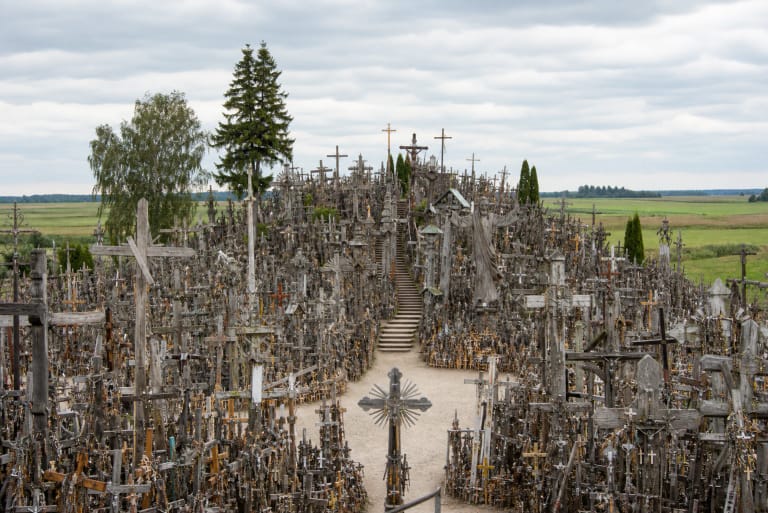
New doors by sculptor Martynas Gaubas were blessed in 2019. Their imagery brings together Christ's symbol of the gate, a biblical motif, the Hill of Crosses, Pope John Paul II's visit, and the memory of Blessed Teofilius Matulionis. This is a local work worth examining at the entrance, but its details are best understood as the artist's and parish's story, not as surviving decoration from the old church.
The authoritative sources reviewed do not name an architect for the present church. They do document the later work of parishioners, the parish priest, bell makers, and the door sculptor. That distinction matters: the building's authorship should not be invented from later repairs or artworks.
A white interior, 2000 organ, and a living music venue
Inside, the church retains a light and restrained space: white walls, arched windows, a broad vaulted ceiling, white pilasters and columns, wooden pews, and the presbytery altar. The parish highlights new presbytery furnishings, an altar, pews, and confessionals. This is not a museum display, so visitors should adapt their viewing to prayer and the parish community's rhythm.
An organ brought from Germany was installed in 2000. The parish history mentions it alongside adult and youth choirs, and since 2003 the church has hosted the young performers' festival Polifonija ir aš and the organ music festival Vargonų legendos. Radviliškis Church is therefore not only a historic building but also an active regional music space.
Visiting: Mass, the parish office, and careful planning
The Diocese of Šiauliai publishes Mass at 9:30, 11:00, and 12:30 on Sundays, at 11:00 and 18:00 on Saturdays, and at 18:00 on weekdays. The parish contacts page says that the office receives visitors on Mondays from 15:00-17:30, Tuesday-Friday from 9:00-13:00 and 15:00-17:30, and on weekends before and after Mass. Holiday arrangements can change, so check the parish page before travelling.
The parish and diocese do not publish separate tourist opening hours or a ticket price. This means access must be planned around services, funerals, concerts, and other parish events rather than treated as a guaranteed museum opening. No public source confirms a step-free entrance or a car park dedicated to visitors, so call the parish on +370 422 51083 about individual needs.
On 15 July 2026 the exact Google Maps listing showed 55.806393, 23.542606 at 8 Maironio g. Its Place ID is ChIJMfhVpKcO5kYRodfbCFpGTI4 and its average rating that day was 4.5/5. This is a mutable visitor rating, not a heritage status. The map pin marks the church site, not a confirmed entrance or parking point.