- Place
- Prienai, Prienai District Municipality
- Region
- Prienai District
- Type
- municipal regional museum with exhibitions on ethnography, resistance, literature, aviation, and notable local people
- Address
- 13 F. Martišiaus Street, Prienai
- Coordinates
- 54.63222, 23.94526
- Visit duration
- 90-120 minutes for the principal exhibitions; longer with a pre-booked workshop
- Best time
- a Wednesday-Friday morning or the start of a weekend day, leaving at least 90 minutes before closing
Prienų krašto muziejus, Prienai Museum, The Museum of Prienai Region
This is the main museum building, not a single admission point for every district branch
Prienai Regional Museum at 13 F. Martišiaus Street is the principal venue of the municipal museum service. It contains the permanent exhibitions on regional ethnography, resistance, literature, aviation, and notable people, as well as the administration, temporary shows, and workshops. The same institution also operates separate sites in Šilavotas, Naujasodis, Pilotiškės, Skriaudžiai, and Veiveriai. Their objects, addresses, hours, and access arrangements should not be treated as rooms within this building.
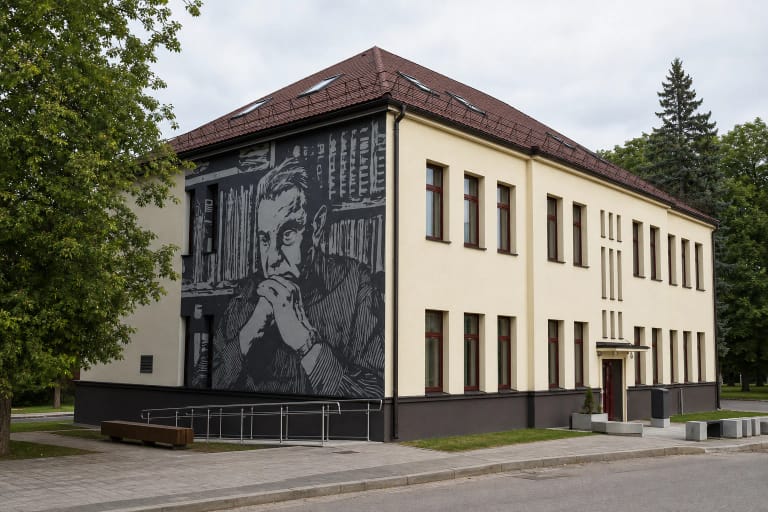
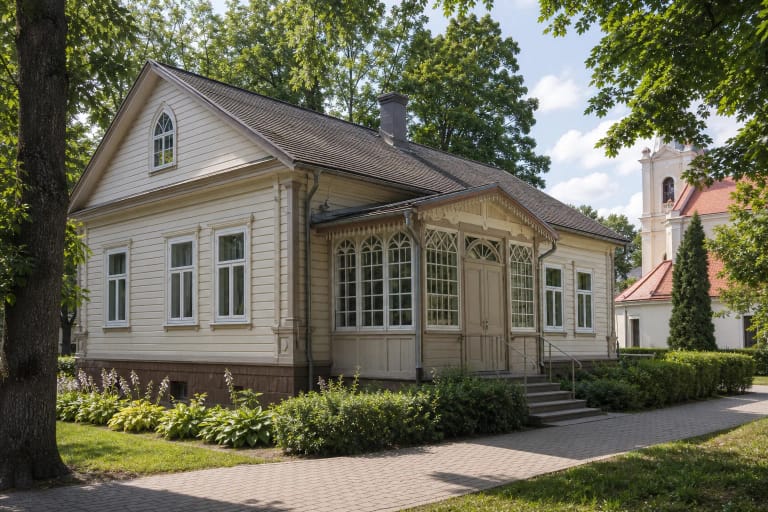
Recognise the pale-grey two-storey house by its complex dark roof, central gable, balcony above the doorway, broad steps, metal ramp, and carved timber memorial posts inside the fence. Several connected wings extend behind it, while a small glider on the lawn immediately signals one of Prienai's defining industrial stories. The coordinate 54.632217, 23.945264 marks the museum site, not a parking bay or a precisely surveyed step-free threshold.
There are many displays for a compact regional museum, and a rushed half-hour would reveal only their surface. Allow 90-120 minutes and decide whether the resistance story, literary terminals, or ethnography deserves the longest stop. VLE counted approximately 31,000 objects in the museum's collections in 2025, but that figure covers the institution's holdings rather than the number simultaneously displayed in this house.
The museum grew from Antanina Aleknavičienė's local-history work inside the Pšemeneckis family home
Teacher and local historian Antanina Aleknavičienė began collecting objects for a future regional museum in 1990. Five years later, on 16 September 1995, the museum formally opened in the former family home of Cezaras Pšemeneckis. That is the documented beginning of the public museum; it should not be confused with the legal entity's 1996 registration or the earlier foundation dates of branches later brought into the network.
Cezaras Pšemeneckis (1887-1967) was an electrical engineer, teacher of physics and mathematics, and active Prienai civic figure. According to the museum, he initiated a 6,000-volt overhead line from Kaunas that was later extended towards Birštonas and other settlements, and residents were receiving electricity by early 1928. The electricity network maintained its reception office in the Pšemeneckis house, linking the building directly to the town's modernisation.
The property changed function after the family left. A hospital and dental polyclinic operated here during the Soviet period, while police used part of the premises. The building-history display now plays memories from former medical staff and one of Pšemeneckis's pupils, offers a quiz, and even lets visitors sit in an old dentist's chair. It is not a decorative reconstruction of an untouched interwar residence; the exhibition deliberately follows a private home through successive public uses and into its museum life.
A Suvalkian parlour and a bunker represent two radically different regional experiences
The centrepiece of the ethnography and folk-art exhibition is a Suvalkian formal room known locally as a stubelė. Its timber finish, furniture, decoration, and domestic objects form an authentic or historically sympathetic interior. The museum identifies woven textiles as the largest and most authentic component of its folk-art collection, including work by Bronė Urlikienė, Elvyra Pempytė, Ona Dabrišienė, and other local weavers who preserved older techniques.
Figures dressed in Dzūkian and Sūduvian national costume remind visitors that Prienai District is a cultural borderland that no single ethnographic label fully explains. Household utensils, craft tools, fabrics, and family-celebration objects surround the stubelė. Read them as an interconnected domestic system rather than isolated antiques: what a household made, how it dressed, and how working time differed from a feast day.
The partisan exhibition creates an entirely different atmosphere. Routes belonging to the Tauras, Dainava, and Didžioji Kova partisan districts crossed within today's Prienai District, so the local account cannot be reduced to one formation. The bunker-like room introduces key participants and events, while a large body of photographs and documents has been digitised into a thematic terminal. This is an interpretive exhibition space, not an authentic bunker removed from its original site.
Literature, dissent, gliders, and the Lukša family form an unusually broad second route
The Juozas Zdebskis display presents the Soviet-persecuted defender of religious rights through clothing, letters, books, and recorded testimony. Visitors can hear Cardinal Sigitas Tamkevičius's memories and recordings of retreats led by Zdebskis. One object is deliberately touchable: a steering wheel in which a concealed rosary can be felt. That practical detail conveys the everyday reality of underground religious activity more precisely than a general heroic label.
Literary Prienai brings together Justinas Marcinkevičius, Vytautas Bubnys, Marija Aukštaitė, and other writers connected with the district. Memorial objects from Marcinkevičius's Vilnius flat, books, awards, and theatre material are joined by an interactive analysis of his vocabulary, poems set to music, and digitised posters. This is not the same collection as the one in Prienai's Justinas Marcinkevičius Public Library: the museum interprets his creative career, while the library preserves his personal book collection.
Glider History explains the Prienai Experimental Sport Aviation Factory, its long-serving leader Vytautas Pakarskas, the manufacturing process, and important aircraft. Regional Luminaries introduces traveller Matas Šalčius, philosopher Antanas Maceina, opera singer Antanas Kučingis, lawyer Petras Leonas, and others. In the Lukša family room, personal objects, family memories, and Voice of America recordings broaden the story beyond Juozas Lukša-Daumantas to the choices made by the whole family under occupation.
Workshops and the 2024 access project offer different ways into the collections
The workshop programme is organised around actions rather than lectures alone. Bookable activities cover bread baking, candle dipping, weaving, flax processing, seasonal customs, and local history. On 18 July 2026, Bread's Journey to the Table cost EUR 6 for an adult and EUR 5 at the concession or Prienai Resident Card rate; candle dipping and several other programmes were EUR 5 and EUR 4. Duration, group size, price, and venue vary, so call +370 656 37554 and confirm that the activity will take place in the main Prienai building.
In 2024, five displays - Town History, Glider History, Regional Luminaries, Literary Prienai, and Lukša Family History - received measures for visitors with hearing, visual, and developmental disabilities. Terminals gained Lithuanian Sign Language and subtitles, audio guides were prepared, and three exhibitions received 16 audio points with physical buttons labelled in Braille. The virtual tour was supplemented with short easy-to-understand narratives.
A metal ramp is clearly visible at the main entrance in current photographs, but the public official information did not provide a complete physical-access audit covering door widths, internal thresholds, a lift, and an adapted toilet. Sensory and information access can therefore be described specifically, while a wholly step-free building cannot be promised. For a wheelchair, walking aid, or another individual requirement, call +370 319 60379 before travelling.
The verified timetable and EUR 2 ticket still need rechecking before travel
On 18 July 2026, the main museum welcomed visitors from 9 am to 6 pm Wednesday-Friday and 10 am to 4 pm Saturday-Sunday; it was closed on Monday and Tuesday. The museum lists closure on specified national and family holidays and closes one hour earlier on the day before a holiday. Because hours and temporary exceptions can change, particularly around summer leave and holiday weeks, consult the official page on the day of travel.
The adult admission price on the same review date was EUR 2. A EUR 1 rate was listed for holders of the Prienai Resident Card, and the official notes extended the same concession to pupils, students, older people, and visitors with disabilities. Workshops, a guide, commercial filming, and several other services are charged separately. Confirm both current prices and any evidence required for a concession at the desk or by phone.
The museum stands near Prienai bus station and the Nemunas riverfront, so a car is unnecessary for a short town itinerary. Continue to the river after the exhibitions or extend the literary theme at the Justinas Marcinkevičius Public Library. If Šilavotas Davatkynas or another museum branch is planned for the same day, treat it as a separate journey: check its own address, opening days, phone number, and lunch break rather than relying on the main building's timetable.