- Place
- Prienai District Municipality
- Region
- Suvalkija
- Type
- open-air ethnographic museum preserving a davatkynas
- Address
- Lašašos g. 11, Naujasodis village, Šilavotas Eldership, Prienai District
- Coordinates
- 54.66520, 23.75570
Šilavotas Davatkynas, monastery without vows, davatkėlės cottages
Šilavotas Davatkynas: what kind of place is this?
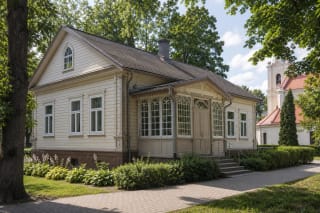
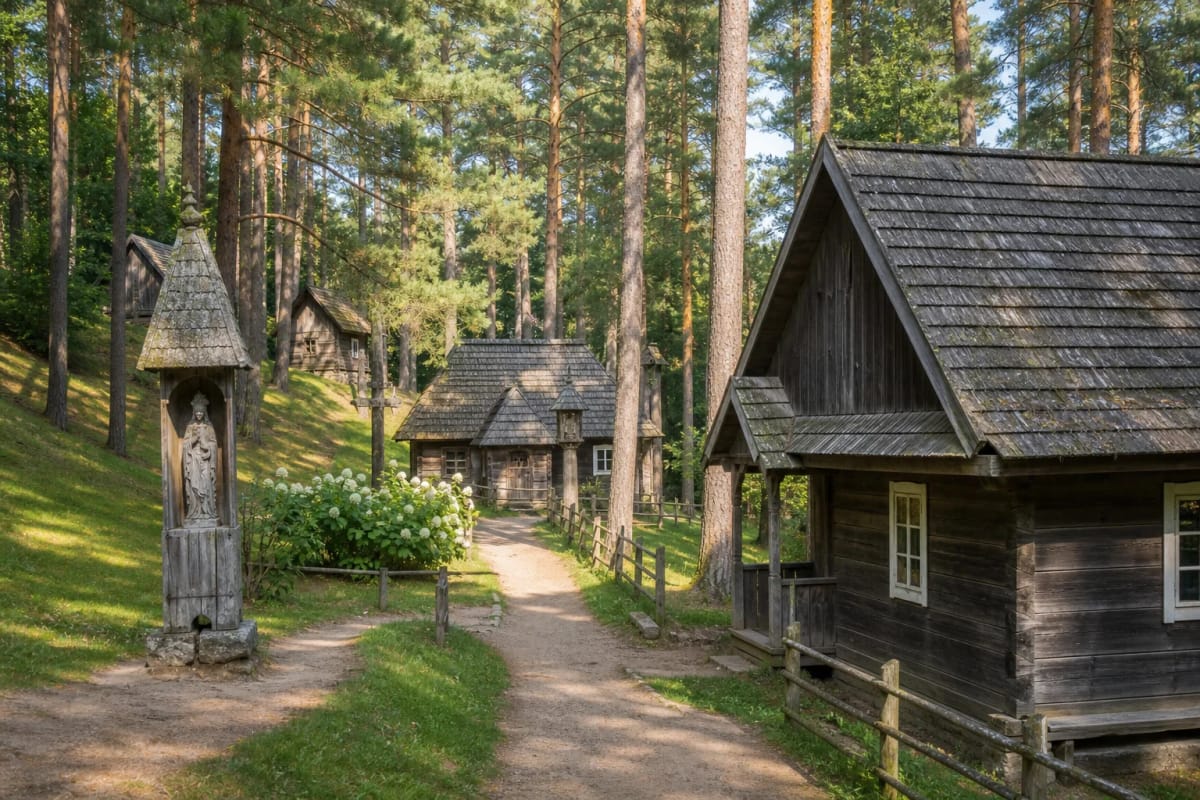
Šilavotas Davatkynas is a small complex of old wooden cottages on a pine-forest slope in Naujasodis village, near Šilavotas in Prienai District. In the late nineteenth century devout village women, called davatkos or davatkėlės, settled here. Today it is an open-air ethnographic museum and a branch of the Prienai Regional Museum.
This is a rare and probably the best-preserved place of its kind in Lithuania. Walking among the cottages and saint sculptures, visitors can sense how a women's community lived when it chose service to the church and neighbour, but had neither a formal monastery nor official vows.
Who the davatkos were, and what a davatkynas means
A davatka, or davatkėlė, was usually an unmarried lay Catholic woman who dedicated her life to the church and prayer without taking monastic vows. It is a kind of Lithuanian equivalent to a beguine. In everyday Lithuanian the word davatka can sound dismissive, so this place and its history should be approached respectfully.
A davatkynas is a group of homes where such women lived together. It is documented that they cared for the parish church, helped priests and neighbours, nursed the sick, taught sewing, weaving, spinning, and knitting, and, during the press-ban and Soviet periods, secretly prepared children for First Communion.
The women who created the davatkynas
The davatkynas began to form in the late nineteenth century, when women bought land from a local farmer and built their cottages on a pine-forest slope, about 0.7 km from the Šilavotas church. Marijona Dabrišiūtė, who settled here in 1895, is considered the first davatkėlė to live here.
At its height, up to seven residential cottages stood in the davatkynas, and about fourteen women lived here at one time. Two authentic residential cottages and two farm buildings have survived, forming something like a separate tiny settlement. The community's vitality is also shown by the fact that one davatkėlė was tried during the Soviet period for teaching religion.
From cottages to museum
After the last davatkėlė died, the davatkynas was inherited by the relatives of the first resident, the Lincevičius family, who care for its preservation together with the community. A private museum began operating here in 2004, and in 2007 the cottages became a branch of the Prienai Regional Museum.
Each memorial cottage contains an exhibition about the everyday life, work, and piety of the davatkėlės. Exhibits include authentic belongings of the women, regional ethnographic material, a collection of religious oleographs, old furniture, tools, and textiles.
Trail of saint sculptures
In 2006, a trail of saint sculptures was installed along the route by which the davatkėlės walked daily to church. It includes small chapels with images of holy women - Anne, Magdalene, Veronica, and Catherine - a sculpture of the Blessed Virgin Mary, and, at the centre, the Sacred Heart of Jesus, echoing the title of the Šilavotas church.
The trail runs along the pine-forest slope and links the davatkynas with Šilavotas Church of the Sacred Heart of Jesus. A visit to the cottages is convenient to combine with this Neo-Gothic church, built in 1898-1902.
Visiting
The davatkynas usually operates from Wednesday to Sunday and is closed on Monday and Tuesday. Outside opening hours, or for groups, visits should be arranged in advance by phone. Exact opening hours and any ticket price should be checked on the official Prienai Regional Museum page, because information can change.
Allow about 45-60 minutes for the cottages and sculpture trail, plus another 20-30 minutes for the nearby Šilavotas church. The sculpture trail is most attractive from spring to autumn.