- Place
- Jonava District Municipality
- Region
- Aukštaitija
- Type
- 60.86 m single-span steel pedestrian and cycle overpass
- Address
- Above Žeimiai Street by Jonava Sports Arena, Jonava
- Coordinates
- 55.07694, 24.27523
- Visit duration
- 15-30 minutes; about 1-2 hours with Joninės Valley and the Jonava Ponds
- Best time
- a bright morning to study the structure, or blue hour and evening to see the RGB lighting
Jonava pedestrian bridge, Žeimiai Street bridge, pedestrian and cycle overpass in Jonava
A 60.86 m urban link above Žeimiai Street
The bridge crosses Žeimiai Street beside Jonava Sports Arena and connects the Kosmonautai residential district with the sports and recreation facilities on the opposite side. The arena, municipal stadium, swimming pool, and Joninės Valley are reached this way. It is not merely a decorative lookout: the overpass removes the need to cross the busy carriageway at street level on this route.
Jonava District Municipality's 2021 operational-plan report records a completed pedestrian and cycle bridge measuring 60.86 m. Descriptions published by the designers, contractor, and at the opening usually give 61 m. There is no real discrepancy: 61 m is the official 60.86 m figure rounded to the nearest metre.
The coordinate on this page, 55.076936, 24.275235, marks the approximate centre of the bridge deck above the road. It is not the foot of the stairs, the entrance to a ramp, or a parking space. Anyone planning a step-free approach should navigate to one of the side accesses rather than trying to reach the map pin itself.
From a 2016 concept to the 2021 opening
Work on the new connection's concept began in 2016, when the site, rising pedestrian flows, and relationship with the new sports arena were assessed. Several design alternatives were developed, and local residents took part in selecting the final direction. The bridge opened on 7 August 2021 during events marking Jonava's 271st birthday.
Architect Gintaras Čaikauskas developed the concept, while Arūnas Lapinskas and the company Šiltas namas prepared the design, with engineer Jevgenijus Gintovas working on its structural solution. Kauno tiltai carried out the construction. The complex steel superstructure was manufactured in Kretinga and transported to Jonava in sections at night.
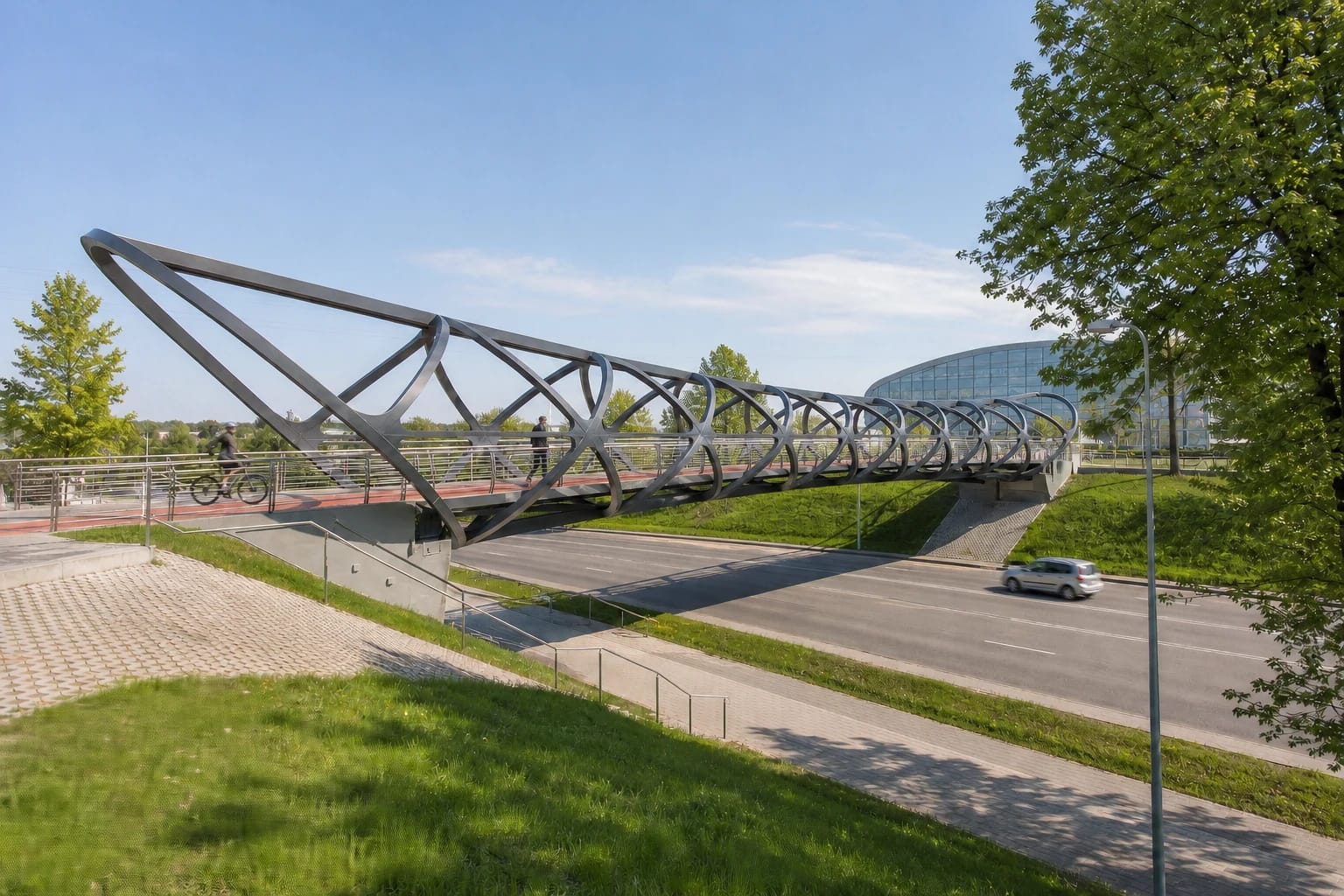
The form was deliberately related to the contemporary architecture of the neighbouring arena. Seen from the side, the dark-grey spatial truss is not a regular box: its members curve in two directions, oval loops repeat along the span, and the two ends flare into taller points. The structure changes with the viewing angle, so a short circuit on both sides of the street reveals more than a single crossing.
What the public-procurement figures reveal
The 2020 CVP IS notice described construction as one integrated package: site works, abutments and pile foundations, the steel superstructure, electrical systems, relocation of district-heating services, a working design, a geodetic survey, and a cadastral file. That scope explains why a modest-city pedestrian bridge was substantially more complex than a prefabricated footbridge.
The procurement allowed for about 170.4 tonnes of S420 steel in the superstructure and beams, approximately 375 cubic metres of concrete, and 56.59 tonnes of reinforcing steel in the supports. These were preliminary procurement quantities, not a final weighing of the entire completed structure. They should therefore not be treated as directly equivalent to rounded total-weight figures used in opening reports.
The documents also specified roughly 132 m of stainless-steel railings and about 340 square metres of five-millimetre polyurethane surfacing in the traffic area. The steel members were to receive a high-resistance anticorrosion system. Visitors see these specifications as silver horizontal rails, a red path, and a dark truss that reads clearly against its surroundings.
Red surfacing and controllable RGB lighting
The strongest daytime colour contrast comes from the path rather than the truss. The spatial steel structure remains graphite grey, while the pedestrian-cycle surface is red. Its multi-layer polyurethane system was designed for durability and improved grip, but it cannot eliminate the slip risk created by rain, leaves, snow, or ice.
The CVP IS specification included RGB luminaires integrated into the path and railings, together with lighting columns at the approaches. After dark, the light picks out the repeating truss loops and changes the bridge's silhouette. Blue hour works better than complete darkness for photographs because the street, arena, and embankments remain visible while the coloured lighting has already taken effect.
On 18 July 2026, the public colour selector at tiltas.jnv.lt was online, offering yellow, green, red, blue, and violet, with a 30-second pause between changes. The interface was checked without submitting a colour command, so its live connection to the physical luminaires was not tested. If a particular colour matters for photography, check the controller on site rather than relying entirely on an advance plan.
A short route into Joninės Valley
Allow 15-30 minutes for the bridge itself: cross it, view the truss from an embankment, and return by the other edge of the approach. This reveals both the looping structure and its relationship with the arena and street. Avoid standing on the path for long while taking photographs, since the bridge is first and foremost an everyday transport route.
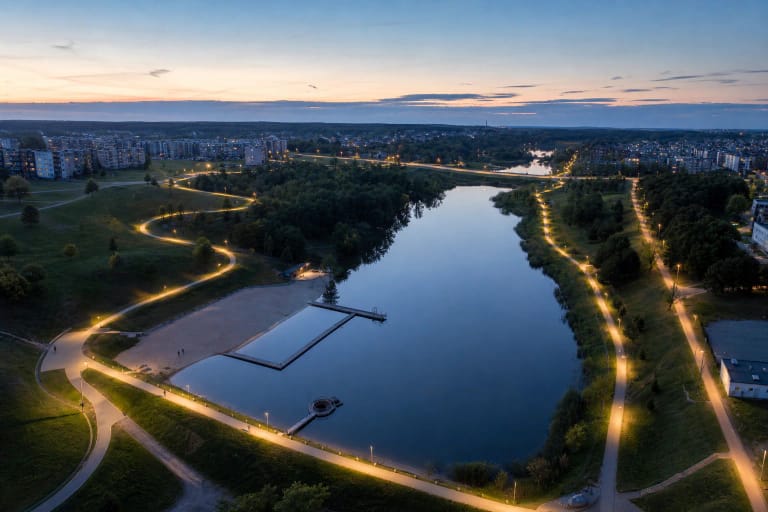
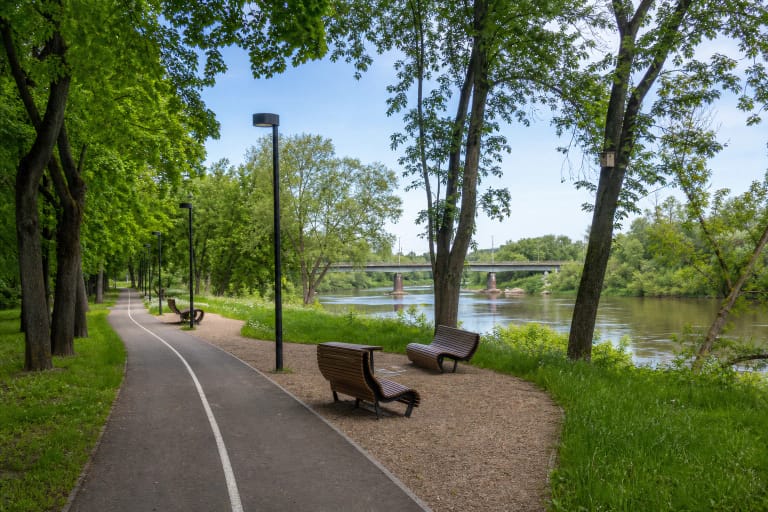
The most natural continuation is Joninės Valley. From the sports-arena side, paths descend into its event and recreation spaces, then continue towards the Jonava Ponds. Allow about 1-2 hours for this combined walk or unhurried cycle ride, excluding time for an event, swimming, or a longer rest.
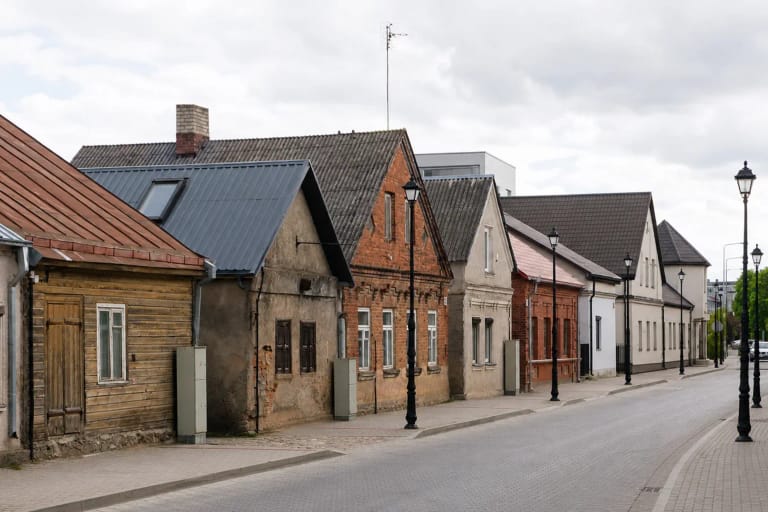
A longer urban route can continue towards the historic centre and Kauno Street, or cyclists can choose the direction of Taurosta Park. These extensions cover more ground than the compact bridge-and-valley circuit, so consider the weather, arena events, and your return route before setting out.
Access and safe movement in a shared space
The bridge has stairs and ramped approaches, allowing access on foot, by bicycle, with a wheelchair, or with a pushchair. No published independent audit of current accessibility conditions could be located, however. Travellers who need a specific gradient, rest landings, or particular kerb and surface conditions should assess the approach before or at the start of their visit.
Pedestrians and cyclists share the route, so match speed to the number of people, maintain a predictable line, and pass only with adequate clearance. Move especially slowly at ramp bends and exits, where railings and truss members restrict sightlines. After rain, under autumn leaves, or during frost, the surface may be slippery despite its technical coating system.
This is public urban transport infrastructure with no admission ticket. Crowds can increase around the arena and Joninės Valley on event days, and normal access or traffic arrangements may change temporarily. Use a ramp for a bicycle or mobility aid and leave cars only in lawfully marked spaces without obstructing paths or emergency access.