- Place
- Jonava, Jonava District Municipality
- Region
- Aukštaitija
- Type
- educational riverside park and a walking-cycling route section
- Address
- Taurostos g., Jonava
- Coordinates
- 55.07039, 24.28989
- Visit duration
- 45 minutes-1.5 hours; longer if continuing along the Neris by bicycle
- Best time
- late spring, summer, or early autumn; a dry morning for a quiet walk
Taurostos parkas
A quiet Jonava route along the Neris
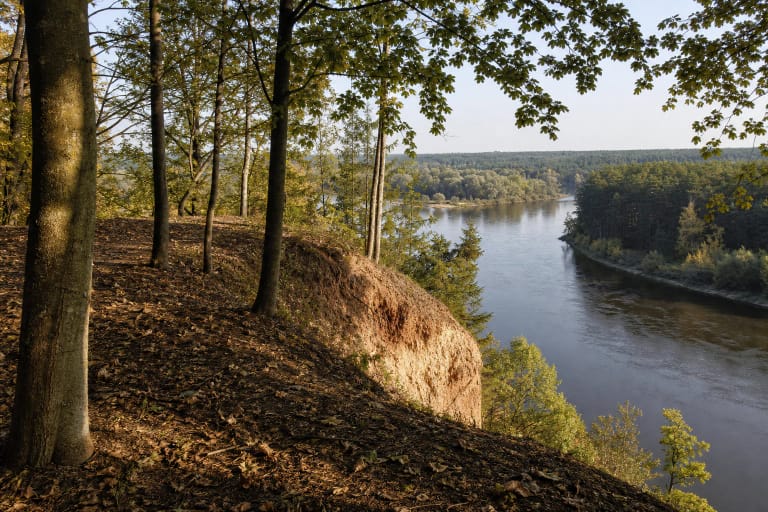
Taurosta Park follows the Neris riverbank beside Taurostos Street in eastern Jonava. It is not a formal town garden of flower beds and monuments, but a riverside green where tree cover, open grass, and river views alternate with paths designed for everyday movement. The official visitor description gives the park an approximate area of 10 hectares.
The main attraction is the chance to walk or cycle while keeping the Neris in view. Small rest areas, benches, and reclining seats stand beside the path, with some oriented directly towards the river channel. The park is best approached not as a checklist of photo stops but as a slow walk through planting, interpretation, and a quiet place beside the water.
Why Taurosta is described as an educational park
A landscape project improved five hectares of the park in 2017-2019. Work included removing invasive trees and scrub, planting trees and shrubs characteristic of Lithuania, and installing nature paths and small-scale visitor features. The five-hectare project area and the approximately ten-hectare park therefore describe different boundaries, not two separate parks.
Information boards identify plants and explain their value in the local environment. Habitat boxes were installed for birds, bats, and insects. This is not a zoological display or a promise that any particular species will appear; the features show how an urban green space was designed to combine public access with support for habitats.
The project's purpose went beyond making the area look tidier. Official documents emphasise continuity of the ecological network, survival of herbaceous and woody riverside plant communities, and the relationship between a natural bank and the urban town. On a visit, notice this transition from an organised path to a less controlled riverside edge.
How the park changed from 2017 to 2020
The agreement for improving the ecological condition of Taurosta Park was signed on 2 August 2017, and planned activities were completed by 30 September 2019. The municipality records a landscape plan, public consultation, restoration of the footpath along the Neris, and measures intended to support biodiversity.
A separate mobility stage was completed in September 2020. A new 600 m illuminated walking and cycling path with rest areas opened through the park. It connects with an earlier path of nearly 2 km leading from Taurosta Park towards the Achema plant, so the place works both as a short park walk and as one section of a longer cycle route.
What to notice on the nature path
A slow circuit reveals three layers: the Neris and its bank, tree and shrub groups of varying density, and the infrastructure added for visitors. The interpretation boards, habitat boxes, and rest areas make most sense as parts of one landscape project rather than as separate attractions.
Walkers and cyclists share the principal path, so stop for photographs in a rest area rather than in the riding line. Natural-surface side sections may soften after prolonged rain, and the slope and water level should be considered close to the river. Do not disturb planting, habitat boxes, or interpretation boards.
Planning a visit to Taurosta Park
The park is an open municipal green space without a ticket office or timed admission. Walking is free, though it is sensible to check the municipal site for temporary path repairs, events, or riverbank-maintenance restrictions before travelling. Part of the main route is lit in the evening, but daylight is best for exploring the natural sections.
Allow about 45 minutes for a short walk and a pause beside the Neris, or up to 1.5 hours for the nature information and rest areas at an unhurried pace. Cyclists can continue towards Achema on the linked route. Families should remember that this remains a real riverbank, so children need normal close supervision beside the water.