- Place
- Kaunas City Municipality
- Region
- Kaunas
- Type
- urban forest park with pine woodland, paved and natural trails, and routes along the Nemunas
- Address
- 4 Gailutės Street, Kaunas - a representative address for the broad forest area
- Coordinates
- 54.87614, 23.96697
- Visit duration
- 1-2 hours for one loop; 2.5-3 hours for a longer route including the Nemunas riverbank
- Best time
- a bright early-autumn morning; steeper natural paths can be slippery after rain and in winter
Panemunės šilas, Panemunė pinewood, Jonas Basanavičius Park
The pinewood is a network of routes, not one point on Gailutės Street
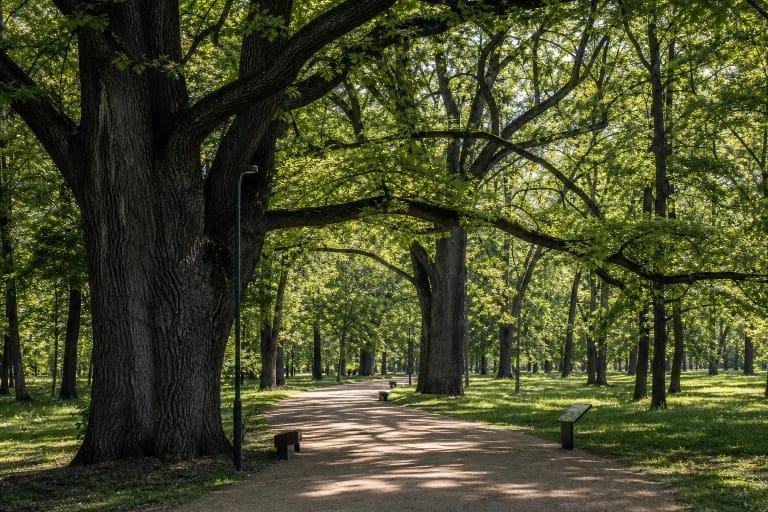
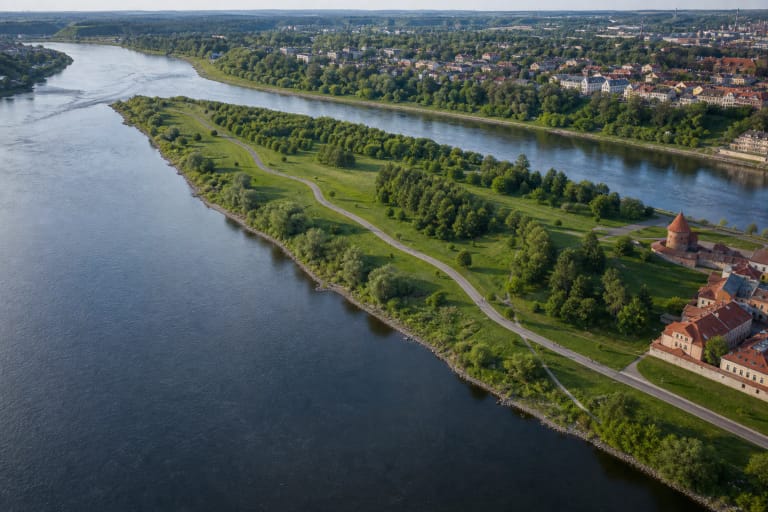
Panemunė Pinewood lies inside a bend of the Nemunas in south-eastern Kaunas and is presented by Kaunas City Museum as the city's largest pinewood. Tall pines and other conifers dominate, although birch and various deciduous species also grow here. The scale of the forest park becomes clearest on a loop, rather than by searching for one main gate or central square.
The Google Maps address, 4 Gailutės Street, and coordinates 54.876142, 23.966973 mark a representative point within the broad forest area. They are not a metre-precise reference for the only entrance, a car park, or the beach. Access is possible from Panemunė's residential streets, the Vaidilos Street side, and across the pedestrian Three Maidens Bridge from Šančiai.
Panemunė is an entire city district, while the pinewood is one large part of it. The English label Panemunė pinewood used in navigation refers to the same forest park, but Panemunė Beach, the bridge, and other facilities have separate map entries.
The upper terrace and Nemunas riverbank create two different walks
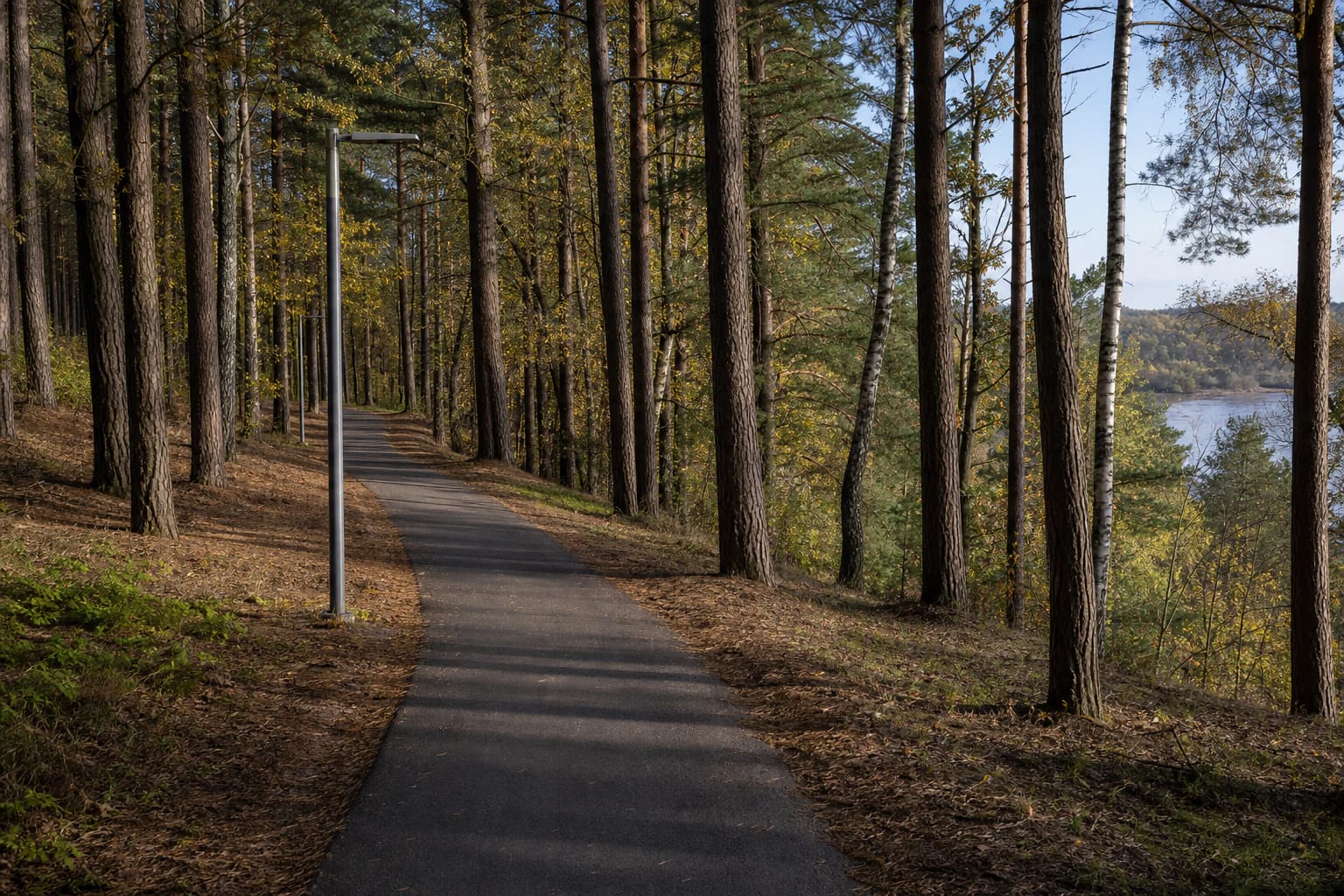
In the upper forest, paths weave between pines over drier and occasionally rolling terrain. Principal paved routes work well for walking, running, and unhurried cycling, while side trails retain natural surfaces, roots, and sandy stretches. Different users share the network, so keep to one side and reduce speed at bends.
The lower terrace approaches the Nemunas and offers more river views, but connections down from the upper level can involve gradients or steps. Natural links become more slippery after downpours, freezing rain, and snow than the paved loops. For a short family visit, choose one main route and add the riverbank only after considering the weather and everyone's mobility.
In 2017, the municipality stated that paved paths in the pinewood totalled 15 km. That number does not include every informal forest track, nor does it mean the whole forest is level or fully suitable for wheels.
Animal-named avenues preserve the landscape of the interwar resort
After the First World War, Panemunė Pinewood began drawing increasing numbers of leisure visitors. A monument to Jonas Basanavičius was erected here in 1928, and the forest park took his name. Panemunė was incorporated into Kaunas in 1931 and gained resort status in 1933.
By 1935, roughly 7 km of routes had been arranged. Cuckoo, Tern, Mermaid, Nightingale, and Stork avenues, together with Fox, Roe Deer, and Elk paths, received memorable woodland names. Some survive today, making them a continuation of the interwar recreational landscape rather than a recent branding device.
The resort had a kurhaus with a veranda, buffet, dances, and concerts, while two beaches operated beside the Nemunas. The building declined during the Soviet period, but Kaunas City Museum records an open-air dance tradition near its foundations continuing from about 1964. This is documented urban leisure history, not a promise that a restored kurhaus stands there today.
Renewal strengthened the main loops without turning the forest into a gated park
In 2017, while improvement works were halfway through, the municipality reported new asphalt, LED lighting, and 15 rest points beside the paths. Each was to have a bench and bin, while two car parks had been created on Vaidilos Street. These records explain the scale of the principal infrastructure, but the condition of individual benches, lights, and parking areas can change.
The same announcement described expanded play, senior activity, and sports areas as later phases. If one particular item of equipment is the reason for visiting, check the newest municipal information or map instead of treating a historic project list as a current inventory. The forest and its routes remain the primary attraction.
Although some paths are lit, this is not an enclosed park with controlled gates. On 21 July 2026, Google Maps listed it as open around the clock and showed 3,288 reviews averaging 4.8 out of 5, but unfamiliar and remote sections are safest in daylight.
The beach, Three Maidens Bridge, and forest are connected but not identical
Panemunė Beach is a separate riverside recreation area beside the pinewood. Its bathing season, water-quality tests, lifeguard coverage, and other seasonal services must be checked in current city information. The forest's unrestricted access and Google opening hours say nothing about whether swimming is safe on a particular day.
Three Maidens Bridge provides pedestrian and cycle access from Šančiai, but its coordinates are not the centre of the forest. An official Kaunas family-cycle route estimates about 13 km from the Old Town to picnic areas in the pinewood along the Nemunas direction. The actual distance depends on the starting point and loop selected.
Drivers should navigate to legal parking serving their chosen side of the forest, rather than the representative Gailutės Street point, and must not leave a vehicle on a forest verge or path. Public transport and the bridge also make a one-way walk possible when the return stop is planned in advance.
Forest safety depends on the route, weather, and season
For a longer route, carry water, keep a charged phone, and save a map. Many intersecting paths look similar, so an animal-named avenue alone may not be enough for orientation. Return to a principal lit route before darkness when visiting for the first time.
Use tick protection in the warm season and check yourself after the walk. Keep dogs under control, avoid disturbing other visitors, and light fires only where this is clearly permitted and facilities are provided. A forest of mature trees is not a suitable walking destination during strong winds or storms.