- Place
- Kaunas City Municipality
- Region
- Kaunas
- Type
- Baroque church and monastery ensemble by the Kaunas Reservoir
- Address
- T. Masiulio g. 31, Kaunas
- Coordinates
- 54.87600, 24.02200
Pažaislis church and monastery ensemble
Lithuania's most important Baroque ensemble
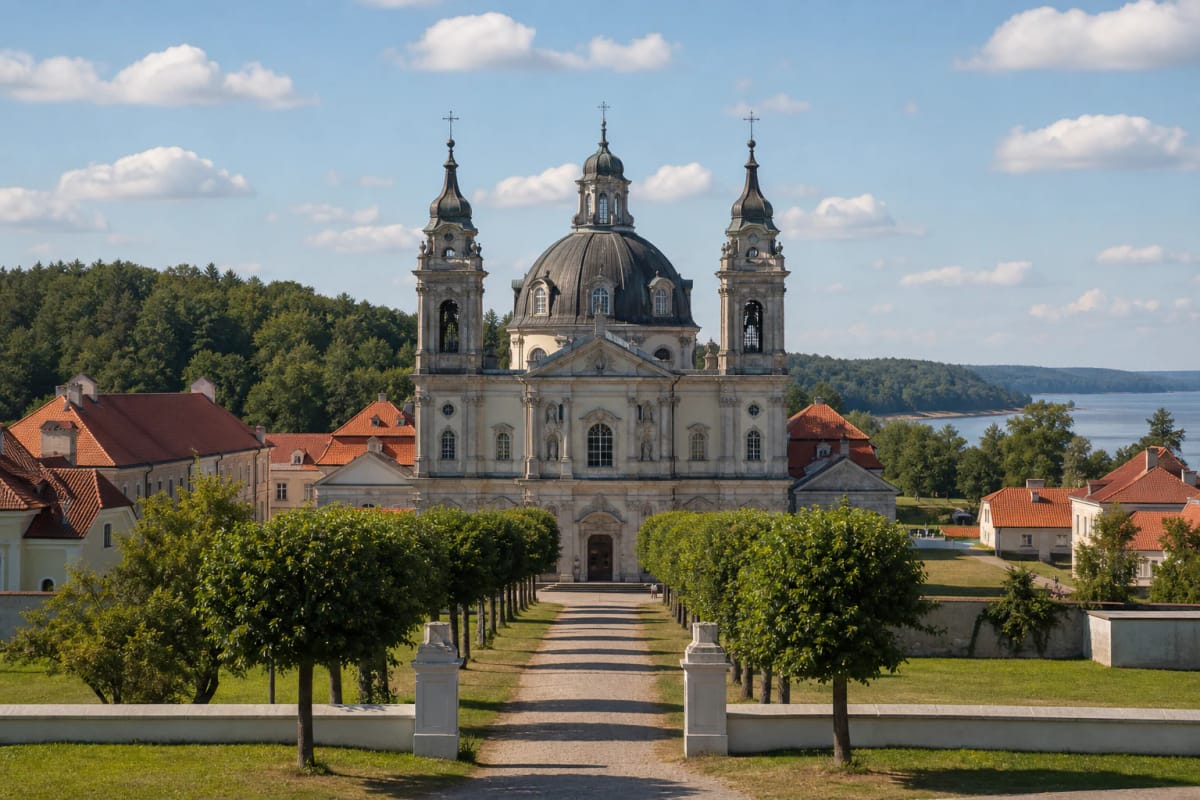
VLE calls Pažaislis church and monastery ensemble the most famous Baroque ensemble in Lithuania. That is a strong description because Pažaislis is not just a beautiful church by water; it is a coherent composition of architecture, art, monastic life, and landscape.
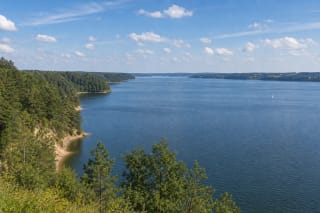
The ensemble stands on the north-western shore of the Kaunas Reservoir. The present water body appeared later, but today the view of Pažaislis is inseparable from the reservoir, forest, and peninsula atmosphere. VLE notes that the site was planned according to Camaldolese monastic rules, with a western guest and service zone and an eastern enclosed hermitage zone.
Pac family foundation and Camaldolese monks
VLE states that the monastery was founded for the Camaldolese by Kristupas Žygimantas Pacas, Chancellor of the Grand Duchy of Lithuania, and that construction began in 1667 under architect G. Frediani and others. The central Church of the Visitation of the Blessed Virgin Mary also became a Pac family crypt.
The Camaldolese were a hermit monastic order, so the site's distance from the city centre and its enclosed planning have spiritual meaning, not only aesthetic value. VLE notes that individual Camaldolese hermit houses once stood in the hermitage zone; in the second half of the nineteenth century ten of them were demolished, leaving only three.
Italian Baroque in Lithuania
VLE links Pažaislis with Italian architect G. Frediani, while P. Puttini directed works until 1689. The church has a hexagonal plan, two towers against the western facade, giant-order double pilasters, and a balustrade above the attic that once held four statues by the sculptor M. Volšeidas.
The interior's richness comes from Italian materials and masters. VLE states that the walls were covered with black and pink marble, J. Merli created the stucco decoration in 1674-1676, and M. Palloni painted frescoes in 1676-1687, followed by G. Rossi in 1692-1712. Do not stop at the exterior if the interior is open.
Soviet-period and return layers
Pažaislis experienced major historical ruptures. After the 1831 uprising, the Camaldolese monastery was closed, and in 1840 an Orthodox Dormition monastery was consecrated here; adapting the church as an Orthodox church destroyed some fittings, wooden altars, paintings, and frescoes. In 1920 the Sisters of St Casimir took over the ensemble.
In 1948 the monastery was closed again. During Soviet occupation, the complex held a central archive, a care home, a psychoneurological hospital, and a tourist base. From 1967 to 1991 it belonged to the National M. K. Čiurlionis Museum of Art, which restored stucco and frescoes, and in 1992 it was returned to the Sisters of St Casimir.
Music and events
Pažaislis is closely associated with the Pažaislis Music Festival, held here every summer since 1996 and now one of Lithuania's largest classical-music festivals. Events change the experience: the architecture becomes not only something to look at but an acoustic and cultural space.
If travelling during an event, check tickets, access, and parking in advance. For a quiet architectural visit, choose a day without a large event.
Practical visiting
The official visitor page checked on 8 September 2026 lists Tuesday–Friday 10:00–17:00 (last entry 16:30) and Saturday 10:00–15:30 (last entry 15:00). The ensemble is closed to tourists on Mondays; on Sundays Mass is held at 11:00, while the museum is closed and tours do not run. Adult admission is €10; preschool-age children and visitors with disabilities who show supporting documentation enter free. Check for schedule changes before travelling. The centre has no resident guide. Professional Kaunas city guides lead tours for a separately agreed fee. Ask the centre for guide contacts at +370 37 458868 and arrange a tour in advance.
Plan at least an hour. If you want to understand the frescoes, foundation, and monastic history, take a guided tour or prepare a short route in advance.