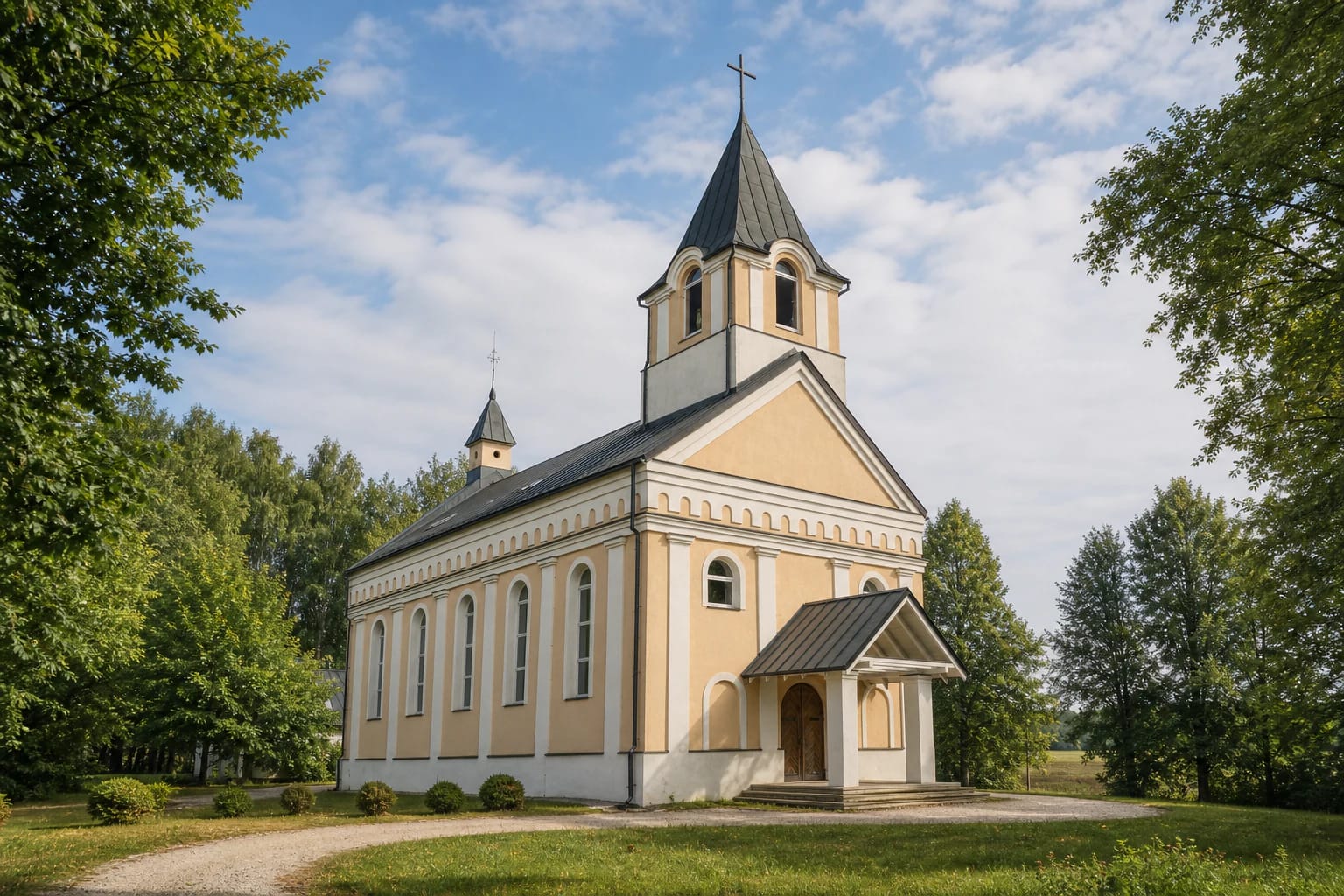
- Place
- Pakutuvėnai, Plungė District Municipality
- Region
- Samogitia
- Type
- rectangular masonry church built in 1941-1943, with restrained Classical facades, one tall tower, and an active Franciscan community
- Address
- 22 Minijos Street, Pakutuvėnai village, Plungė District, LT-90390
- Coordinates
- 55.89918, 21.68971
- Visit duration
- 30-45 minutes for the church and its setting; longer for Mass, the patronal feast, or a pre-arranged Pakūta event
- Best time
- before or after Sunday Mass at 12:00, or Tuesday Mass at 18:00, after checking the latest official notices
Church of St Anthony of Padua in Pakutuvėnai, Pakutuvėnai Church, Pakūta Church, Pakutuvėnų Šv. Antano Paduviečio bažnyčia
A remote church near the Minija has no museum-style opening hours
The church stands at 22 Minijos Street in a secluded part of Pakutuvėnai village, west of Plungė. Coordinates 55.8991817, 21.6897059 identify the sanctuary itself among the trees rather than the whole Pakūta site. Because the grounds contain several buildings with different functions, select the exact church listing in navigation rather than a general place or organisation marker.
On 29 July 2026, Pakūta's official website listed Mass at 12:00 on Sundays and 18:00 on Tuesdays. It publishes neither dedicated visitor hours nor an admission charge. The doors may be locked at other times, so the most reliable opportunity to see the interior is immediately before or after worship, after checking the official website again.
For a group, retreat, sacrament, or assistance at the entrance, the official website gives +370 671 30611 and pakutosbendruomene@gmail.com. It does not publish a complete account of a step-free route, accessible toilet, or individual support, so visitors with mobility or other requirements should ask before travelling.
Construction in 1941-1943 relied on local patrons, workers, and scarce wartime materials
The idea predated construction. Residents around Aleksandravas discussed a church in 1939, and in 1941 Plungė parish priest Prelate Povilas Pukys took charge of the project. Justina Stroputė provided the main plot, while Stanislovas Grigalauskas added land for a corner of the building, churchyard, road, and an extension to the cemetery. A local building committee was approved on 21 August 1941.
Kretinga district engineer Jonas Zubkus drew a rectangular church 24 metres long and 12 metres wide in 1941. The Plungė commandant's office supplied 600 bags of cement for the floor. At Pukys's request, Plungė mayor Eduardas Misevičius released another 1,200 bags and 27 iron beams; residents bought logs, carried gravel from the Minija, and transported supplies by cart. Latvian master builder Edvardas Burkanas directed the work.
Mass was first celebrated in a room of the rectory and then in a timber chapel moved from Plungė and re-erected in Pakutuvėnai cemetery. Bishop Vincentas Borisevičius blessed the cornerstone and cemetery on 3 May 1942, and masonry work began that July. On 26 September 1943, the same bishop consecrated the completed church under the title of St Anthony of Padua.
A restrained Classical exterior encloses a simple community worship space
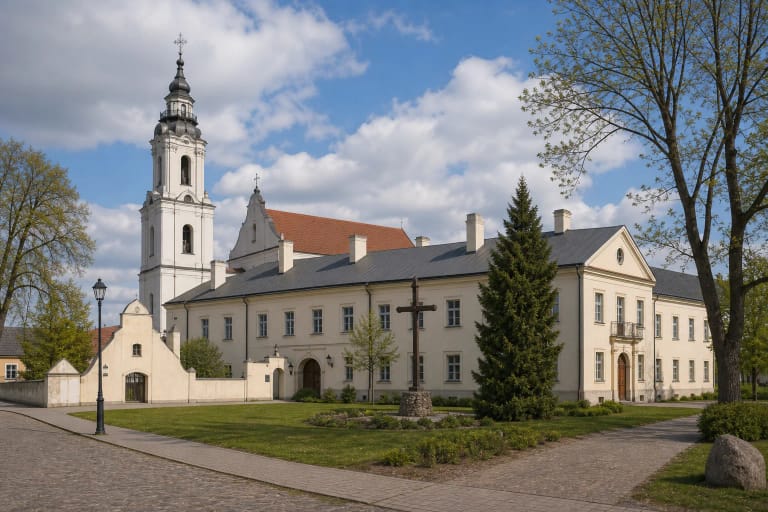
The rectangular building measures 24 by 12 metres. White vertical bands and tall round-headed windows articulate the pale yellow rendered walls, while a frieze of shallow blind arches repeats below the cornice. A triangular gable and a small timber porch supported by four white posts complete the entrance facade.
A square tower rises over the front part of the church, with tall arched openings, a dark pyramidal sheet-metal roof, and a cross. A smaller turret marks the opposite end of the roof. Sources describe the symmetry, restrained render detail, and rounded openings as Classical features, although this is a modest rural church from the early 1940s rather than an academically ornate Neoclassical building.
The church initially received three altars from the former church in Plungė, but that original ensemble did not remain intact here. Today's tall, undivided room is much simpler, focusing attention on the altar table, a large timber cross, icons, wooden pews, and rugs. Enter only areas that are open, do not touch liturgical objects, and never photograph people without consent.
Franciscans transformed a solitary church into Pakūta, but the community is not an exhibit
As Soviet land consolidation emptied the surrounding countryside, the church became isolated and services were eventually held only on limited occasions. A new period began on 14 June 1991, when the first Franciscan novices came here for a retreat. Brother Gediminas Numgaudis OFM assumed pastoral responsibility for Pakutuvėnai in 1995.
That same year, the Kretinga Franciscan Youth Service leased 49.25 hectares around the church for 50 years and began the Reconciliation Homestead. Its purpose was to help people rebuild relationships with themselves, God, and others through prayer, work, and rest. The public institution Susitaikinimo sodyba was established in 2007; the site now supports a parish, Franciscan friary, spiritual assistance, and evangelisation initiatives.
The publicly accessible focus is the church and events announced by the community. Residential, support, and recovery buildings are not museum displays, and their residents are not a sight. Retreats, camps, and community programmes require an announced event or prior arrangement; visitors should not wander into private areas or photograph people.
The 2026 disasters damaged community buildings, but church life continued
A Telšiai Diocese report dated 2 February 2026 states that a timber building used to house people experiencing homelessness and addiction burned down and heavy snow broke through the roof of the largest event building, known as the hangar. It does not say that the church burned or was damaged. The bishop celebrated Mass inside it on 1 February, and the Pakūta website later continued to publish its regular worship schedule.
The distinction matters when planning a visit. The church can be approached according to official notices, but arrangements for larger events, reception facilities, and movement near rebuilding work may change. Do not enter fenced or working areas, and check the latest information before attending a special event.
The patronal feast of St Anthony of Padua is traditionally associated with 13 June or the nearest Sunday, but each year's exact programme is announced separately. Allow 30-45 minutes for an unhurried architectural visit. For a wider Franciscan story continue to Kretinga Monastery, while Pukys's building career is best followed in Plungė.