- Place
- Pagėgiai, Pagėgiai Municipality
- Region
- Lithuania Minor
- Type
- Evangelical Lutheran church
- Address
- Vilniaus g. 1, Pagėgiai
- Coordinates
- 55.13754, 21.90729
Pagėgiai Parish, Pagėgiai Lutheran Church, Pogegen Evangelical Lutheran Church
Pagėgiai Lutheran Church in a railway and border town
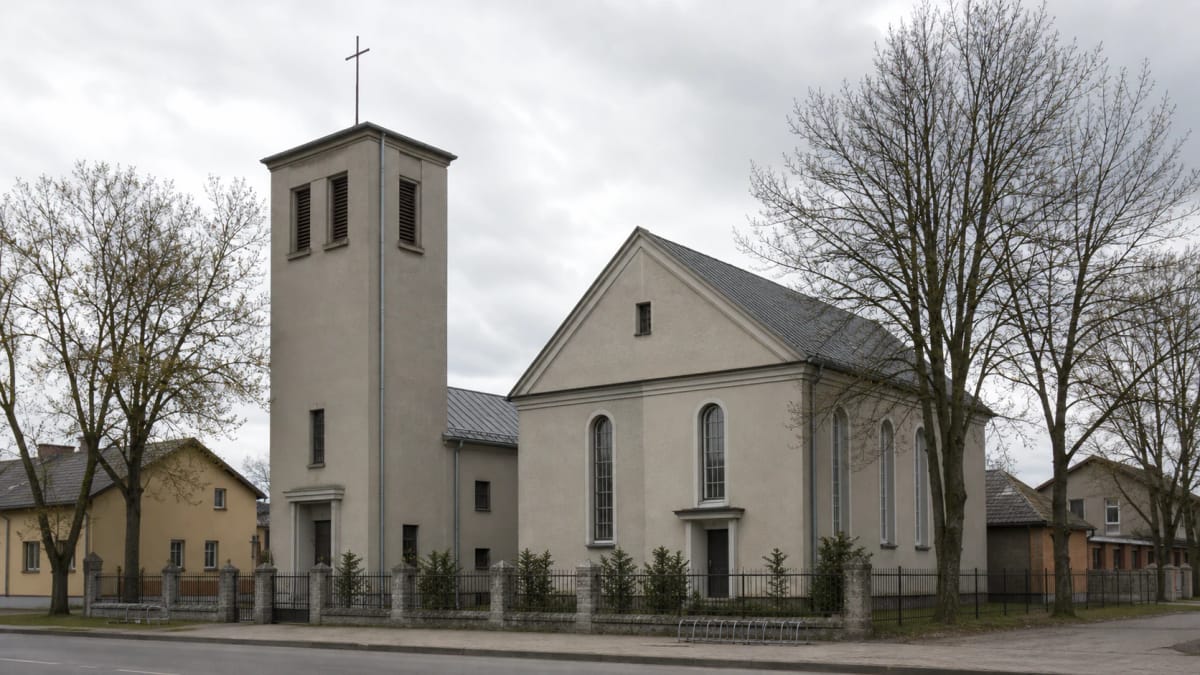
Pagėgiai Evangelical Lutheran Church stands on Vilniaus Street in a town whose growth was shaped not by old history but by a transport hub. According to VLE, Pagėgiai is first mentioned in 1307, but became a town only in the nineteenth century, after the Tilsit-Klaipėda highway (1848-1853) and the railway with its station and post office (1866-1875) were built. From 1920 to 1939 Pagėgiai was a county centre, and in 1923 it joined Lithuania together with the whole Klaipėda region.
So the Lutheran church here is not an old seventeenth- or eighteenth-century sanctuary. Its value lies in the twentieth-century story of a Lithuania Minor border town, where a fast-growing, increasingly multi-ethnic community long had no house of prayer of its own. VLE dates the Lutheran church to about 1933.
From church-district centre to independent parish (1922-1931)
According to the history by Albertas Juška published by the Evangelical Lutheran Church of Lithuania, having become a county centre in 1920, Pagėgiai was recognised as a church-district centre in 1922, yet had no church of its own - people travelled to Tilsit for services. The superintendent's residence was set up in the remote village of Plaškiai, where Rev. Otto Obereigner began work in 1922.
In 1928 the adjunct pastor Gustav Kupss was sent to Pagėgiai, soon replaced by Kurt Malzer. In 1931 came Martynas Šernius from Priekulė, who had served for several years as a missionary on distant Borneo and later as a pastor in Naumiestis. That same year, 1931, the Pagėgiai community was finally granted independent parish rights - it comprised 14 villages (Būbliškės, Grigolaičiai, Jėgininkai, Mikytai, Nausėdai, and others) that had previously belonged to the Tilsit church.
The 1933 house of prayer and the 1938 tower with Apolda bells
Building the parish's own house of prayer was repeatedly delayed, but in the end it rose quickly: a plain, at first towerless structure about 20 m long and 10 m wide. The consecration took place on 19 February 1933, attended by the Klaipėda-region General Superintendent F. Gregor, the Pagėgiai church-district superintendent O. Obereigner, and pastors from neighbouring parishes. Tellingly, not one clergyman was invited from Greater Lithuania. Barely a month later M. Šernius died, and from 1934 until the end of 1944 the pastor here was Jacob Labrenz.
In 1936 the community numbered about 3,000, many of whom now considered themselves German (in 1937, 61 confirmands were blessed at German-language services and only 8 at Lithuanian ones). In 1938 the church was somewhat rebuilt, a tower was added, and two bells cast at the famous Apolda works in Thuringia were acquired. Soon afterwards the German authorities abolished Pagėgiai county and, in 1939, reassigned its western parishes - Natkiškiai, Plaškiai, Rukai, and Katyčiai - to Šilutė.
The postwar years: grain store and the Komjaunuolis cinema
After the war the church's fate was harsh. In the spring of 1946 returning residents still worshipped freely, but that autumn the county authorities seized the church and set up a grain store inside it. People gathered to pray in a repaired chapel at the Evangelical cemetery. On 30 June 1948 the community submitted registration documents, yet the same date appears in a secret file as the record of its "closure."
Later, after the tower was demolished, the Lutheran church was converted into a cinema pointedly named "Komjaunuolis" (Young Communist). For a time people prayed in the cemetery chapel together with Catholics, but even that was banned - only house prayer-gatherings remained, organised by the lay preacher Šikšnius. In 1943 the Nazi authorities had renamed the town itself Ordenswalde, and after the war Soviet architecture changed the old face of Pagėgiai still further.
The 1989 revival and visiting Pagėgiai
On 27 August 1989 the Pagėgiai Lutherans appealed to the Šilutė District Executive Committee, asking it to recognise the community and return the confiscated church. This time there was no objection: on 29 October the district authorities, and on 27 November the Council for Religious Affairs, decided to register the parish, and the house of prayer was returned. Today it is an active parish of the Evangelical Lutheran Church of Lithuania (pastor Gediminas Kleinas), at Vilniaus g. 1.
In Pagėgiai the church is easy to combine with the Kristijonas Donelaitis Gymnasium and the town's railway and border history, and on a wider route with Rambynas Hill and Šereitlaukis Manor Estate. In this way the whole Lithuania Minor layer of Pagėgiai Municipality opens up - from the border town to the memory sites along the Nemunas.