- Place
- Katyčiai, Šilutė District Municipality
- Region
- Pamarys
- Type
- Evangelical Lutheran church and part of a protected building complex
- Address
- Turgaus a. 8, Katyčiai
- Coordinates
- 55.28728, 21.82749
Katyčiai Lutheran Church, Katyčiai Evangelical Lutheran Church Building Complex, Coadjuthen Church
A church on Katyčiai Market Square
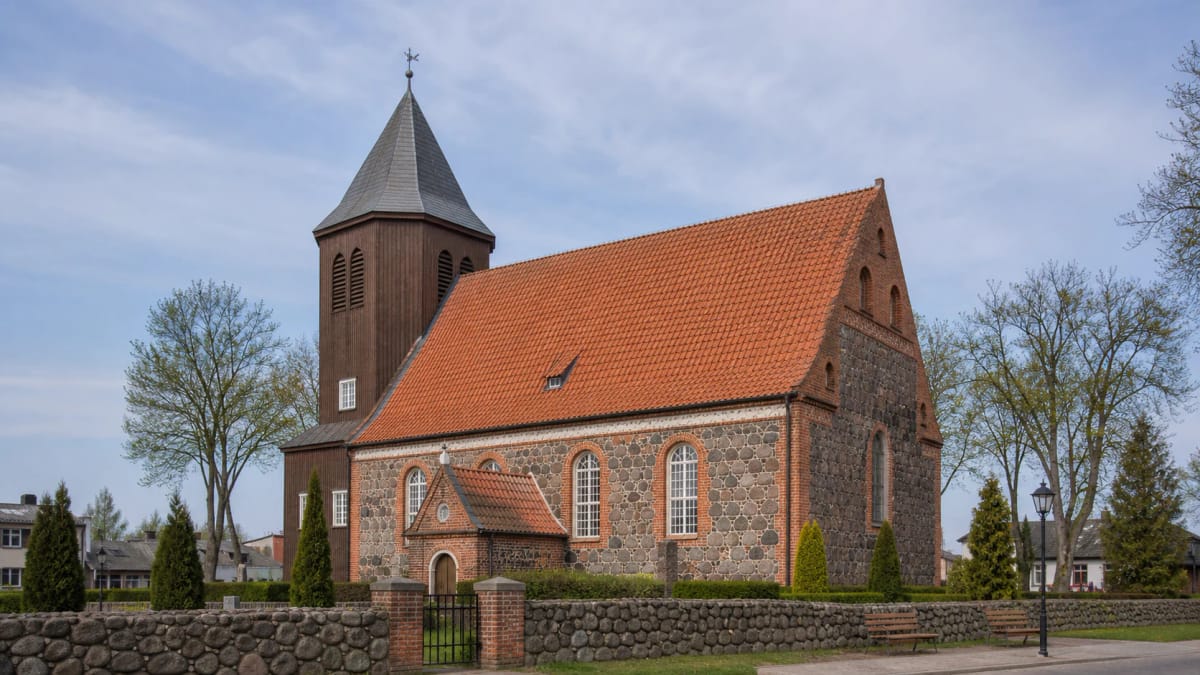
Katyčiai Evangelical Lutheran Church stands on Market Square, in the centre of a town set on both banks of the Šyša stream, so it is not an outlying site but a sign of the old Katyčiai community. In German documents of 1555-1923 Katyčiai was called Coadjuthen (Koadjuten).
The Cultural Heritage Register protects both the church itself (unique code 2293) and its wider building complex, with the churchyard gate and fence fragments (code 32967). That protection shows that not only a single facade matters, but the whole sacred setting, with a churchyard overgrown with lindens and maples.
From the 1568 parish to the 1733-1734 masonry
Services began in the Katyčiai area in 1568, and even before 1574 the first half-timbered church rose by the Šyša. After several repairs, in 1773 the old house of worship was demolished and a new church began to be built in Katyčiai itself; during construction services were held in a wealthier parishioner's barn.
The new church, built of fieldstones and brick and plastered, was consecrated on 1 May 1734 (the Register dates construction to 1733-1734). The tower was made of wood and held two bells; in keeping with the Protestant tradition of the time, a classical-form altar was set opposite the tower, while the old baptismal font from the early sixteenth century was kept. New organs were installed in 1756. Soon afterwards, during the Seven Years' War, invading Cossacks ravaged the newly built church, and it took 15 years to fully repair.
The tower, the Queen Louise bell, and its ringing
On 3 November 1801 a whirlwind of extraordinary force swept through Katyčiai and broke the sphere-shaped top of the tower; the masons who rebuilt it placed two ancient shillings and a prayer text asking to guard the tower from similar disasters into a beam. In 1802 a robbery of the church treasury became widely known - 100 dragoons came from Königsberg to investigate.
The Katyčiai community long remembered a meeting with the Prussian Queen Louise (called „Luvyza“ by the Lietuvininkai), who around 1808 unexpectedly dropped in on a service and promised the church a bell. She kept her promise - the parish received a bell of about 600 kg and a very pleasant tone, rung from then on not only on Sundays but every morning at 7; in still air its sound carried up to 10 km. In 1894 the church was thoroughly rebuilt and gained a strict rectangular form of 25 x 12 m with a reinforced wooden tower ending in a tent-shaped roof.
Baroque interior and architectural features
The Register describes the church as an asymmetrical, hall-type, single-nave, single-tower sanctuary of Baroque style. Its main body is covered by a gabled clay-tile roof and its wooden west tower by sheet metal; the east sacristy and north porch abutting the nave are of half-timbered construction.
The walls are of brick on a dressed-fieldstone plinth, and the interior is asymmetrical, with a vestibule, an organ choir above it, and galleries on both sides of the nave. The nave ceiling is adorned with four round wooden rosettes cut with stylized plant motifs, and the joint altar-pulpit typical of Lutheran churches was reconstructed around 1994. The building complex is classed as Baroque and Historicist in style.
Vilius Gaigalaitis, the Soviet era, and revival
In 1915-1919 Vilius Gaigalaitis served as pastor in Katyčiai - his efforts revived Lithuanian identity in the area, as shown by a fivefold rise in the number of confirmands confirmed in Lithuanian; the Katyčiai „Vainikas“ society was also renowned at the time. The church suffered little in the Second World War, but after the war newcomers ravaged it.
The postwar parish was registered in 1948, but deportations soon began - 18 of the 20 who signed the registration were sent to Siberia. In 1955 the church was nationalized and turned into a house of culture: the altar was torn out, the organ destroyed, the bells taken down, and the one donated by Queen Louise smashed; the wooden tower was demolished in 1955-1956. The community was re-legitimized in 1991, the church and tower were restored in 1992-1994, and the renewed house of worship was consecrated on 28 May 1994.
Services and visiting
The parish information of the Evangelical Lutheran Church of Lithuania states that services are held on the second and fourth Sunday of the month at 13:00; the community has about 150 members. Such schedules can change, so check the official parish page before travelling.
If the church is closed, its masonry and tower are still worth viewing from Market Square. Katyčiai suits a quiet sacred-heritage route together with Saugos, Šilutė, and Žemaičių Naumiestis.