- Place
- Bitėnai and Lumpėnai, Pagėgiai Municipality
- Region
- Rambynas Regional Park
- Type
- cultural hill and Nemunas valley viewpoint
- Coordinates
- 55.08780, 22.02110
Rambynas, Rambynas Hill
Rambynas Hill: why Rambynas matters
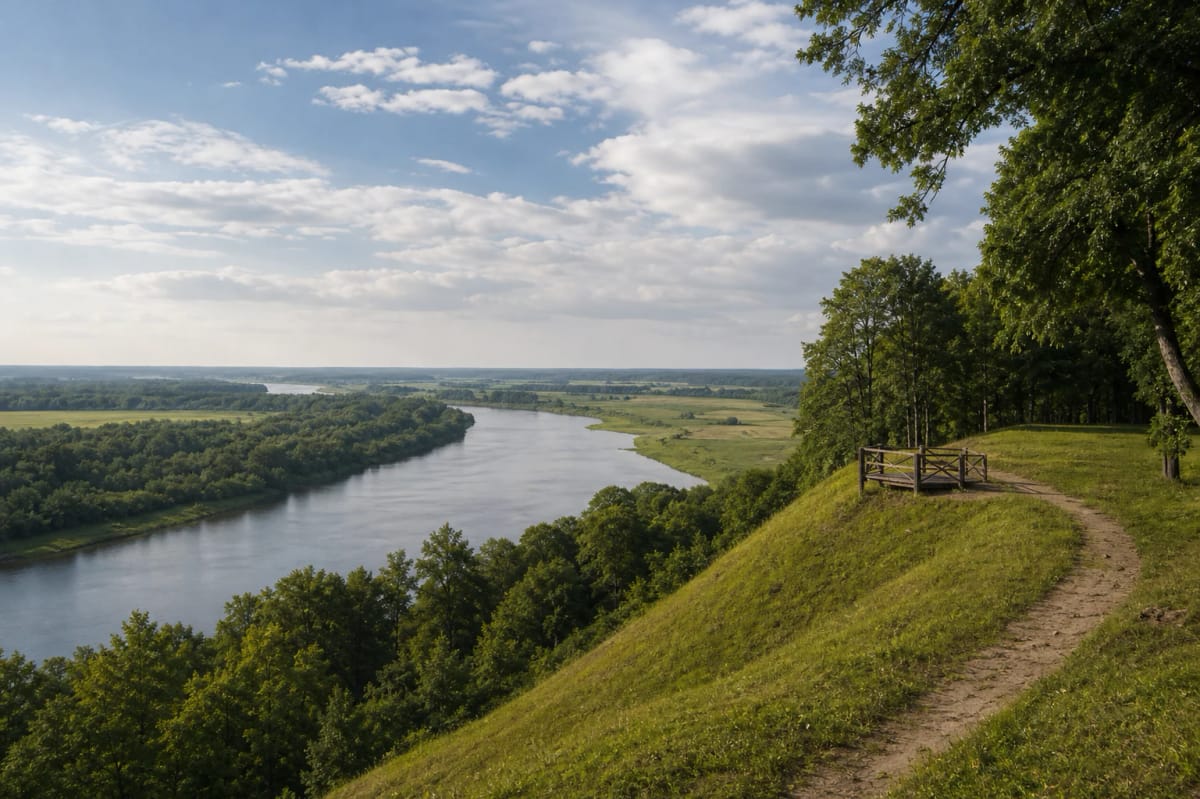
Rambynas Hill is not high in the usual mountain sense, but its position above the Nemunas gives it much greater scale. VLE describes it as a hill in Pagėgiai Municipality, 2 km south of Lumpėnai, on the right bank of the Nemunas, in Rambynas Regional Park.
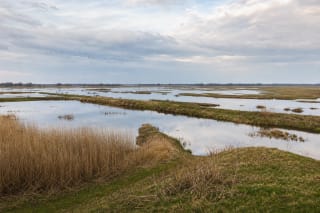
For visitors, Rambynas is one of the strongest landscape places of Lithuania Minor: from the hill you can see the lower Nemunas, the space of the Ragainė bend, flooded meadows, and the calm Bitėnai surroundings. But the hill matters not only for the view. Natural origin, sacred-site memory, the Skalvian castle tradition, and nineteenth- to twentieth-century cultural events overlap here.
Origin and formation of Rambynas Hill
VLE writes that Rambynas is a kame massif of the western branch of the Vilkyškiai ridge, formed about 14,000 years ago. Meltwater in glacier gaps laid down sandy deposits, and after the glacier melted they became a high relief form.
The hill's history is also a history of erosion. VLE states that 10,000-13,000 years ago the southern slope was eroded by a meltwater breakthrough formed near Ragainė, and later the Nemunas contributed to slope change: in 1835 the southern part slid down, and in 1878 the eastern slope did.
The sacred stone and sacred site of Rambynas
The Rambynas sacred site and sacred stone are mentioned by VLE from 1559. The stone may have been about 10 m in diameter and about 2.7 m high, with carved signs. In 1811 it was blown up, and its pieces reached local people, private collections, and museums.
Legends and customs linked with the stone give Rambynas its sacred-site layer. VLE mentions stories about treasures under the stone, laumės living on the hill, healing powers of water, and offerings such as small objects, money, and woven gifts. People could climb the hill only clean and in festive clothing, while fragments of the stone were kept at home in hope of protection from illness. This is not tourist decoration but part of local memory, worth reading respectfully.
VLE notes that a sacred Rambynas forest is mentioned from 1394, and that near the hill grew Laima's triple-trunk linden, about 600 years old. These elements show that sacredness at Rambynas was connected not only with one stone but with the whole hill and surrounding forest landscape.
Rambynas Hill, Ramigė Castle, and cultural events
VLE states that the northern-foot part of the hillfort hill survives, and that in 2002 an expedition led by V. Šimėnas excavated 150 sq. m but found no cultural layer. Nevertheless, it is believed that the Skalvian castle Ramigė stood at Rambynas and was destroyed by the Teutonic Order in 1276.
After the castle was abandoned, the hill began to be venerated. VLE also notes that cultural events have been held on Rambynas Hill since the nineteenth century, commemorative trees were planted, and song festivals organized. Rambynas therefore functions as a stage of Lithuania Minor cultural memory.
The strongest living Rambynas custom is Joninės, or Rasos. Since the nineteenth century, midsummer celebrations on Rambynas, with fires, songs, and wreaths, have become one of Lithuania's best-known Joninės festivals and a living continuation of the old sacred site. In late June, during the shortest night, the largest crowds gather here, making it the strongest but busiest time for Rambynas.
Rambynas Regional Park context
According to VLE, Rambynas Regional Park was established in 1992 and covers 4,811.6 ha. It protects the lower Nemunas landscape, oxbow lakes in the Ragainė bend, the Vilkyškiai moraine ridge, Rambynas Hill, and cultural heritage values.
For a practical route, combine Rambynas with Bitėnai, Martynas Jankus memory sites, the Šereiklaukis viewing tower, and the Vilkyškiai ridge landscape. If time is short, the viewpoint and a short walk are enough, but the region opens better when taken slowly.