- Place
- Klaipėda City Municipality
- Region
- Klaipėda
- Type
- active Orthodox church in a former municipal cemetery chapel
- Address
- 45 Liepų Street, Klaipėda
- Coordinates
- 55.71617, 21.14306
- Visit duration
- 25-40 minutes when the church is open; longer when attending a service
- Best time
- during the day or before a parish-announced service, without disturbing liturgical preparation
Klaipėdos Visų Rusijos Šventųjų cerkvė, Church of All Saints Who Shone Forth in the Russian Land, All Saints Orthodox Church on Liepų Street
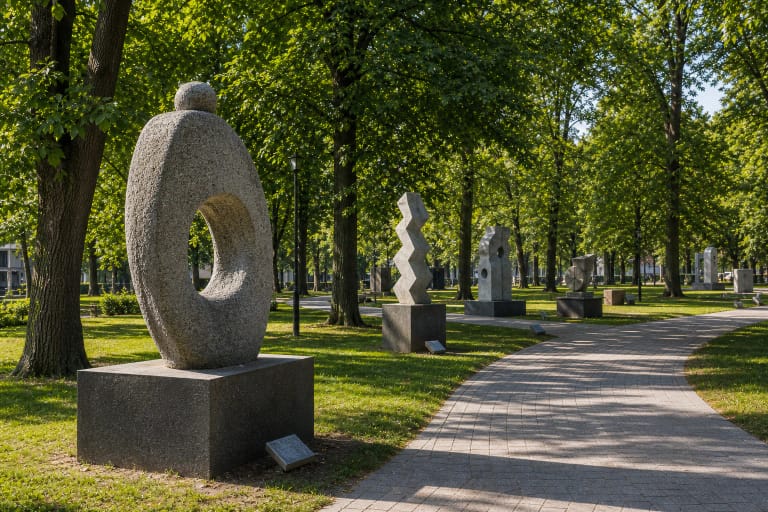
A cemetery chapel beside today's Sculpture Park
The church stands near the junction of Liepų and Trilapio streets, at the edge of Klaipėda's former municipal cemetery. The cemetery moved here in 1820 and became a richly planted burial ground for several Christian denominations in the second half of the nineteenth century. It was closed in 1977 and replaced by today's Sculpture Park, so the greenery around the church is not an ordinary churchyard.
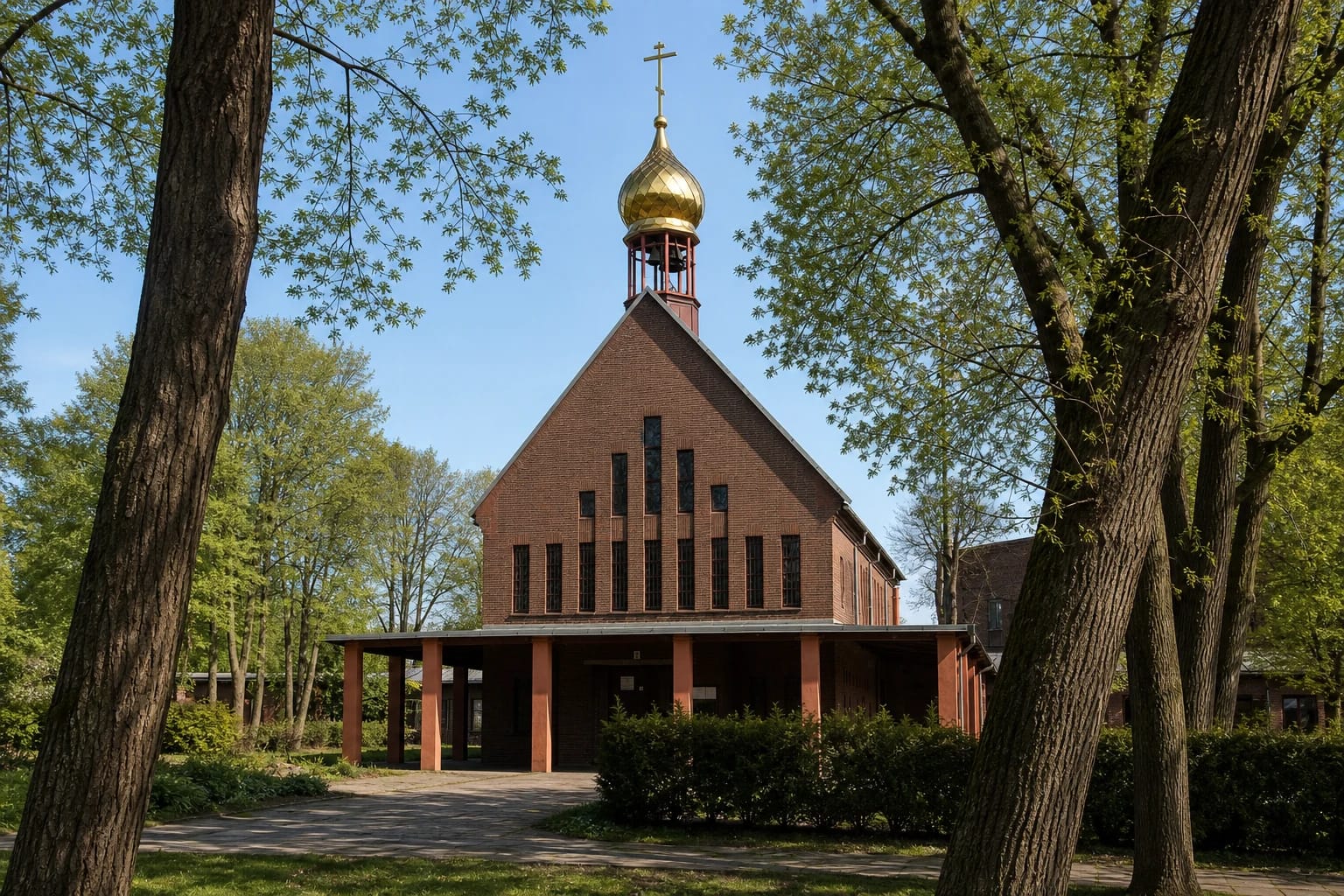
A modern clinker-brick cemetery chapel was built here in 1938-1939 to a design associated with the city's chief architect, Paulius Gizingas. A steep gabled roof, narrow vertical windows, and an original Neo-Gothic turret gave the building a Historicist character. A colonnaded shelter wrapped around three sides, while adjoining spaces served cremation and mortuary functions.
From grain store to Orthodox church in 1947
The chapel was used as a grain store in 1945. Klaipėda's population changed dramatically after the war, and its Orthodox community grew from only a few dozen people before the conflict to approximately one thousand. Worshippers petitioned for a church in 1945-1947, and the former Lutheran cemetery chapel was handed to them in December 1947.
The first Divine Liturgy in the adapted space took place on 28 December 1947. The former Neo-Gothic turret was later replaced by an open belfry carrying a small onion dome and Orthodox cross. An icon of All Russian Saints was consecrated on 31 October 1954, establishing the church's present dedication.
For a period, the building remained a shared worship space. Klaipėda's Lutherans gathered here in the afternoons after Orthodox services from 1952 until 1990. This layer matters: the present church is not a purpose-built Russian Revival sanctuary but a cemetery-complex building used by several of the city's communities.
The Liepāja iconostasis and its oldest icons
The principal interior object is the carved iconostasis brought from St Nicholas Naval Cathedral in Liepāja. An art-historical study published by the Lithuanian Orthodox Church in 2024 states that it was made at the Abrosimov workshop in St Petersburg in the early twentieth century and was probably designed in connection with the cathedral's architect, Vasily Kosyakov. Two horse-drawn carts carried it to Klaipėda in 1947.
The iconostasis from Liepāja's southern aisle was too narrow for the Klaipėda sanctuary, so matching side sections were added here. Not every icon now visible belongs to the original ensemble. Surviving works in the lower tier include Filipp Raylian's oil-on-canvas images of Aaron, Melchizedek, and angels of the Lord, while two present central icons are later works by Klaipėda artist Valerijus Osyšnas.
Wall painting behind a restrained exterior
From the park, the building remains restrained: reddish-brown clinker, a broad triangular gable, rows of vertical windows, and a low colonnaded porch still evoke its original cemetery-chapel purpose. Only the small golden onion dome and cross clearly signal its Orthodox identity, which helps distinguish it from the larger Church of the Protection of the Mother of God and St Nicholas on Smiltelės Street.
The interior creates a very different impression. Wall and ceiling paintings follow a Byzantine iconographic arrangement and were executed in 2007-2009 by Kaunas artist Olga Beita, with part of the work completed by Archpriest Vladimir Artamonov. The wider renewal also restored the iconostasis gilding and repaired the dome and ancillary rooms.
Services and respectful access
This is an active parish of the Lithuanian Orthodox Church, not a museum. A publicly announced episcopal Divine Liturgy took place here on 2 May 2026, but no stable all-day tourist opening schedule could be confirmed. Before making a special trip, check the parish's newest timetable or contact the community; opening times copied on older pages may be obsolete.
There is no admission ticket, and donations are voluntary. Enter quietly, remove men's hats, choose clothing covering shoulders and knees, do not walk in front of the iconostasis during worship, and never photograph people at prayer. Ask permission before photographing the interior or icons.
On 24 July 2026, the exact Google Maps listing, “Orthodox Church of All Russian Saints”, showed 4.8 out of 5 from 135 reviews. The coordinates 55.7161724, 21.1430574 identify the Liepų Street building beside Sculpture Park, not Klaipėda's other Orthodox or Old Believer churches.