- Place
- Kaunas City Municipality
- Region
- Kaunas
- Type
- interwar representative palace and army cultural-heritage site
- Address
- A. Mickevičiaus g. 19, Kaunas
- Coordinates
- 54.89682, 23.91694
Officers' Club, Kaunas Garrison Officers' Club, Representative Palace of the Lithuanian Officers' Club
A palace for officers and the state
The Lithuanian Officers' Club cannot be reduced to a handsome interwar facade. It is one of the most ceremonial late-interwar Lithuanian buildings, and AUTC stresses that the palace had to serve not only the officers' corporation but also the representative needs of the government.
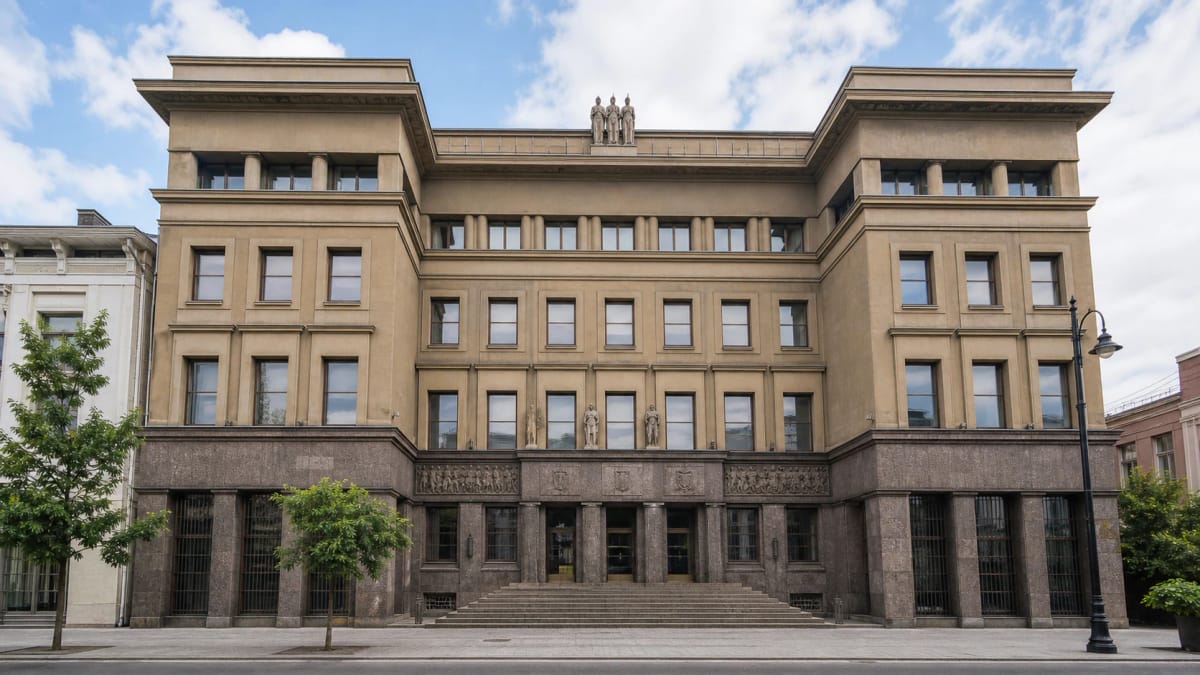
That explains the building's scale and tone. On A. Mickevičiaus Street, near Laisvės alėja, the facade speaks not in a commercial but in a ceremonial language: dark granite base, broad stair landing, representative portal, vertical rhythm of windows, and Bronius Pundzius' sculptural programme above.
What ramovė means
The Lithuanian Armed Forces history page explains that the Kaunas Garrison Soldiers' Club was established on July 23, 1919, and on April 30, 1924 an order of the Minister of National Defence renamed it the Lithuanian Officers' Ramovė. Jonas Jablonskis is identified as the author of the name.
The name matters because ramovė here meant more than a building. It was a centre for soldiers' culture, self-education, community, and representation. The official history stresses the aim of gathering military people, strengthening military and national spirit, and fostering science, education, and sport.
Project, competition, and construction
AUTC states that the idea of the palace formed in 1930, and that more than 30 proposals were submitted to the 1931 international competition. First prize went to Estonian architects Elmar Lohk and Herbert Johanson, but their work became a basis for ideas rather than the final project.
Design work then passed to Vladimiras Dubeneckis with Stasys Kudokas and Jonas Kriščiukaitis; after Dubeneckis' death, Mykolas Songaila, Kazys Kriščiukaitis, and others contributed. The Lithuanian Armed Forces history page says the practical project and construction supervision were carried out by Stasys Kudokas, with help from K. Kriščiukaitis and structural engineer Anatolijus Rozenbliumas. Construction began in October 1935, and the palace was formally opened on April 23, 1937.
The facade and the Three Giants
AUTC defines the building's style as modernized historicism and national style. This is visible on the facade: it is not pure functionalism, but neither is it a copy of historical forms. The lower part is clad in dressed Lithuanian granite, and the first-floor window grilles were understood not only as protection but also as an aesthetic device strengthening the base.
The main accent is Bronius Pundzius' Three Giants on the attic. The Lithuanian Armed Forces symbolism page describes them as 2.5 m-high granite warriors dated 1937. The same source stresses that during the Soviet period, their raised shields with the Columns of Gediminas recalled the idea of independent Lithuania.
Vilnius, Kaunas, and Klaipėda above the portal
Above the central entrance are three reliefs with the coats of arms of Vilnius, Kaunas, and Klaipėda. The Lithuanian Armed Forces symbolism page quotes interwar press explaining that these coats of arms, set in a military background, were meant to show that the palace's owners guarded Lithuania's territorial borders and did not rest regarding Vilnius.
This symbolic layer matters especially because the palace was built in the temporary capital while Vilnius was occupied. The facade is therefore not merely decorative; it is a text in stone about political geography, state aspirations, and officers' self-understanding.
The second floor is the main experience
AUTC says the interior, especially the second representative floor, leaves the strongest impression. This is where the most important rooms are concentrated: Vytautas Hall or seklyčia, the Presidential Room, the Small Hall, the Great Hall, and the winter garden-orangerie.
These spaces are the reason to follow events or seek an arranged visit. From outside, the building's state representation is readable, but inside a mixture of furniture, wood, metal inlays, textile patterns, historical styles, and modern technology makes the Officers' Club one of Lithuania's most interesting interwar interior sites.
Presidential Room and Vytautas Hall
The Presidential Room was designed as a representative space with a Lithuanian character. AUTC mentions oak, Caucasian walnut veneer, juniper inlays, stylized tulip and fir-tree motifs, metal inlay, and oak parquet laid according to a Lithuanian textile pattern. Even furniture designs generated professional debate, so the room is valuable not only as decoration but as a document of design history.
The idea of Vytautas Hall arose in 1930, during the commemoration of Vytautas the Great's death anniversary. AUTC writes that a Gothic style was chosen for it and that its designer Jonas Kovalskis even travelled to see Marienburg and Arensburg castles as well as Lithuanian Gothic examples. The room shows how the interwar period created its own scenography of historical memory.
From occupations to restoration
The Lithuanian Armed Forces history page describes the fate of the Club as dramatic. During the first Soviet occupation it was taken from Lithuanian officers; during the German occupation its activity was restricted; during the second Soviet occupation the building housed a military hospital and later the Soviet Army Officers' House.
The same source states that symbols of statehood were destroyed, wall painting was painted over, and reliefs and stained glass disappeared. Restoration began during the Sąjūdis years. In 1992 the building was taken over by Lithuanian military personnel, and in 2020 the historic name Lithuanian Officers' Ramovė was restored.
How to visit today
Today this is not a standard museum with regular ticket-office hours. It is a cultural and representative space of the Lithuanian Armed Forces, hosting events, commemorations, and military-community activities. Do not plan a spontaneous interior visit as if it were always open.
The most reliable option is to view the facade from A. Mickevičiaus Street, and for the interior look for public events, tours, or arrange a visit directly with the Ramovė. If you do get inside, prioritize the second floor: Vytautas Hall, the Presidential Room, the Great Hall, and the winter garden.