- Place
- Druskininkai Municipality
- Region
- Druskininkai
- Type
- landscape reserve and suffosion valley
- Address
- Švendubrė surroundings, Druskininkai Municipality
- Coordinates
- 53.96600, 23.96300
Raigardas, Raigardas Landscape Reserve
A broad valley near Druskininkai
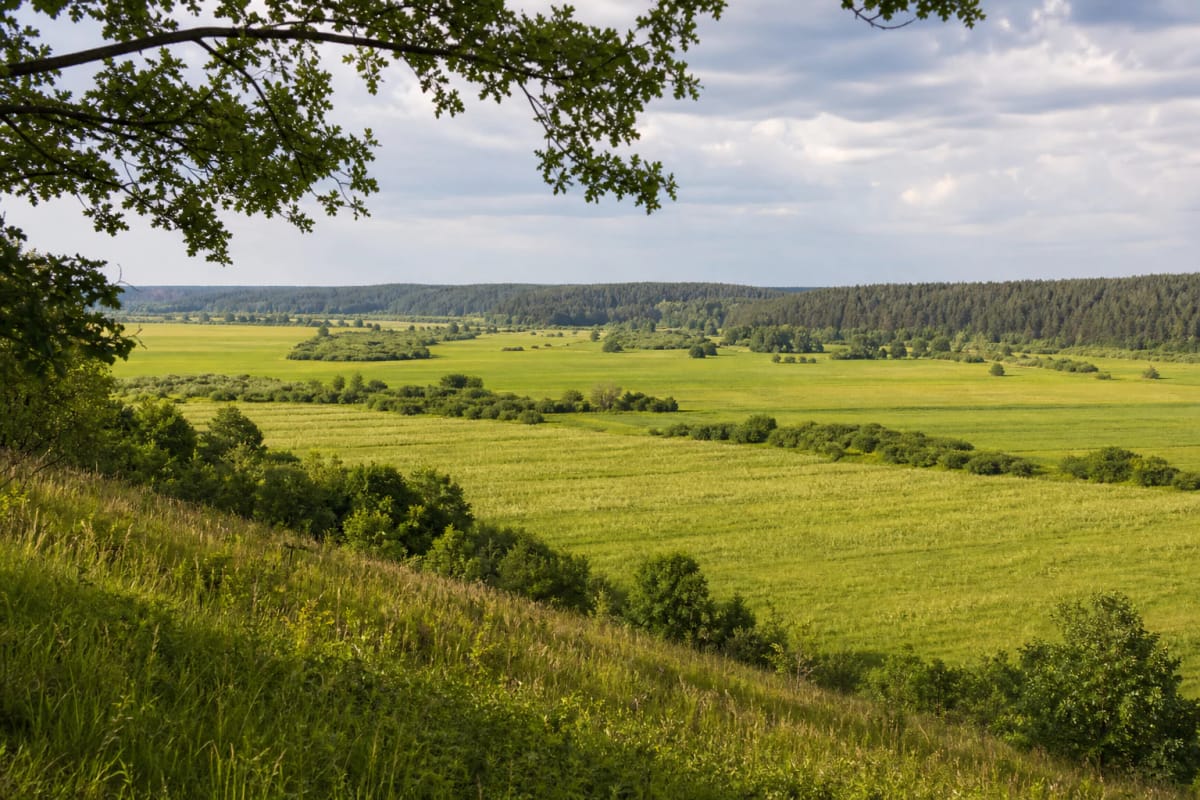
Raigardas Valley lies about 5 km south of Druskininkai, in the surroundings of Švendubrė and Pryvalka. It is not a single viewpoint but a broad landscape, best seen from the higher slopes near Švendubrė.
VLE gives Raigardas Valley an area of about 1,400 ha, a length of about 5 km, and a width of up to 4 km. From above, the valley looks calm and agricultural, but its form tells a story of complex geological processes.
Lithuania's largest suffosion cirque
Saugoma.lt describes Raigardas Landscape Reserve as a territory created to preserve Lithuania's largest suffosion cirque. The reserve was established in 1960, and its area is given as 1,122 ha.
Suffosion generally means that underground or surface water washes out fine particles, while slopes gradually move and reshape the relief. VLE also explains the origin of Raigardas: the valley formed as a bend of the Nemunas shifted to the right; after the river cut a straighter channel, the bend became an oxbow, and springs from the sandy right slope made the ground slide down, forming a huge suffosion-landslide cirque. Raigardas is therefore not a steep rocky abyss, but a broad hollow with fields, slopes, and marshy parts.
Memory of a Nemunas bend
Raigardas Valley is tied to changes in the Nemunas landscape. Sources describe its development as connected with a shifting Nemunas bend, springs, and slope movement.
For that reason, when visiting Raigardas, do not look for only one sharp object. The key thing here is scale: from the upper slope you see fields, wetlands, gullies, and distant forest lines that together explain why the place is protected as a landscape.
Raigardas Marsh and the living valley floor
VLE notes that the eastern and south-eastern edge of the valley is occupied by Raigardas Marsh, about 426 ha in area. This is an important part of the landscape because the valley is not only a panorama of dry fields.
Wet places, springs, and lower areas remind visitors that water is still active here. After rain or in spring, some places may be wet, so the best visitor choice is to view the valley from convenient viewpoints and roadside stops rather than trying to cross it anywhere.
Čiurlionis and the layer of legends
Raigardas has a strong cultural shadow. VLE states that M. K. Čiurlionis immortalized Raigardas in the tempera triptych Raigardas, painted in 1907. The valley is therefore often understood not only as a natural form but also as an image that entered Lithuanian art memory.
The place is also surrounded by legends about a sunken city. These stories should be treated as a cultural part of the valley, while the geological explanation and protected-area status are what precisely explain the real uniqueness of Raigardas.
How to visit Raigardas Valley
Raigardas Valley is best for a short stop or a slow walk in the surroundings of Švendubrė. It is not a classic boardwalk with one obvious route, so before driving there, mark the reserve coordinates and choose a safe stop for the panorama.
The valley is at its most beautiful when the field strips are visible: in early summer as grain ripens, or in autumn. Early morning and evening give softer light, while midday is useful for reading the relief clearly.