- Place
- Kėdainiai District Municipality
- Region
- Central Lithuania
- Type
- botanical natural-heritage object and cultural memory tree
- Address
- Kosmonautų g., Babėnai, Kėdainiai
- Coordinates
- 55.32392, 23.97693
- Visit duration
- 15-35 minutes; about 1-2 hours with the Babėnai Forest route
- Best time
- May-June after leafing or early October when the crown's scale is clearest
Daukša Oak, Mikalojus Daukša Oak in Babėnai
A 5.4-metre-girth oak in Babėnai
Official Kėdainiai sources give the trunk circumference as 5.4 metres, diameter as 1.70 metres, and height as 23 metres. It is regarded as the oldest oak in the city and designated as a botanical natural-heritage object.
Walk around it on the established path to understand the scale from several sides. The broad crown changes with the season, while winter exposes the structure of old branches. Keep out of compacted root areas wherever signs or paths ask visitors to stand back.
The story that Daukša planted the tree
Local tradition says that Mikalojus Daukša planted the oak in his native Babėnai. It must be presented as a story: no published dendrochronological study confirms an exact planting date or Daukša's personal action.
The place association remains sound. The Universal Lithuanian Encyclopedia states that Daukša was born in Babėnai, now part of Kėdainiai, sometime between 1527 and 1538. The oak therefore works as a living marker of birthplace and written culture.
Why Mikalojus Daukša matters to Lithuanian
Daukša was a Catholic priest, humanist, and one of the creators of Lithuanian writing. His 1595 translated Catechism was the first surviving Lithuanian-language book printed within the Grand Duchy of Lithuania.
His most important work was Postilla catholicka, published in 1599. In its Polish-language Preface to the Benevolent Reader, he celebrated the native language and connected it with national unity, survival, and political autonomy. The oak has therefore become a symbol of linguistic continuity, not only of one person.
Do not confuse it with the Daukša Oak in Betygala
Another oak bearing Mikalojus Daukša's name stands in Betygala, Raseiniai District. It grows by the Vieviršė stream and is associated with the years 1592-1600, when Daukša served as priest in Betygala.
This page concerns the Babėnai tree in Kėdainiai, officially measured at 5.4 metres around and 23 metres high. Select Babėnai and the specific Google Maps place ID when navigating.
Adding the oak to a Kėdainiai route
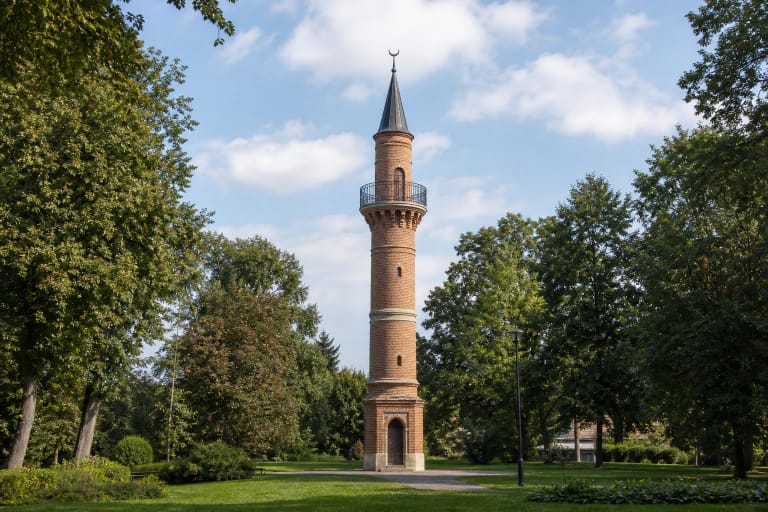
A municipality cycle route runs from the oak through the Babėnai recreational forest path, Kėdainiai Minaret, and the former manor park into the old town. Its published length is about seven kilometres excluding park paths.
The oak is free to visit and has no opening hours, but daylight is best. Do not climb it, attach objects, strip bark, or lean bicycles against the trunk. After rain, avoid widening muddy paths through the root zone.