- Place
- Mažeikiai, Mažeikiai District Municipality
- Region
- Samogitia
- Type
- a single-towered masonry church from 1936 and a separate concrete memorial cross erected at the edge of Old Town Park in 1926
- Address
- 18 J. Basanavičiaus Street and 34 Birutės Street, Mažeikiai
- Coordinates
- 56.31479, 22.34841
- Visit duration
- 35-60 minutes for the exteriors of both sites; longer if the church is open, worship is under way, or you wish to view the interior quietly
- Best time
- a bright day for both exteriors; for the interior, visit before or after a service whose time you have confirmed, without disturbing the liturgy
Mažeikiai Church of the Most Sacred Heart of Jesus, Mažeikiai old church, St Francis of Assisi (Martyrs') Cross of Mažeikiai Burgomaster Jonas Motuzas, Martyrs' Cross in Mažeikiai, Mažeikių Švč. Jėzaus Širdies bažnyčia ir Asyžiečio kankinių kryžius
These are two sites at different addresses, and the map pin marks the Martyrs' Cross
This is not a single churchyard containing both monuments. The Church of the Most Sacred Heart of Jesus stands at 18 J. Basanavičiaus Street, at 56.314491, 22.347162. The Martyrs' Cross occupies a separate plot at 34 Birutės Street, on the southwestern edge of Old Town Park by the junction of Birutės and Mindaugo streets, at 56.314788, 22.348407. This page's map pin deliberately identifies the smaller, easier-to-miss cross.
The two points are about 85 m apart as the crow flies, making them a natural pair on a 35-60 minute walk. Remain on public paths and follow current road or works signs. The cross is beside the park, not at the newer Church of St Francis of Assisi elsewhere in Mažeikiai.
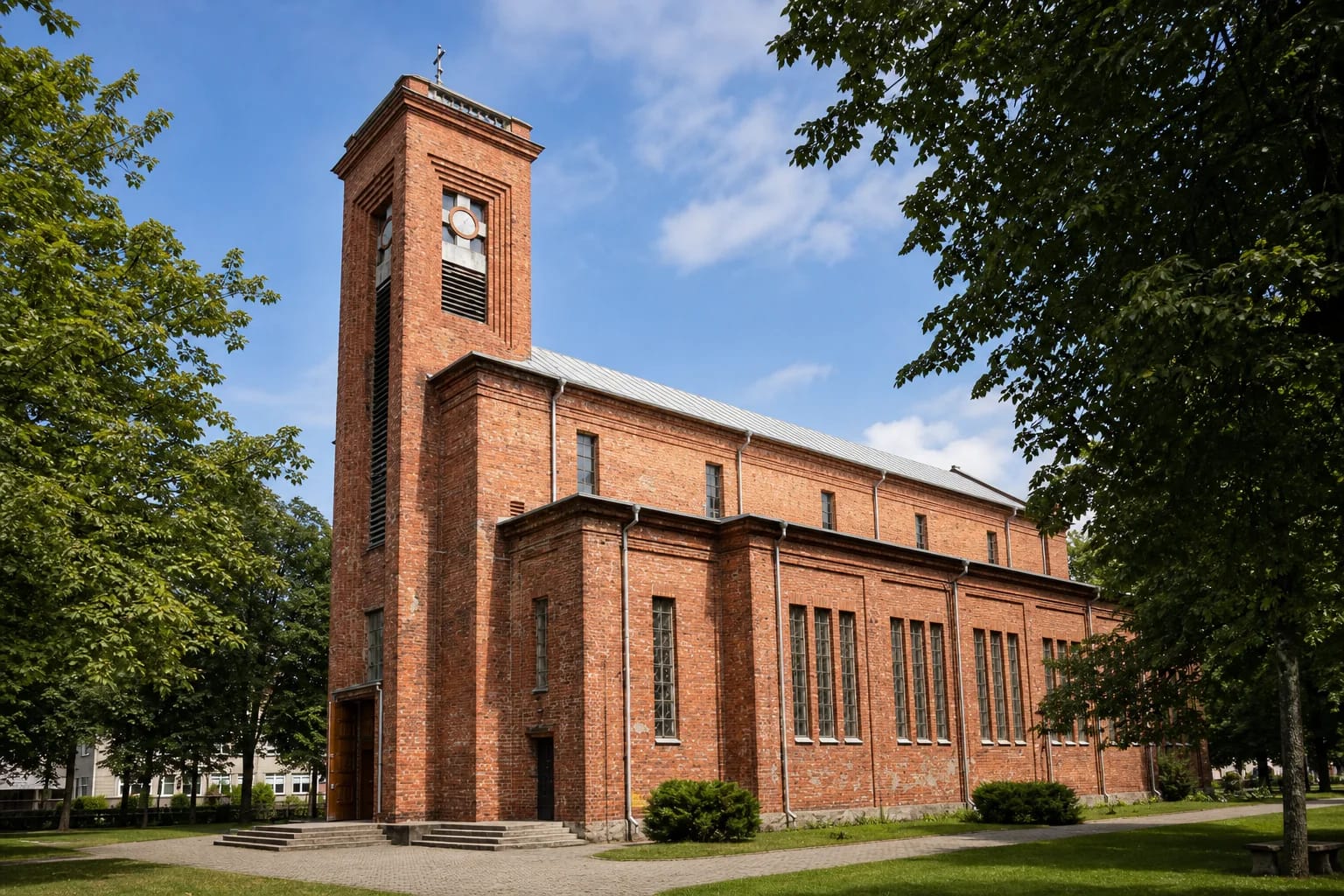
The church built in 1930-1936 combines modernism with classical order
As Mažeikiai grew, its old timber church could no longer hold the parish. A municipal publication dates the beginning of work on the present masonry sanctuary to 1930 and associates its design with Vytautas Landsbergis-Žemkalnis. Canon Stanislovas Budvytis directed construction, and the church was blessed on 2 August 1936.
The Diocese of Telšiai calls the building Neoclassical, while the town's heritage interpretation emphasises its mixture of interwar modernism and classical forms. Both descriptions illuminate the same restrained massing: a single high rectangular tower without a spire, long red-brick walls, rhythmic tall windows, stepped cornices, and a shallow light-metal roof.
Near the top of the tower, a pale circular, clock-like feature sits above a dark louvred opening. With neither twin towers nor a Gothic steeple, the building is recognised by one simple vertical element set against the nave's long horizontal volume.
War damage and post-war work created several distinct layers inside
Artist Rimtas Kalpokas decorated the church in 1943, but it was badly damaged by war in 1944. Mažeikiai municipality's heritage material notes shrapnel scars still visible on the façades, while worship resumed in the repaired building in May 1948. The interior was restored in 2015 with the aim of recovering its appearance before 1944, so what visitors see is not an untouched layer from 1936.
The diocesan account lists three altars: the central altar of the Holy Cross, Our Lady's altar to the left, and St Anthony of Padua's to the right. The municipality's publication also highlights a 3.4 m statue of the Sacred Heart of Jesus made by Kazimieras Švažas and installed in the principal composition in 1958 to a concept by architect Aloyzas Vilimas. A Pietà sculpture entered in the Register of Cultural Property is also kept in the church.
Take time over the interior only when the doors are open and no ceremony would be disrupted by visitors moving around. Follow parish rules when photographing, never photograph people without consent, and avoid flash around works of art.
The cross's 1926 inscription honours St Francis, while 'Martyrs' describes the place of memory
KVR records the object as the St Francis of Assisi (Martyrs') Cross of Mažeikiai Burgomaster Jonas Motuzas. It is a massive Latin-form concrete cross assembled from a rectangular pedestal, base, square-section shaft, and thick arms. The inscription on its southwest face reads, in translation, 'In memory of the 700th anniversary of St Francis of Assisi, 1226-1926.' The seven centuries therefore refer to the saint's death, not to the age of executions at this location.
The site's history explains the name Martyrs' Cross. KVR documentation states that during the First World War, people punished by the German occupation authorities were executed here, and that Bolsheviks later shot people at the same location. Burgomaster Jonas Motuzas sought a cross commemorating those victims. Parish priest Juozapas Dabužinskas agreed to support it on condition that the monument be dedicated to the 700th anniversary of St Francis's death. An official jubilee inscription and a local name of remembrance consequently coexist on one monument.
In its broader history of Mažeikiai, VLE states that German forces shot about sixty people near the town, but the KVR entry for the cross gives neither an exact victim count for this site nor a list of names. A separate story tells of a Soviet attempt to remove the cross in 1960 that came to a halt; KVR does not corroborate that episode with an incident record, so it should be presented as local memory rather than established documentary fact.
KVR code 2364 protects both the cross's physical form and memorial meaning
The cross entered the Register of Cultural Property on 17 August 1992 and carries KVR code 2364. It is a heritage object of local significance, valued for artistic and memorial qualities. Protection covers more than the general idea of a cross: its massive concrete construction, proportions, pedestal, and inscription are identified as valuable characteristics.
A Mažeikiai Old Town heritage-access project launched by the municipality in May 2025 and scheduled through November 2028 includes the setting of this cross. Visitor information, wayfinding, and improvements to the surrounding access are planned, but inclusion in the project does not mean every measure is already complete. In 2026, visitors should allow for temporary changes to paths or access and follow signs on site.
The most reliable way to find the church open is to plan around a confirmed Mass time
On 20 July 2026, the official diocesan parish page listed Sunday Mass at 8:00, 10:00, 11:30, and 17:00, weekday Mass at 17:00 and 18:00, and Saturday Mass at 17:00 and 18:00; the Saturday morning time was described as variable. Confessions were heard half an hour before Mass and also during Sunday services. Feasts and parish decisions can alter the timetable, so recheck the official page before setting out.
The church is not a museum with fixed visitor hours and a permanent ticket desk. No compulsory visitor admission is published, but the door may be locked outside services; groups or anyone travelling specifically to see the interior should contact the parish in advance. The outdoor cross has no admission fee, but visitors must respect barriers and avoid interfering with works.
No detailed official step-free access audit has been published for the pair. Steps are present at the church, while path conditions and entrance arrangements may change; accessibility around the cross remains part of the current project. Park only where signs presently permit, keep church entrances clear, and never assume that an access measure shown in a project plan has already been delivered.