- Place
- Mažeikiai District Municipality
- Region
- Samogitia
- Type
- Restored manor estate, museum, and park
- Address
- Dvaro g. 2, Renavas village, Seda eldership, Mažeikiai District
- Coordinates
- 56.28050, 22.11790
Renavo dvaras, Renavas Manor estate, Gaurai Manor, Gaurė
Renavas Manor: late Classicist residence by the Varduva
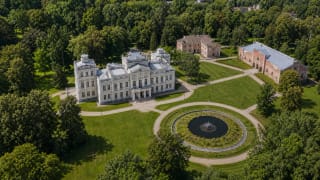
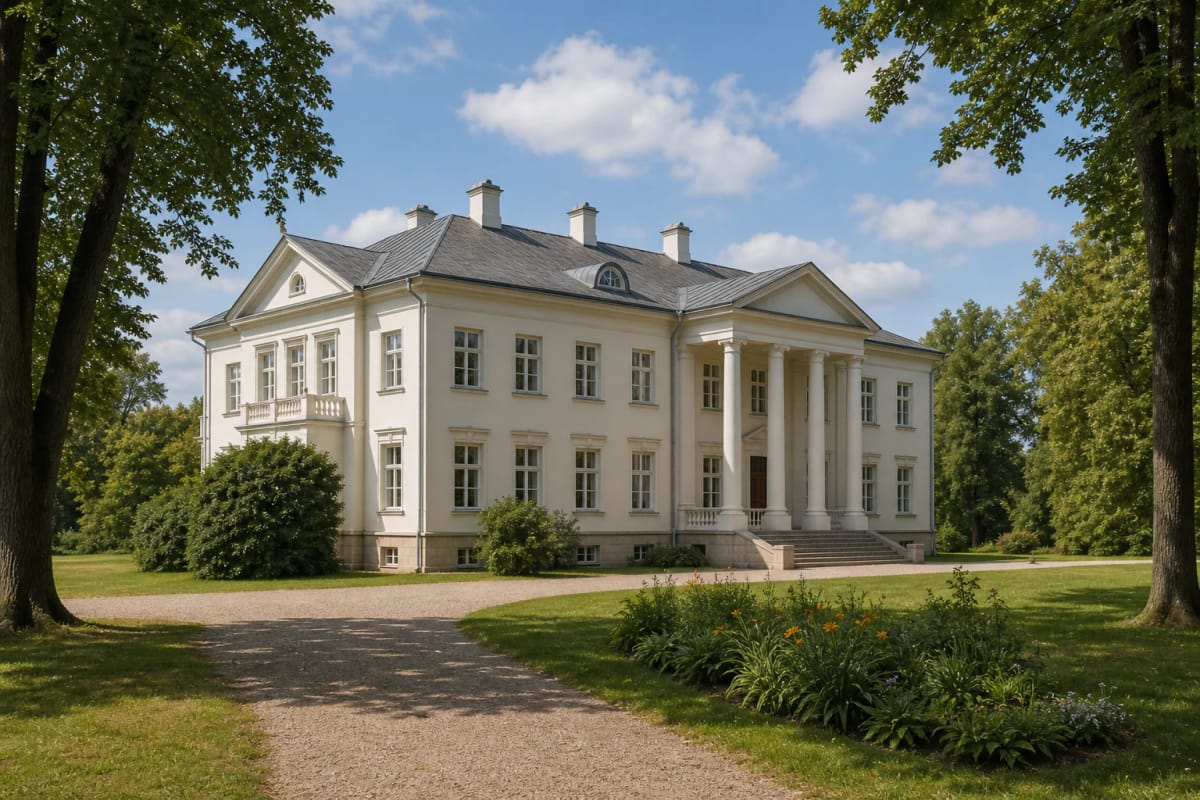
Renavas Manor is one of the most valuable manors in north-western Samogitia: a late Classicist brick palace with slight Neo-Renaissance elements, authentic nineteenth-century interiors, and a large historic park in a bend of the Varduva River. It is a quiet but well-documented place for seeing manor culture beyond the main coastal routes.
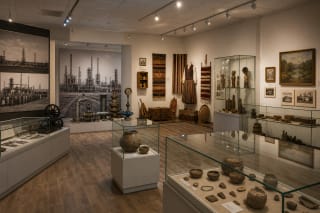
The manor stands in Renavas village, Seda eldership, about 9 km north of Seda. The palace long housed a Mažeikiai Museum branch; since January 2, 2014, Renavas Manor has been an independent Mažeikiai District municipal institution with a permanent manor-interior exhibition, temporary exhibitions, and educational activities.
From Gaurai Manor to Renavas: names and owners
The older name of Renavas was Gaurė, also recorded as Gaurai and Gaureliai. The oldest document mentioning Gaurai Manor is an inventory dated December 26, 1589, when the manor house was wooden and roofed with thatch. Over the centuries it was owned or leased by many families, including the Burbas, Puzinas, Gorskis, Tiškevičiai, and others.
In the early eighteenth century the barons Rönne, of German or Germanised French origin and known in Courland from the fifteenth century, established themselves here. Karl Ernst Rönne married Lithuanian noblewoman Elena Bilevičiūtė and received Gaurai as part of her dowry. After Mikalojus Antanas Rönne turned the manor into a central estate in 1753, it began to flourish; from 1780 the place was called Renavas after the owners' surname.
From the late nineteenth century until nationalisation in 1940, the manor belonged to the Melžinskiai (Mielżyński) counts, who inherited it through the female line of the Rönne family. In 1940 the estate was nationalised, and its archive, moved to Telšiai, burned in the first days of the Second World War, so part of the manor's history is known only from scattered surviving sources.
Classicist palace and authentic interior
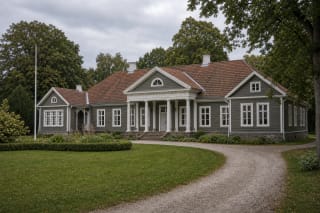
The present brick palace ensemble is classed as late Classicist. According to the official manor history, Baron Antanas Rönne (1794-1877) built it in 1830-1833; VLE associates the start of construction with around 1815 and major expansion with an 1880 reconstruction. The palace is single-storey, with a central portico, mezzanine, and two side risalits; the metal porch bears the date 1880 and the letters FR, for Feliksas Rönne.
Inside, late nineteenth-century decorative painting, mouldings, ornamented tile fireplaces, and stoves survive: rare authentic details of manor decoration. Today the palace contains a long-term exhibition of representative nineteenth- and early twentieth-century Lithuanian manor interiors, renewed in 2021, with furniture, paintings, and decorative details.
Renavas Manor, Laurynas Ivinskis, and the Narutavičius brothers
Renavas also matters for Lithuanian statehood history. Baron Antanas Rönne supported the widow Viktorija Narutavičienė and her sons, and in 1868-1871 hired Laurynas Ivinskis (1810-1881), publisher of the first Lithuanian calendars, naturalist, and linguist, to teach them.
Both of Ivinskis' pupils became major historical figures: Stanislovas Narutavičius (1862-1932) signed Lithuania's Act of Independence of February 16, 1918, while his brother Gabrielius Narutavičius (1865-1922) became the first president of Poland. This link makes Renavas a memorial place for the histories of two states, not only a manor-culture site.
Renavas Manor park and natural monuments
The manor park is an important part of the visit: a mixed-plan landscape with rolling relief, winding paths, avenues, and ponds in a bend of the Varduva. In the nineteenth century Baron Antanas Rönne developed an English-style park of about 18 ha, and 1839 statistics named it the best park in Telšiai County. At the time the manor was even known for silk production, with mulberry trees and silkworms.
Two natural monuments grow in the park: Storoji eglė, the Thick Spruce, and Daugiavaikė liepa, the Prolific Linden. In spring and summer the park offers a green slow route; in autumn it gives colour, and in winter the structure of the trees and their relationship to the buildings is easier to read.
From nationalisation to today's museum
After the Second World War, the estate housed a collective-farm office, warehouses, a library, and a cultural centre. From 1970 the Monument Restoration Institute began research; the palace was first restored in 1985, and in 1996 a museum exhibition opened here as a branch of Mažeikiai Museum.
In 2012 the palace facade and interior rooms were restored; in 2016-2018 the only surviving wooden nineteenth-century manor service wing was repaired; in 2020-2021 the manor garden cellar was adapted for bat hibernation. The estate has gradually returned as an integrated heritage, culture, and nature complex.
How to visit Renavas Manor
Allow 1-2 hours for Renavas Manor: a short visit covers the palace exhibition and park, while exhibitions, educational activities, or events extend the time. The park is open and freely accessible, so it can be walked even when the palace is closed.
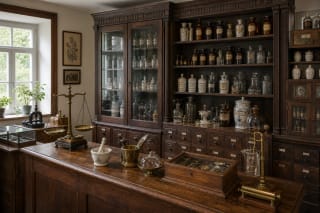
Before travelling, check current opening hours, ticket prices, and events on the official Renavas Manor website, as they vary by season. In Mažeikiai District, the manor combines well with Mažeikiai Museum, Viekšniai Pharmacy Museum, or other Samogitian manors.