- Place
- Klaipėda City Municipality
- Region
- Klaipėda
- Type
- miniature bronze-and-granite public sculpture installed in 2006 with a wish ritual devised by its artists
- Address
- 5 Kepėjų Street at Mėsininkų Street, Klaipėda
- Coordinates
- 55.70851, 21.13237
- Visit duration
- 10-20 minutes; 45-90 minutes when combined with other miniature sculptures in Klaipėda Old Town
- Best time
- in daylight, when the 17 cm figure and its bronze inscription are easy to see; after snow or in darkness it is remarkably easy to miss
Stebuklingasis peliukas, Stebuklingas peliukas, Old Town Mouse
Where to look so that you do not walk straight past
The Magical Mouse occupies a small planted square opposite the setting of the old-town jazz club Kurpiai. Klaipėda City Municipality's public-art inventory locates it in the public space at 5 Kepėjų Street and Mėsininkų Street, while the Ieva Simonaitytė Public Library guide gives 55.708510, 21.132374. Visitor descriptions often say the junction of Kurpių and Kepėjų streets. Both directions lead toward the same small square, but 5 Kepėjų Street is the most precise search point.
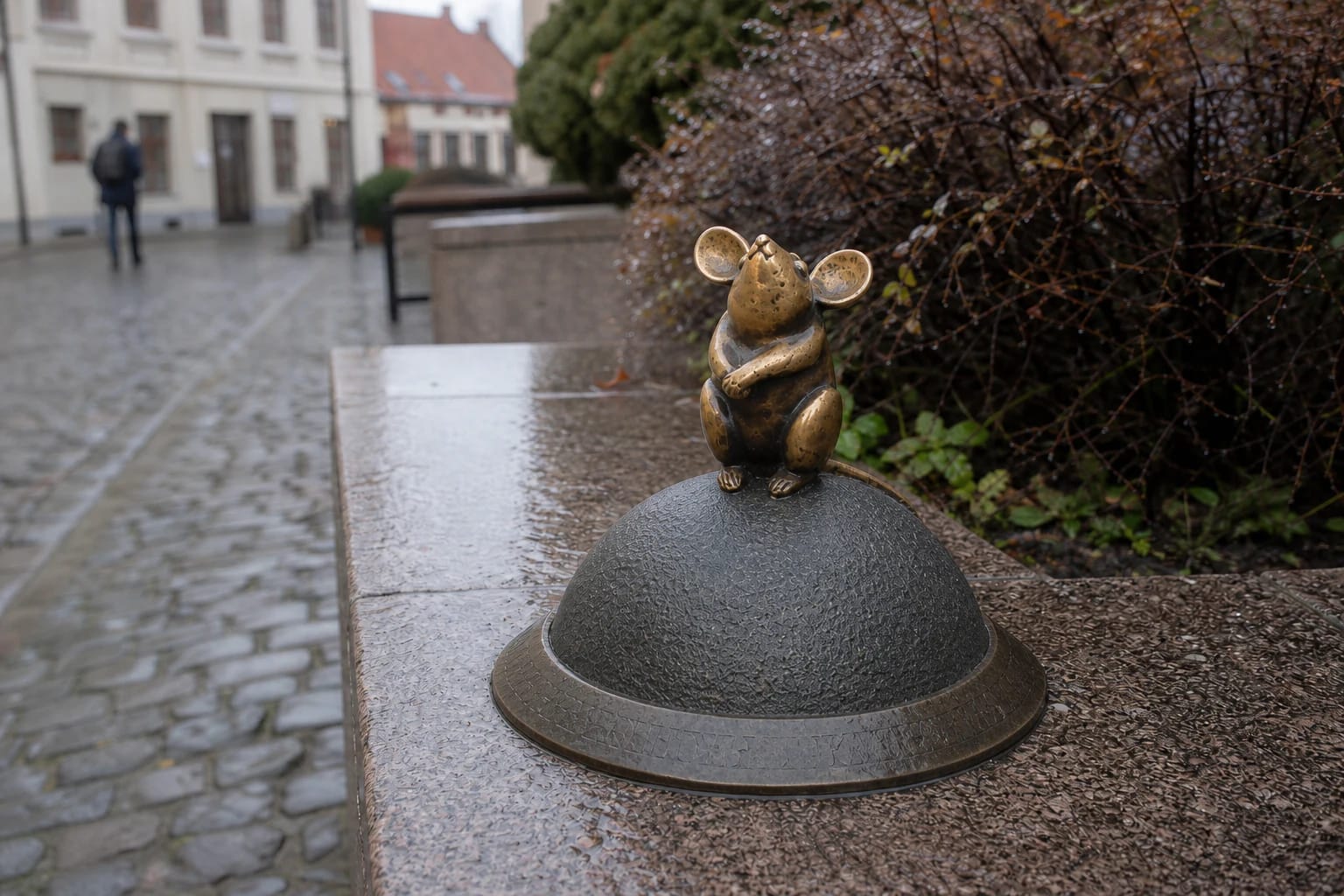
Do not look for the Mouse at adult eye level or in the middle of a plaza. It sits on a granite hemisphere built into a low stone border around the planting bed. The bronze figure itself is only about 17 cm high. The roughly 30 cm measurement found in some descriptions refers more broadly to the bronze-and-stone composition, not only to the animal.
Its scale makes daylight the best time to visit. Snow can hide the granite base and inscription, while at night the bronze merges with the dark shrubs behind it. If your map says that you have arrived, scan the edge of the planted square for a rounded dome of dark granite.
Enormous ears, an upturned snout, and a sentence around the stone
The bronze Mouse is stylised as a proud animal seated upright on its hind legs. Its head points upward, its forepaws meet in front of its body, and its round ears are deliberately oversized. The library account connects their shape with the ritual: the Mouse must be able to hear the visitor's words clearly.
The figure stands on a rough, dark-grey granite hemisphere. A bronze band around its base bears 'Mintis paversk žodžiais - žodžiai taps stebuklais', meaning 'Turn thoughts into words - words will become miracles.' This is not a separate information plaque. The sentence is part of the sculptural composition and asks the passer-by to speak rather than merely look.
The frequently touched ears, snout, and rounded body have become lighter than the surrounding bronze. That shine records a living relationship with the work, but the Mouse's ears, tail, and inscribed band are also fragile. Leaning close to whisper is enough; there is no need to climb onto the base or pull at the sculpture.
A Christmas gift in 2006 prompted by the nearby Cat
Architect Vytautas Paulionis proposed the Magical Mouse, and sculptors Svajūnas Jurkus and Sergejus Plotnikovas turned the idea into bronze. In an early December 2006 preview, the artists explained that Regimantas Midvikis's Cat with the Face of a Gentleman had returned to the old town earlier that summer, so it now needed a mouse nearby. This was a playful explanation for a new artwork, not a historical city legend.
The artists developed three designs over about six weeks. One gave the Mouse a cloak and wizard's hat, but they rejected the costume because it made the work look too much like a seasonal Christmas decoration. The final unclothed, stylised animal was meant to become a permanent old-town resident in its own right.
Jurkus and Plotnikovas funded the sculpture themselves as a gift to Klaipėda, and the municipality's Culture Division approved its placement. The theatrical unveiling was scheduled for 5 pm on 21 December 2006, immediately before Christmas. Migrated archive timestamps sometimes create the impression that it appeared in 2008, but the conception, production, and original installation are documented in 2006.
How the wish ritual works, and where documentation ends
The artists' rule is simple: think of a good wish, bend toward the Mouse's large ear, say it quietly, and believe. The library description emphasises the good intention and words whispered into the ear. Accounts of the unveiling and later visitor practice sometimes add that you should rub the ear, but touching it is not the only or essential version of the ritual.
Its status should be described accurately. There is no evidence that this is an old Memel legend, an ethnographic belief, or a folk custom that predates the sculpture. The artists gave their work its magical role in 2006, and repeated visitor participation transformed that concept into a living contemporary urban legend.
The inscription explains why whispering matters: a thought must first become words. Even without believing in literal wish fulfilment, this is a clear piece of interactive public art. A passer-by pauses, formulates a hope, and becomes part of the artwork's action.
A small artwork that has survived damage and restoration
Miniature scale and direct physical contact have come at a cost. Period press documented an episode in which the figure was torn from its mount, its tail, ear, and snout were broken, and the artists restored and returned it. A later incident damaged part of the bronze inscription band around the base.
By 2011, reports stated that the municipality had taken ownership of the sculpture, allowing city funding to be allocated to its restoration. The important point is not a catalogue of vandalism, but a change in status: a privately financed gift from two artists became a public object maintained by the city.
The present polished surface does not mean that the bronze was cast in one bright colour. Patina and worn highlights change with weather, maintenance, and thousands of hands. A strong photograph shows both layers: the darker aged bronze and the lighter places repeatedly touched by visitors.
A free sculpture-route stop and the separate Little Mouse
The Magical Mouse stands in an open public space, so there is no admission ticket or gate schedule. Ten to twenty minutes is enough for this stop, but the work makes more sense in a route through Klaipėda's small old-town sculptures. Continue toward the Cat with the Face of a Gentleman, the Dragon, the Chimney Sweep, the Black Ghost, the Danė quays, and Theatre Square.
In 2025, the library documented a different new object called Stebuklinga pelytė, the Magical Little Mouse, at 2T Kurpių Street. It is mounted high on the ends of two pipes projecting from a wall and holds a magic wand; no authorship has been officially published. It is not the relocated or replaced 2006 Mouse, but a separate symbolic detail extending its story.
Reaching the original Mouse does not require steps or a ticket, but the square includes stone surfaces, kerbs, and uneven old-town paving. No detailed official accessibility audit is published, and the inscription sits low around the base, which can make it difficult to read from a wheelchair or without bending. The sculpture can still be viewed from the path without entering the planting bed.