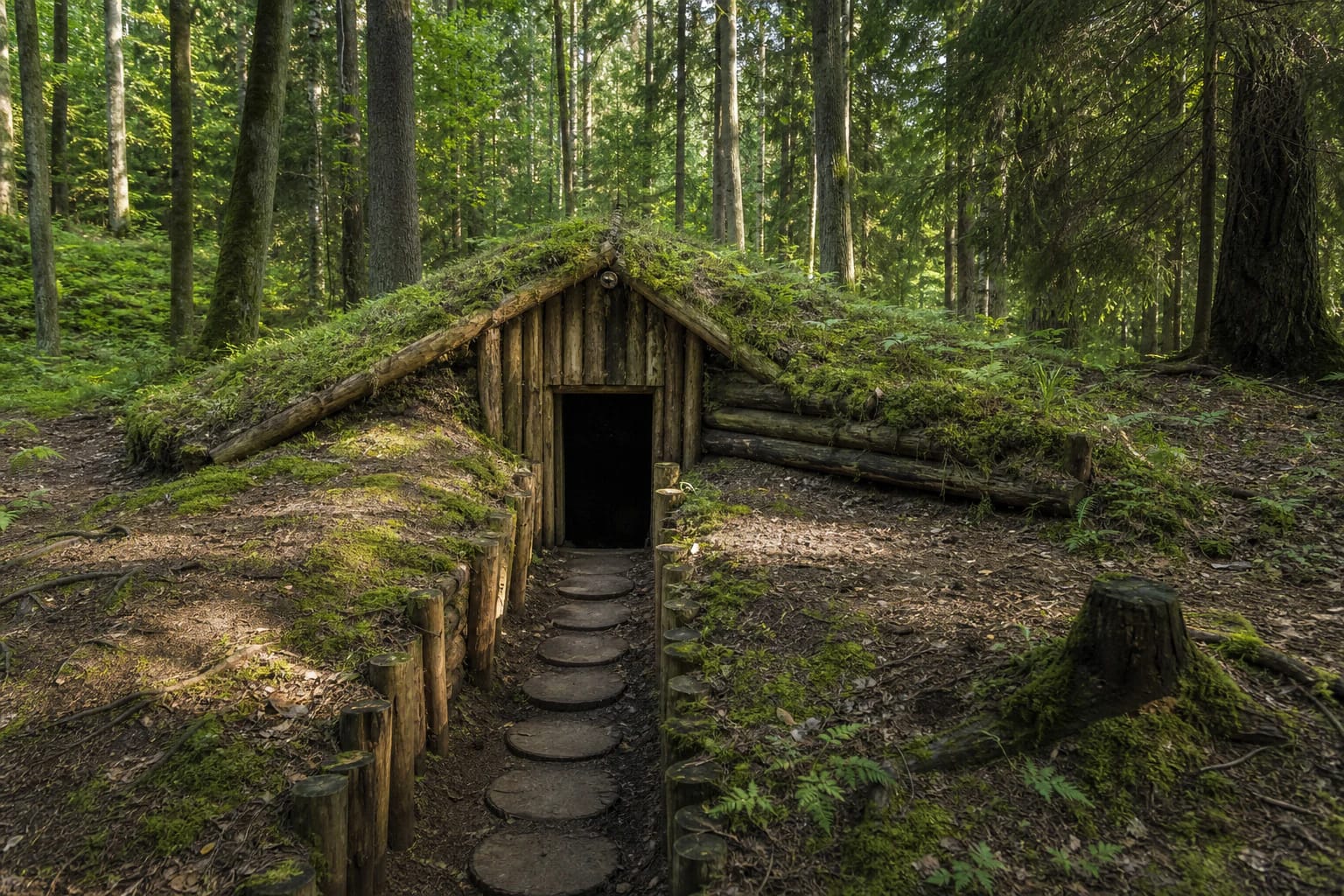
- Place
- Pagramantis Forest, Didkiemis Eldership, Šilalė District Municipality
- Region
- Samogitia
- Type
- forest earth shelter reconstructed in 2014 at a historic partisan site and a memorial to the Jūra Platoon
- Address
- Pagramantis Forest, Didkiemis Eldership, LT-75112 Šilalė District
- Coordinates
- 55.39111, 22.18838
- Visit duration
- 30-60 minutes including the roughly 200-metre forest approach; longer as part of a hike through Pagramantis Regional Park
- Best time
- in daylight and dry weather; the uneven path and sloping entrance may be slippery after rain or in freezing conditions
Jūra Platoon Partisan Bunker, Pagramantis Forest Partisan Bunker, Lydis Detachment Earth Shelter
A reconstructed earth shelter, not an original surviving bunker
The structure in the forest is a modern memorial reconstruction. The protected-areas authority dates the earth shelter reconstructed at this historic partisan site to 2014, and LGGRTC records its unveiling on 18 October 2014. No public archaeological or architectural report establishes surviving original fabric, precise post-war dimensions or a literal reconstruction of the shelter's original plan.
A VLE article about Pagramantis Regional Park gives 2004, but the current site manager's description and the contemporary LGGRTC event record agree on 2014. This guide therefore uses the documented 2014 date. A memorial marker to the platoon and two fighters killed in the forest had already been unveiled on 22 May 2005, so the commemoration of the site predates the present shelter.
The unit commemorated at this forest site
The shelter commemorates the 2nd Platoon of the Lydis Detachment's 3rd Company within the Kęstutis District. From 1948, this unit was known as the Jūra Platoon. Here Jūra is the name of a particular partisan platoon and its memorial; it should not be confused either with the nearby River Jūra or the larger Jūra Partisan Region in western Lithuania.
The LGGRTC register associates the memorial with Antanas Stonis, killed on 25 May 1947, and Jonas Turulis (aliases Malūnas and Kudirka), killed on 18 April 1948. The source places their deaths in Pagramantis Forest but does not justify saying that both men died inside the footprint of today's reconstruction. The memorial also honours the broader unit that operated here.
The Lydis Detachment became a foundation of the Kęstutis District
The Lydis Detachment began taking shape in early 1945. Its organisers included Eržvilkas Gymnasium teachers and Lithuanian Liberty Army members Henrikas Danilavičius-Vidmantas, Petras Ruibys-Garbštas, Jonas Kubilius-Bernotas and Jonas Žičkus-Viksva. A headquarters and three companies, Kadagys, Uosis and Neptūnas, were organised in August 1945. At its greatest extent, the detachment operated across 16 rural districts in Pagėgiai, Šilutė and Tauragė counties and part of Raseiniai County.
In September 1946, the detachment became a foundation of the new Joint Kęstutis District. It transferred its statute, internal regulations and the underground newspaper Laisvės varpas to the district organisation; Jonas Žemaitis-Vytautas later adapted parts of this organisational experience for wider partisan structures. Its name changed over time: Lydis until July 1947, then Aukuras, and Butigeidis from summer 1948.
What the log structure reveals
The exterior consists of a log structure set into the slope, a low roof covered with earth and moss, and a narrow entrance trench reinforced with timber walls and steps. This form helps visitors imagine how a shelter could merge with the forest floor, but it remains essential to distinguish an educational reconstruction from authentic 1940s timber.
Published hiking accounts and photographs show visitors entering the reconstructed interior, where a low log roof, support posts, rough flooring and two-tier log bunks can be seen. There is nevertheless no official promise that the interior will always be open or safe. Do not enter if the opening is blocked, timber appears damaged, the chamber is flooded or temporary forest restrictions are in force.
A 200-metre forest path and practical conditions
A timber waymarker gives 0.2 kilometres to the bunker. The final section follows an unpaved, uneven forest path with leaves, exposed roots and a simple handrail in places. The coordinate 55.3911109, 22.1883764 marks the memorial itself, not a car park. No verified dedicated parking point was found, so leave a vehicle only where it is legal and will not obstruct a forest road.
No separate ticket, booking requirement or staffed opening hours are published. Google Maps labels the site as open around the clock, but no lighting is documented in the forest, so visit in daylight and assess weather and forest conditions before setting out. The map listing reports no accessible entrance; the uneven trail, sunken approach and low steps are unsuitable for independent wheelchair access. Allow 30-60 minutes and behave as you would at any memorial: do not climb on the roof, disturb the moss or leave burning candles unattended.