- Place
- Vilnius City Municipality
- Region
- Vilnius
- Type
- historic Vilnius cemetery and place of memory
- Address
- Rasų g. 32, Vilnius
- Coordinates
- 54.66830, 25.30440
Old Rasos, New Rasos
One of Vilnius' most important memory sites
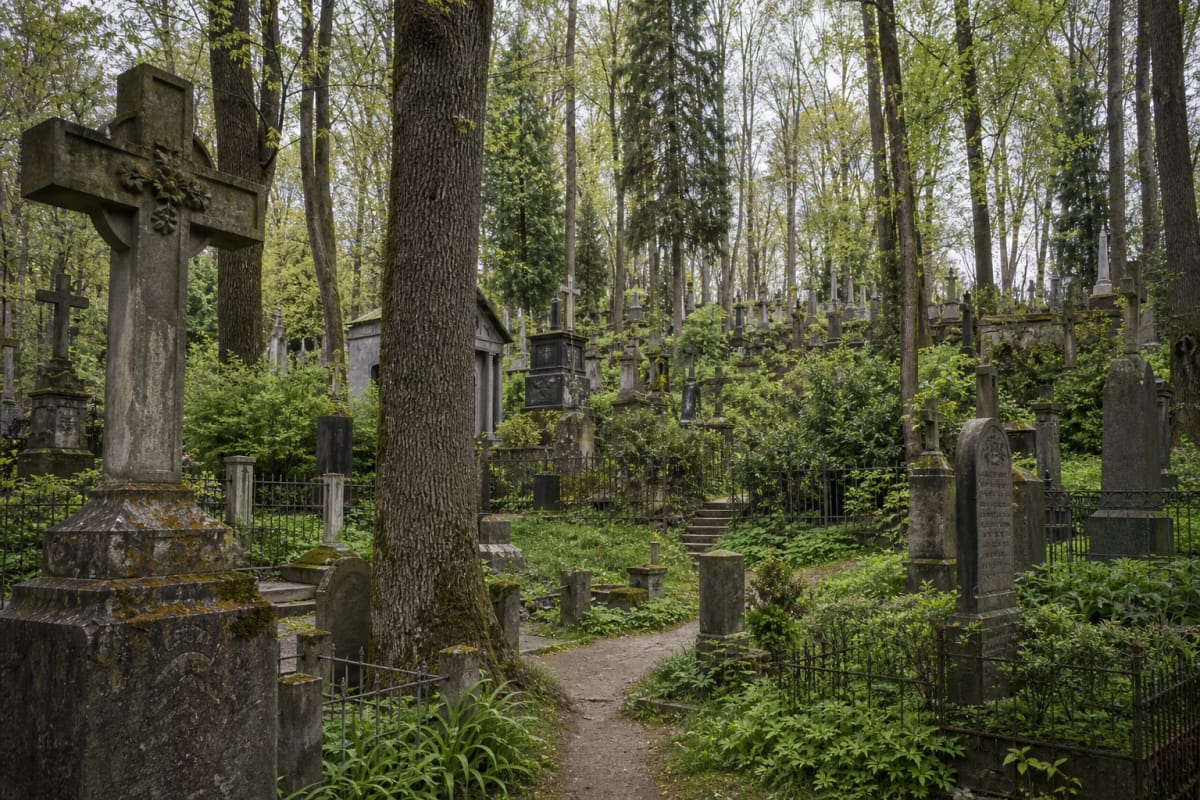
Rasos Cemetery is not just an old cemetery on hills. It is one of Lithuania's most important and oldest cemeteries, located in the Rasos district on the Rasos-Ribiškės hills and covering 10.4 ha. People of different periods, languages, political fates, and cultures are buried here.
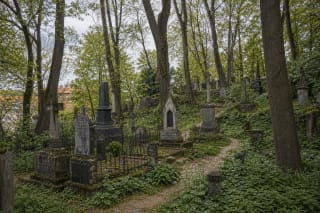
The cemetery landscape is hilly, with winding paths, old trees, and monuments from different periods. Rasos is therefore best visited slowly, with a clear route or at least several names you want to find.
How Rasos Cemetery began in 1801 and grew
The cemetery was established in 1801 by the Church of the Assumption of the Blessed Virgin Mary of the Missionary Monastery, following the Vilnius magistrate's decision to bury the dead outside the city rather than beside churches. The 3.51 ha cemetery was consecrated on May 6, 1801, and burials began on May 8. In 1814 a plot of land was purchased that later became known as Literatai Hill.
Sacred architecture forms an axis of the complex. The Neo-Gothic Great Chapel was built between 1838 and 1850 between the columbaria, to a design by architect Tomas Tišeckis; the bell tower was added in 1888 by architect J. Januševskis. The new cemetery, New Rasos, was established in 1912. Cultural Heritage Register status reminds visitors that the whole complex is protected: path structure, monument density, hilly relief, and the tradition of an urban cemetery.
Signatories, artists, and leaders of the 1863 uprising
Rasos contains the graves of February 16 Act signatories Jonas Basanavičius, Mykolas Biržiška, and Jonas Vileišis, as well as a symbolic cenotaph to K. Bizauskas, P. Dovydaitis, and V. Mironas. Artists Pranciškus Smuglevičius and Mikalojus Konstantinas Čiurlionis, writers Vincas Mykolaitis-Putinas and Balys Sruoga, singer Kipras Petrauskas, historian Joachimas Lelevelis, and jurist Mykolas Romeris are also buried here. Some of the best-known grave monuments were created by J. Zikaras, B. Balzukevičius, and other sculptors.
In 2017, during works on Gediminas Hill, the remains of twenty leaders and participants of the 1863-1864 uprising were found by chance and later identified, among them Konstantinas Kalinauskas, Zygmunt Sierakowski, and Titas Dalevskis. On November 22, 2019, state funerals were held and the remains were buried in the chapel of Old Rasos Cemetery.
Multicultural memory and Piłsudski's heart
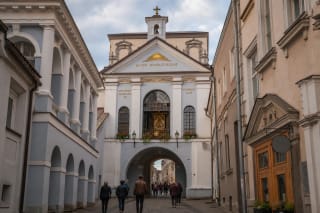
A strong Polish layer is also visible at Rasos. In a crypt installed in 1936, the heart of Józef Piłsudski was buried in a silver urn together with the remains of his mother, Maria Piłsudska. The grave is enclosed by a fence with a small chapel and an image of the Madonna of the Gates of Dawn. Nearby are Lithuanian and Polish soldiers who died in the 1919-1920 fighting. This shows that Rasos matters not only to Vilnius, but to wider Lithuanian and Polish memory.
Still, the value of Rasos Cemetery is not only a list of famous names. Many smaller but important gravestones, multilingual inscriptions, family plots, and signs of city communities have survived here. They show Vilnius as a multicultural city.
Vėlinės at Rasos
During Vėlinės, Lithuania's All Souls' Day tradition, Rasos becomes one of Vilnius' strongest experiences. Candles, streams of people, and evening light change the cemetery's atmosphere, but they also require more patience and respect.
If you visit during Vėlinės, plan more time, come on foot or by public transport, do not walk across graves, and respect people who have come not as tourists but to visit their relatives.
How to visit Rasos Cemetery
For a first visit, choose a 45-120 minute route. Wear comfortable shoes because paths and terrain can be uneven, especially after rain or in autumn.
The cemetery is a place of memory, so photography should be restrained. If you are looking for specific graves, check the official Vilnius cemeteries page or a cemetery map before the trip; orientation on site can be harder than it looks.