- Place
- Nida, Neringa Municipality
- Region
- Neringa
- Type
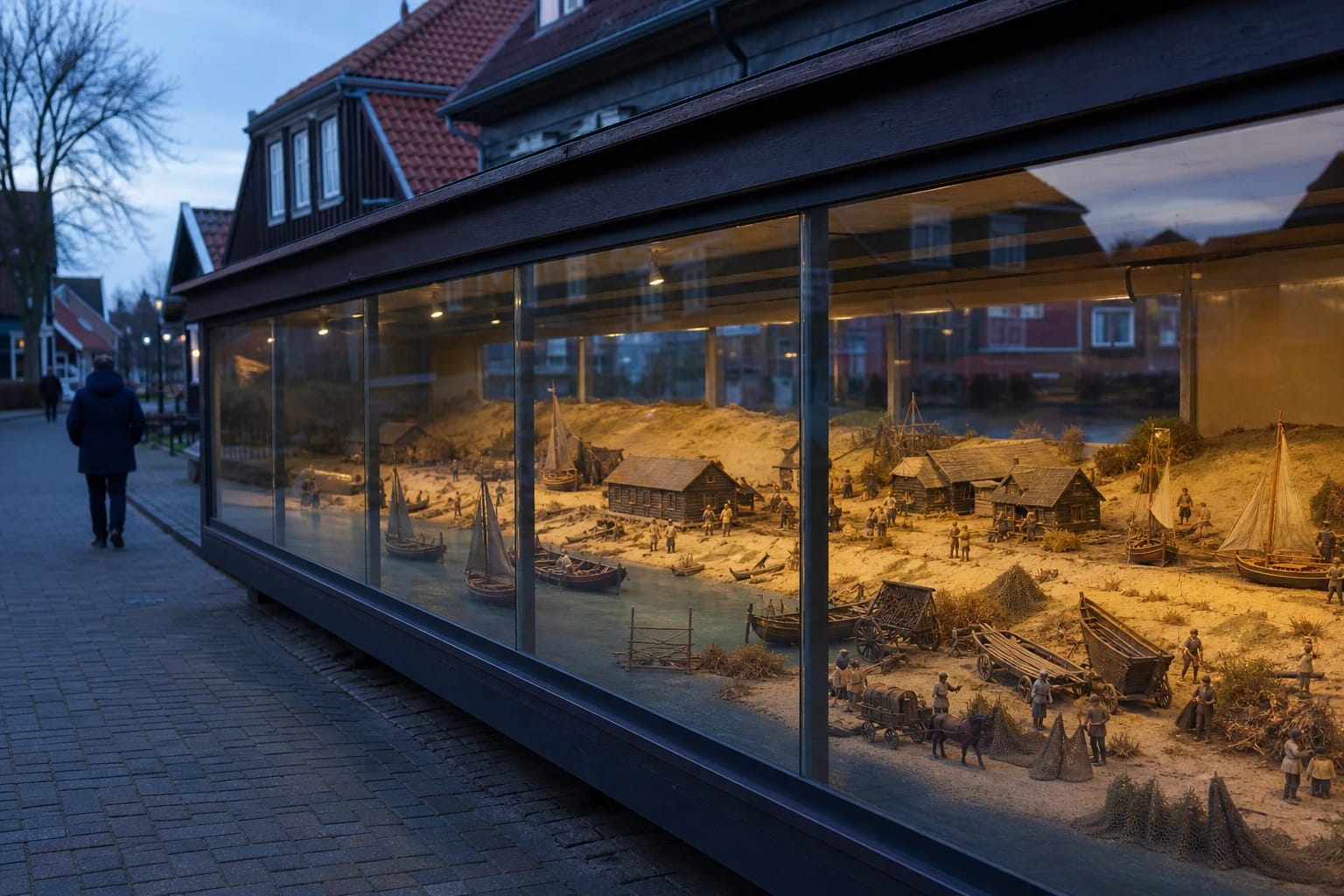
- illuminated historic diorama viewed free from the street
- Address
- by 12 Naglių Street, Nida
- Coordinates
- 55.30262, 21.00664
- Visit duration
- 15-30 minutes; 45-90 minutes when reading the engravings and combining it with an old-town walk
- Best time
- daylight for details and text; illumination may highlight the diorama after dark, but operation on a particular day is not guaranteed
Life on the Curonian Spit in the 19th Century, Dune-dweller life outdoor display
Which display this page identifies
This page covers the outdoor glass case by 12 Naglių Street at 55.3026201, 21.0066408. In 2025, the national park used this address as an excursion meeting point. It is not an indoor display at Nida Fisherman's Ethnographic Homestead at 4 Naglių Street or the Curonian Spit History Museum.
On 24 July 2026, the exact Google listing, place ID ChIJWzegnC-X5EYRLC-pgONiYpQ, showed 4.8 out of 5 from 20 reviews. The coordinate marks the long glass case itself on an old-town street.
A miniature world created by Aida Pečeliūnienė in 2020
Klaipėda artist Aida Raimonda Pečeliūnienė created the display and donated it to the Curonian Spit National Park. Neringa Library's cultural almanac says it was installed in Nida old town in 2020 to show dune-dweller life on a strip of sand between two waters.
The diorama's 56 porcelain figures in period clothes build boats, fish, carry hay, travel by postal carriage, collect amber, and flee sand-buried homes. Thirteen wooden sailing boats occupy the miniature lagoon.
Artistic interpretation and historical sources
The composition is an artistic interpretation of past life, not an archaeological nineteenth-century village preserved in place. It combines many tasks and events in one scene so visitors can read the dune dwellers' relationship with the lagoon, sand, postal road, fishing, and boatbuilding.
The reverse side presents nineteenth-century engravings from Kęstutis Demereckas's collection. They add documentary visual context, but each diorama figure should not be treated as a portrait of a specific historical person.
Viewing from the street
The display is designed as a glass case visible from the street, so there is no separate ticket desk or museum gate. Text is easiest to read by day, while internal illumination may highlight the figures after dark. Assess its current operation on site.
Do not touch the glass, lean on the structure, or block pedestrians. Dark clothing, a lens close to the glass, and avoiding direct sun help reduce reflections. Leave vehicles in a legal Nida space.