- Place
- Nida, Neringa Municipality
- Region
- Neringa
- Type
- private amber gallery-museum and interactive exhibition
- Address
- Naglių g. 27, Nida
- Coordinates
- 55.30446, 21.00680
Mizgirių gintaro muziejus, Mizgiriai Amber Gallery-Museum
Mizgiriai Amber Museum in old Nida
Mizgiriai Amber Museum is in the old part of Nida, at Naglių g. 27, near the Curonian Lagoon promenade. It is a private amber gallery-museum founded by the amber master Kazimieras Mizgiris and his wife Virginija Mizgirienė. According to the Universal Lithuanian Encyclopedia, the Mizgiris amber gallery-museum in Nida opened around 1993 (the VLE article on Nida gives 1995).
The museum is not only about amber jewellery. Its central concept is the amber-tree forest and a river: the flowing river marks amber's path from nature to culture, and amber is shown as a material of nature, geology, art, trade, and local identity.
How amber formed: the amber-tree forest
The exhibition explains how amber formed. It is polymerised fossil resin of Paleogene conifers; according to the Universal Lithuanian Encyclopedia, Baltic amber formed about 50 million years ago, when the Eocene climate warmed and trees in a subtropical forest exuded resin abundantly. The museum's 3D film presents that very distant time as the amber-tree forest that grew about 40-50 million years ago.
Clear amber contains inclusions - trapped insects and plant remains from which the ancient environment can be reconstructed. In an interior multimedia bridge, a fact-based story also explains the formation of the Curonian Spit, so natural history is tied here to the very place where the museum stands.
Perkūno akmuo and the rare-amber collection
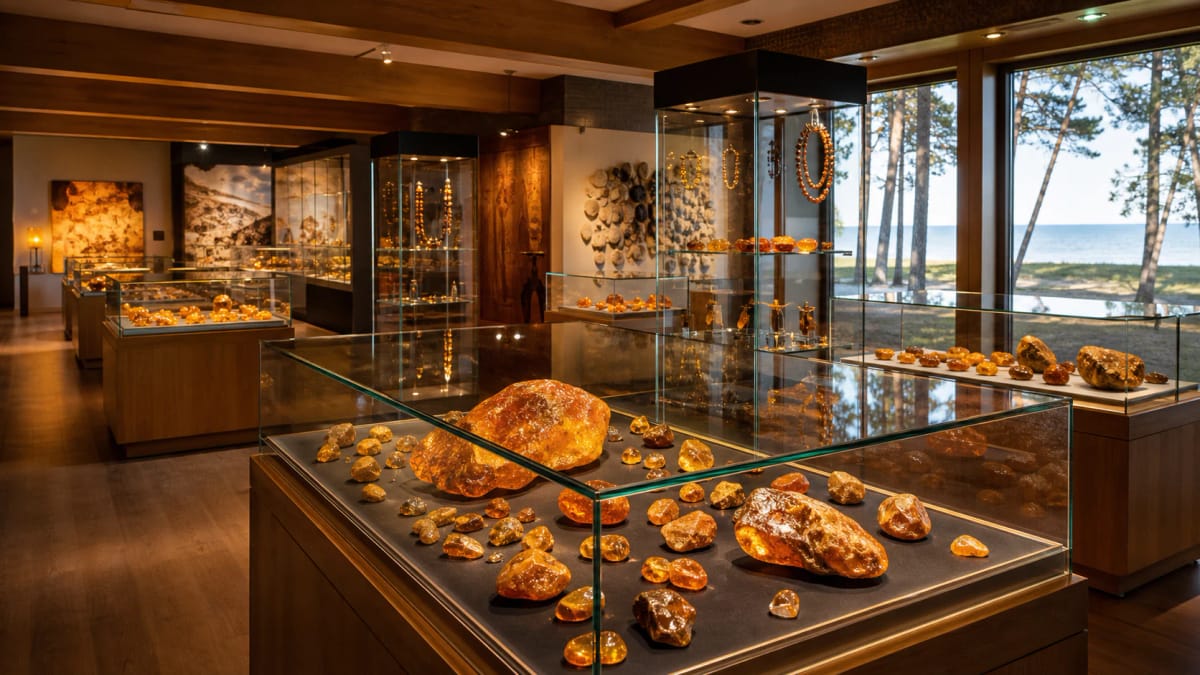
One of the highlights of the Mizgiris amber display is Perkūno akmuo, the Perkūnas Stone, presented as the largest marine amber block in Lithuania. It weighs 3,820 g; according to the Universal Lithuanian Encyclopedia, the block is 240 mm high, 235 mm wide, and 160 mm long. For comparison, the Sun Stone at the Palanga Amber Museum weighs about 3,524 g, so Perkūno akmuo is considered even larger.
Rare amber, artworks, inclusion samples, and a world amber map presenting fossil resins found in other countries are all important parts of the collection. A gallery on the second floor shows the work of professional Lithuanian and foreign artists, while a hands-on space explains amber's physical and healing properties.
The Mizgiris amber gallery network
The Mizgiris family creates amber galleries beyond Nida. According to the Universal Lithuanian Encyclopedia, an amber gallery-museum was founded in Vilnius Old Town in 1988 (by the Mizgiris couple with designers Jonas Gerulaitis and A. Klimas and archaeologist Gediminas Gendrėnas), and in 2021 a new, larger amber museum opened in Nida. The Nida amber display is therefore best understood as part of a wider Mizgiris amber-art and research network.
The amber story in Nida is closely tied to the long Baltic-coast tradition of gathering, working, and trading amber that reaches back to the Stone Age. Beside the exhibition there is a shop where you can buy amber jewellery and artworks.
Opening hours, tickets, and route
At the time of research, the museum website announced that tours run daily at 12:00, 15:00, and 17:00, with registration by phone or by buying a ticket on site. Ticket prices vary by season and visit format, so check the official museum page before going.
A visit usually takes 45-75 minutes. The museum is easy to combine with Nida Fisherman's Ethnographic Homestead, the Curonian Spit History Museum, and the lagoon promenade; it is especially good on a rainy or windy day, when an indoor exhibition in Nida is welcome.