- Place
- Neringa Municipality
- Region
- Neringa
- Type
- Curonian Spit lighthouse on Urbas Hill
- Address
- Švyturio g. 8, Nida, Neringa
- Coordinates
- 55.30370, 21.00410
Urbas Hill Lighthouse, Nidos švyturys
Nida Lighthouse on Urbas Hill
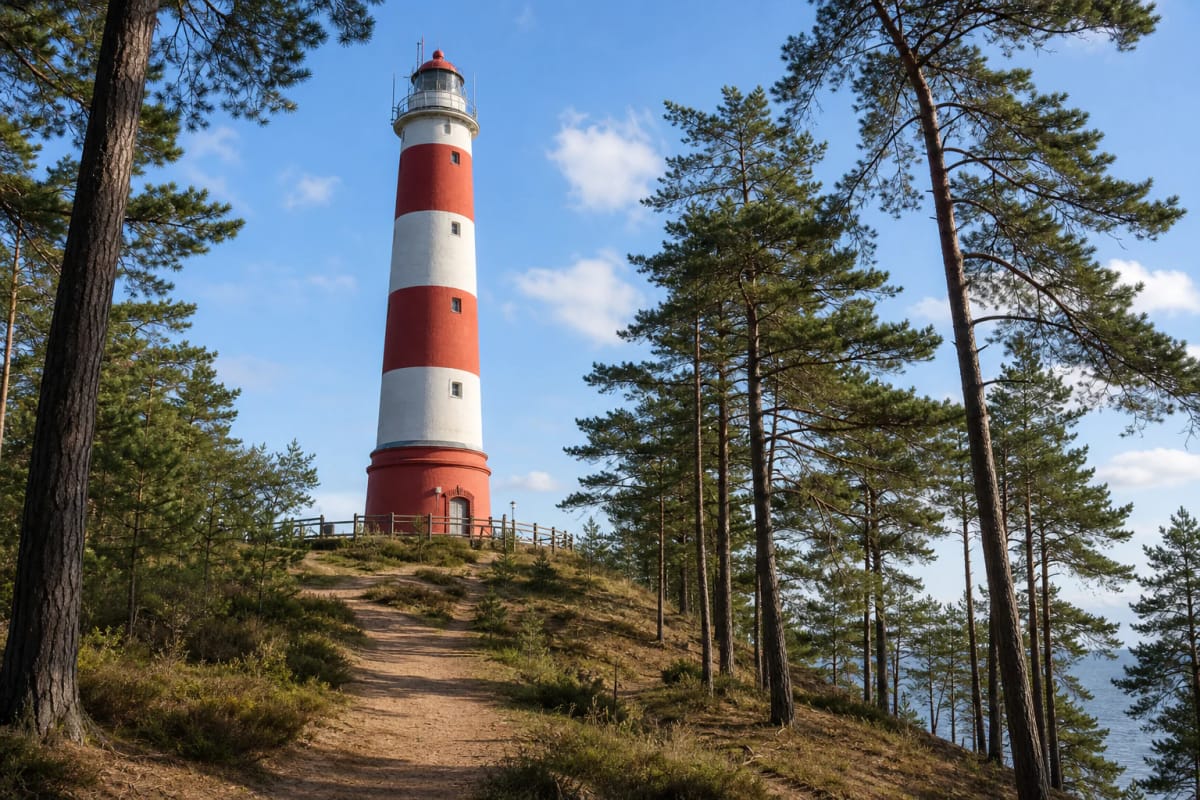
Nida Lighthouse is one of the clearest landmarks in Nida. It stands on Urbas Hill, a planted dune about 51 m high and the highest point in the Nida area. Because of that position, the lighthouse is not only a navigation mark but also a strong landscape accent visible from a distance.
For visitors, the important point is that the present tower is not the first lighthouse on this hill. Neringa Museums gives a clear chronology: the first lighthouse was built in 1874, and the current 29 m lighthouse was built in 1953, after the Curonian Spit already belonged to Lithuania.
The first 1874 lighthouse and wartime loss
The first Nida Lighthouse rose on Urbas Hill in 1874 and was about 23 m high. It mattered for maritime safety along the Curonian Spit and Baltic coast, where sandbanks, fog, and coastal landmarks had practical importance. Neringa Museums describes the lighthouse as a symbol of human victory over the force of sand.
According to Neringa Museums, the first lighthouse was blown up at the end of the Second World War in 1944 as the German army retreated. That means the place carries not only seaside romance but also a wartime layer, as many Curonian Spit sites do.
The current 1953 lighthouse: 29 m high, light visible for about 41 km
The present Nida Lighthouse was built in 1953. Neringa Museums gives its height as 29 m above ground and about 79 m above sea level together with Urbas Hill, while its light is visible up to roughly 41 km. These numbers show that it is not just a decorative Nida symbol but a real automated navigation object with its own flashing rhythm.
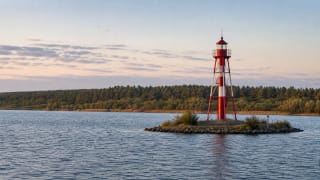
The red-and-white tower among pines is easy to recognize and visually strong. It reveals itself especially well when you approach on foot: the tower appears gradually, and the sandy path gives the visit a slower rhythm than a quick drive-by stop.
Climbing the tower and the view from Urbas Hill
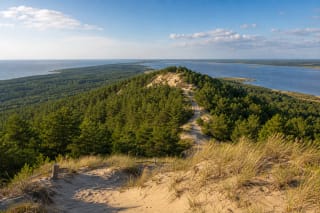
In summer, the lighthouse can be visited from inside. Neringa Museums notes that 132 steps lead to the viewing platform, opening a bird's-eye view of Nida, dunes, lagoon, and forests. Visiting hours are usually limited to summer months and daytime, so check the schedule before you go.
Even when the tower is closed, the site is worth visiting. The main experience is the lighthouse form, the hill setting, and the sense that this place long helped people orient themselves on a coast where windblown sand constantly changed the landscape.
Urbas Hill and Nida walking routes
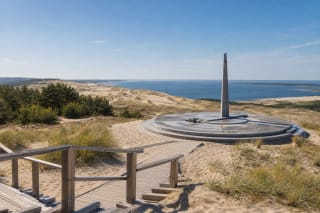
The lighthouse is best visited as part of a walk over Urbas Hill. Nida is strongest on foot: pine paths, sandy relief, town quietness, and short panoramic pauses create a slower travel tempo.
Urbas Hill is part of the Curonian Spit's great dune ridge, a sand ridge stretching about 80 km from Smiltynė to Lesnoye. That helps you see the lighthouse not as an isolated building, but as a landmark in a living sand landscape.
How to visit Nida Lighthouse
Plan 20-45 minutes for Nida Lighthouse, or longer if you want to walk more slowly over Urbas Hill, climb the tower, or combine it with other Nida paths. Comfortable shoes matter because the paths are sandy and steeper in places.
Clear weather is best for photography and orientation, while tower access is possible only during the summer season. In winter or after rain the paths can be slippery, and wind on the hill feels stronger than in town.