- Place
- Ukmergė District Municipality
- Region
- Ukmergė
- Type
- former surface-launched ballistic missile base, living-history club, and freedom-fighters exhibition
- Address
- Miško Broliai, 11 Kopūstėliai, Kopūstėliai village, Ukmergė District
- Coordinates
- 55.18563, 24.71415
- Visit duration
- 1.5-2.5 hours for a pre-arranged tour; longer for an educational programme or history festival
- Best time
- in dry weather and only after arranging the visit; daylight is safest for exploring the large forest site
Kopūstėliai Missile Base, Miško broliai in Kopūstėliai, Kopūstėliai History Club
From a secret construction site to a missile unit
Construction began in 1958 in woodland about ten kilometres from Ukmergė. Ukmergė District Municipality dates completion of the core complex to 1960, while the latest Vilnius University study gives 1958-1962 for the wider building programme. The accounts are compatible: combat operations could begin while work continued on the settlement and support infrastructure.
Kopūstėliai was linked with a similar base about eight kilometres west, near Vepriai. Together, they formed first- and second-salvo units. The forest installation contained much more than launch pads: its closed settlement included barracks, a canteen, medical and leisure facilities, garages, and sports infrastructure.
Eight R-12 missiles and four launch pads
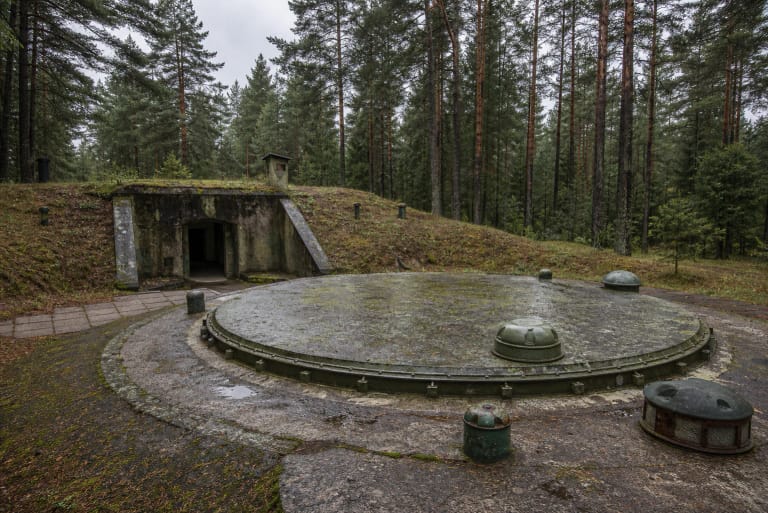
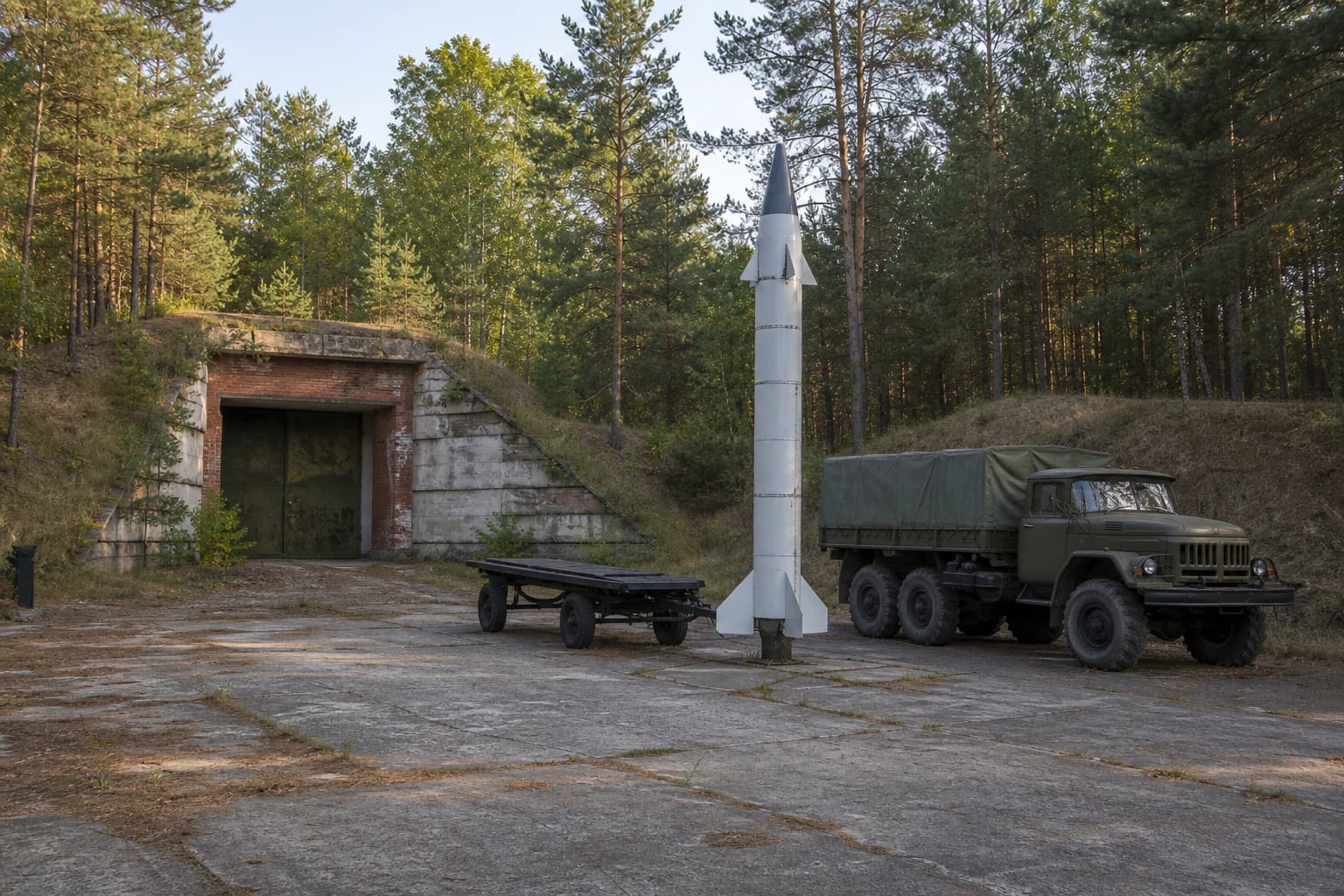
Two earth-covered hangars concealed eight Soviet 8K63 missiles, better known in the West as the R-12 or by the NATO reporting name SS-4 Sandal. These were roughly 22-metre medium-range ballistic missiles capable of carrying a nuclear warhead to targets up to 3,000 kilometres away in Europe, but not to the United States.
Four fixed launch pads stood beside the hangars. The nuclear warheads were not stored on the missiles but in a separate, still more tightly protected compound several kilometres away. After an alert, crews had to tow a missile out, raise it on its launcher, attach the warhead, load propellants, and enter flight data.
The 1968 alert and the base's closure
The municipality's historical account states that Kopūstėliai's missiles entered heightened readiness during the Soviet invasion of Czechoslovakia in 1968. No launch followed, but the episode makes clear that this was not merely a warehouse or training area: it formed part of an operational nuclear force.
After the United States and Soviet Union signed the Intermediate-Range Nuclear Forces Treaty in 1987, the R-12 missiles were removed from Kopūstėliai in 1988. Another Soviet unit used the site for a time. Following the withdrawal of Russian forces from Lithuania, the base passed to Ukmergė District Municipality in 1992, was later privatised, and deteriorated for many years.
What survives at the former base
The most important exhibits on a tour are not individual objects but the whole military landscape: roads built from concrete blocks, launch pads divided by earth berms, traces of launcher rings, command and protection bunkers, the profiles of camouflaged hangars, and fragments of the military settlement. The forest has concealed parts of the infrastructure again, making their purpose difficult to understand without a guide.
The site contains unstable ruins and dark interior spaces. Do not enter fenced structures, climb onto hangars, touch unidentified metal objects, or leave the route set by your guide. This is not an unrestricted abandoned site for independent urban exploration.
Why partisan history is also told here
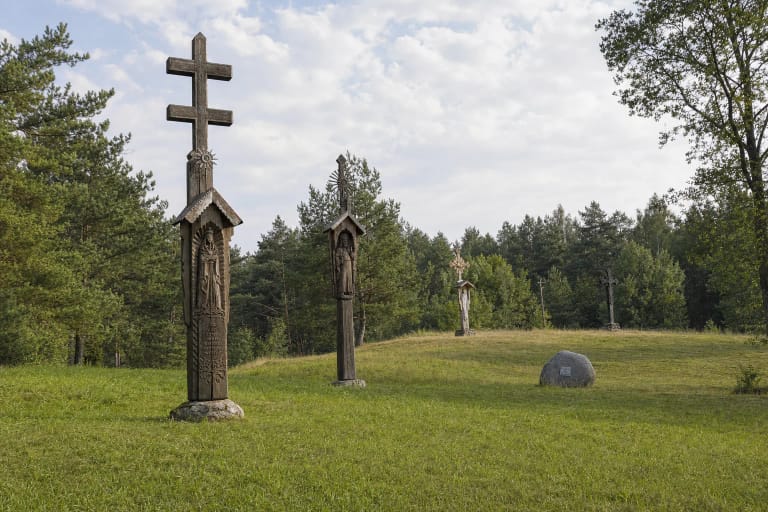
The Miško broliai historical-reenactment club moved into the former base in 2012. The surviving infrastructure was adapted to tell more than a Cold War story: a hangar now houses a museum of Lithuania's freedom struggles, a partisan bunker has been reconstructed, and educational programmes cover the 1944-1953 resistance and the interwar 1st Infantry Regiment of Gediminas the Grand Duke of Lithuania.
A Vilnius University researcher who carried out ethnographic fieldwork in 2024-2025 describes this as an unusual transformation of Soviet heritage. The club does not erase the physical remains of the base but integrates them into active memory practices. Visitors should distinguish three layers: authentic remains of the missile unit, later exhibitions and reconstructions, and the historical interpretation presented by club members.
Tours, contacts, and preparation
Kopūstėliai does not publish regular museum hours on which an unannounced visitor can safely rely. Tours, educational programmes, camps, and events are arranged in advance. On 25 July 2026, Ukmergė's official visitor information listed telephone +370 673 01815 and email miskobroliai@inbox.lt. There was no single public admission tariff, so confirm the price, group size, and programme directly.
Wear sturdy closed footwear, long trousers, and weather-appropriate clothing, and carry drinking water. The Google Maps pin marks the club's visitor location within a very large former base, not the centre of every surviving structure. Movement may be restricted during events or military exercises, so arrive only at the agreed time and follow the organisers' instructions.