- Place
- Ukmergė District Municipality
- Region
- Ukmergė District
- Type
- pair of boulders, geological and archaeological monument
- Address
- Šaltupė Forest, near Sukiniai village, Pabaiskas Eldership, Ukmergė District Municipality
- Coordinates
- 55.16565, 24.64954
Sukiniai Stones, Sukiniai Mokas, Sukiniai Mokiukas, Mokas and Mokiukas, Mokas Stone
Precise name and place
This object is often simplified as the Mokai Stones, but the most reliable sources name it more precisely: Mokas and Mokas's Son. VLE also gives names such as Sukiniai Stones, Sukiniai Mokas, Sukiniai Mokiukas, and Mokas and Mokiukas.
It is not in Kelmė District, and it should not be confused with similarly named Mokas and Mokiukas near Tauragnai in Aukštaitija National Park. This pair is in Ukmergė District, Pabaiskas Eldership, Šaltupė Forest near Sukiniai village.
Two stones, one story
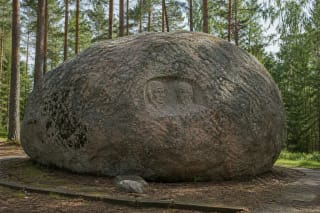
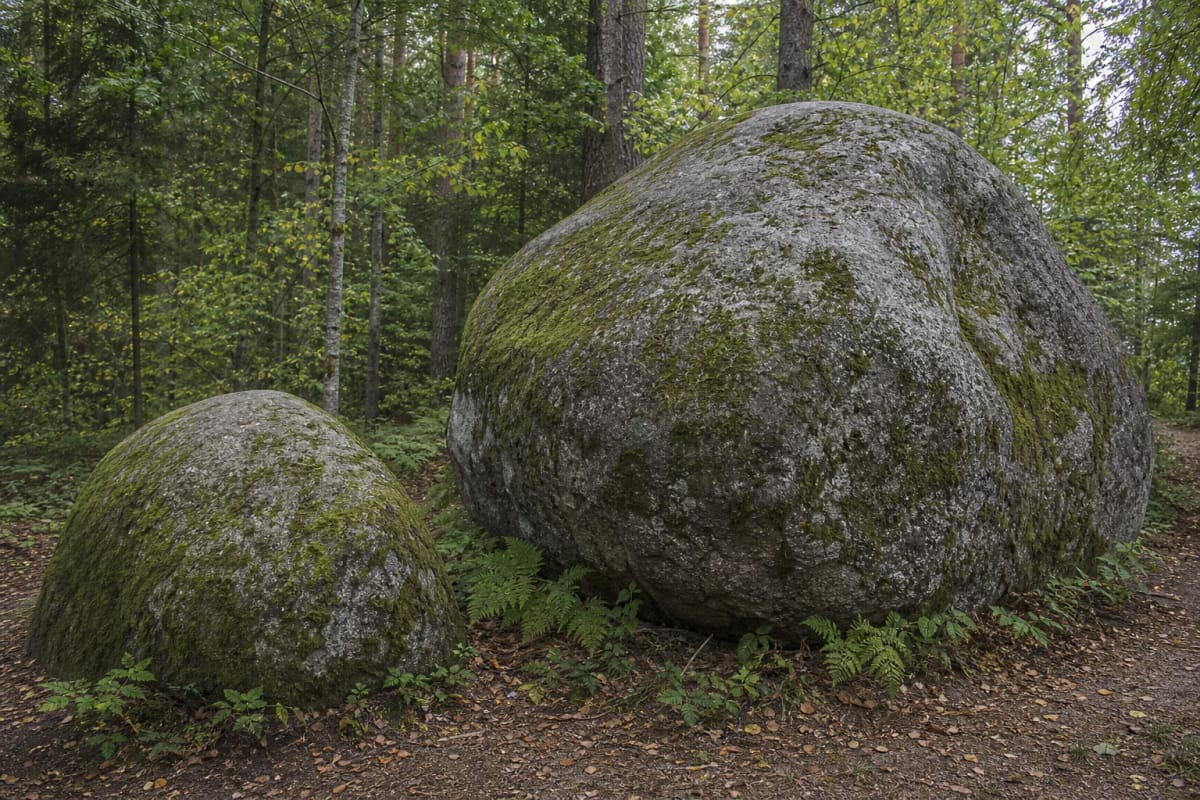
The object consists of two boulders. The larger is called Mokas, the smaller Mokas's Son or Mokiukas. This paired arrangement and naming made the stones both a geological and narrative point in the landscape.
Visit Mokas not as one big stone but as a family-story motif in the forest. The relationship between the two stones explains why the object has many legends and why father-and-child imagery returns in the names.
Dimensions and rock
VLE gives exact dimensions for Mokas: 8.50 m long, 6.26 m wide, 3.45 m high, with a horizontal circumference of 23.12 m. Mokas's Son is 5.26 m long, 3.37 m wide, 1.64 m high, with a circumference of 13.36 m.
Both stones are made of biotite plagiogranitic gneiss. They are erratic crystalline-rock boulders left in Lithuania's landscape by glaciers.
Protection status
VLE calls Mokas and Mokas's Son a natural heritage object, geological natural monument, and archaeological monument. The State Service for Protected Areas also registers the pair as a geological natural heritage object under the name Stones Mokas and Mokas's Son.
The dual status makes sense: they matter as glacial boulders, and their meaning grows through legends, possible ritual traces, and local memory.
Legend of the Mokai family
VLE and local tourism sources connect the stones with legends about the Mokai family. The story says that Mokas and his family were wading through water: Mokas and the child reached the shore and turned into stones, while Mokienė, the wife, remained in the water.
Other stories mention an enchanted treasure under the stone. Such motifs are common around large boulders: an unusual natural object becomes a place for explaining loss, family bonds, dangerous water, and hidden wealth.
Archaeological layer
VLE states that 1971 investigations found pits, charcoal, burnt stones, hand-built pottery sherds, and other finds interpreted as possible traces of ritual activity. The site should therefore be presented not only as folklore but also as an archaeological problem.
Caution is necessary. Finds show traces of human activity, but details about sacrifices or divination should be separated from documented facts. The best wording is that the place is associated with old rites and beliefs.
How to visit
Mokas and Mokas's Son are a forest object, so access matters as much as the stones. Local maps give approximate coordinates 55.165653, 24.64954. Use them for route planning, but follow local marking and paths on site.
Do not climb on the stones, scratch the surface, or leave marks. These boulders preserve geological information as well as legend and archaeological memory, so the visit should be quiet and respectful.
When to stop here
This place suits a trip through Ukmergė District when you want more than manors or hillforts. The stop is short but rich: glaciers, family legend, archaeology, and forest landscape meet at once.
For photography, overcast or soft light is best, so moss, lichens, and stone surfaces are not burned out by sun. Autumn especially emphasizes the paired composition.