- Place
- Karmėlava, Kaunas District Municipality
- Region
- Kaunas District
- Type
- wooden public chapel built in 1945 beside Karmėlava's historic churchyard
- Address
- Piliakalnio g. 17, Karmėlava, LT-54447
- Coordinates
- 54.97313, 24.06027
- Visit duration
- 20-30 minutes for the chapel, old churchyard, and gates; up to 45 minutes if the interior can be visited quietly
- Best time
- on Sunday before or after the 10 am or noon Mass, after checking the official timetable; use a bright day for the gates and churchyard
Karmėlava church, Karmėlava public Chapel of St Anne, Karmėlava St Anne Church
Its house-like appearance is the central part of the story
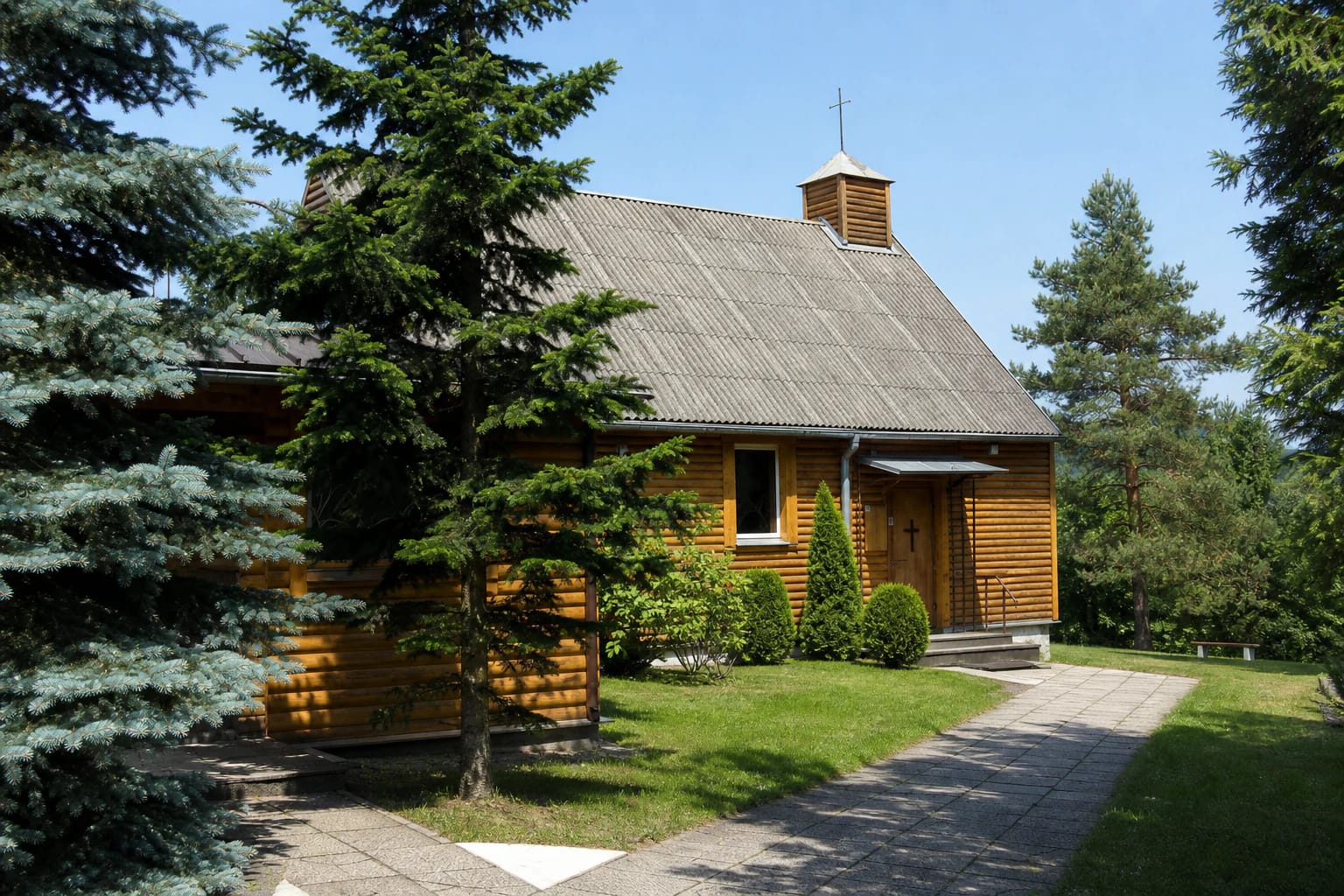
The present place of worship stands beside the old churchyard on Piliakalnio Street. It is a small rectangular timber building clad in horizontal brown boards and covered by a broad grey gabled roof. A tiny square turret with a cross on the ridge, a cross on the door, and the cared-for churchyard provide the clearest signs of its religious purpose.
The parish history page explicitly describes the chapel as a small wooden church resembling an ordinary house. Visitors should not expect a monumental facade, tall bell tower, or historic aisles. Its value lies elsewhere: an improvised postwar solution has remained the living parish church for more than eight decades.
The entrance is set into the side wall beside a short path. This is an active chapel, so its interior exists first for worship rather than as a permanent visitor display. If the doors are open, enter quietly, do not photograph people without permission, and stay out of rooms reserved for liturgical use.
The 1529 foundation and a 1782 inventory reveal the lost church in documents
The Universal Lithuanian Encyclopaedia dates Karmėlava's first church to 1529. A church inventory published by the parish in 1782 gives the same year for a foundation by King Sigismund I the Old. This is documented history rather than a later local legend.
The inventory records that Simonas Sirutis, elder of Kaunas, rebuilt the timber church in 1768. The building was 39 cubits long and 21 cubits wide, with stone-and-brick foundations, a shingle roof, nine large windows, a small cupola containing a bell, and a separate sacristy.
Three altars were listed: a high altar with the Virgin and Child, one dedicated to St George, and another to St Anne. These details do not describe the present chapel. They reconstruct the scale and furnishing of the eighteenth-century church that once occupied the historic churchyard.
The Second World War loss survives in parish records and foundations, not legend
The official parish account states that the old church burned during the Second World War. The encyclopaedia dates the present Church of St Anne to 1945, while the parish describes it as a temporary small chapel built beside the churchyard in the postwar years.
That temporary building was never replaced by a new monumental church. Parishioners still worship here, so the visitor sees an authentic result of a religious community adapting after wartime destruction, not a later historical reconstruction.
Parish archive photographs from 1968 show the chapel, its altar, a temporary belfry, the foundations of the old church, and the gates. Keep those images in mind when walking around the site: the present building and historic churchyard belong to different periods.
The stone wall and ornate gates survived from the earlier sacred enclosure
The old churchyard wall and gates are protected in the Register of Cultural Property under number 1370. A stone enclosure and masonry gate piers mark the historic boundary, while ornamental ironwork and crosses above the openings retain a distinctly sacred emphasis.
The wall and gates are not merely decoration for the current chapel. They belonged to the earlier church precinct, which explains why their scale can appear surprisingly grand beside the modest timber building. That mismatch makes the postwar transformation immediately legible.
View the gates from lawful public access and enter the churchyard through them when it is open. Do not climb on the masonry, touch fragile metal ornament, or stray across the old foundations and burial area beyond established paths.
Mass times are the most reliable guide if you hope to see inside
On 27 July 2026, the official parish page listed Mass at 9 am on weekdays, 10 am on Saturdays, and 10 am and noon on Sundays. Other services were by arrangement with the parish priest. Timetables can change for feast days, parish festivals, and clergy appointments, so check the official page before setting out.
No separate tourist admission charge or fixed sightseeing hours are published. The exterior, old churchyard, and gates can be viewed from publicly accessible paths, but the chapel doors may be locked outside services. Contact the parish in advance for a group or a more detailed interior visit.
The Google Maps coordinates 54.9731308, 24.0602739 mark the chapel itself rather than Karmėlava Hillfort or the cemetery. On 27 July 2026, the exact listing showed 4.5 out of 5 from 132 reviews. Park only where permitted and never obstruct access to an active place of worship.