- Place
- Kaunas City Municipality
- Region
- Kaunas
- Type
- 3.81-hectare urban park with a pond, pedestrian bridge, fountain, sculptures, and community spaces
- Address
- V. Krėvės pr. 99C, between V. Krėvės Avenue and Partizanų Street, Kaunas
- Coordinates
- 54.92675, 23.98584
- Visit duration
- 45 minutes to 1.5 hours for a pond circuit and the sculptures; 2-3 hours with children's, sports, or community activities
- Best time
- a warm summer evening, when the illuminated fountain is most likely to be operating; check its current status before travelling
Dainava Park
The 3.81-hectare park fits between V. Krėvės Avenue and Partizanų Street
Dainava Park is a small, easily understood green space in eastern Kaunas. The Ąžuolynas Library description gives an area of 3.81 hectares, while municipal reconstruction documents round it to 3.8 hectares. Its edges lie toward V. Krėvės Avenue and Partizanų Street, and the address V. Krėvės pr. 99C identifies the correct map listing.
The coordinate 54.9267475, 23.9858439 marks a representative point inside the grounds, not a dedicated car park or sole entrance. Its limited scale makes it possible to circle the pond, cross the bridge, find both sculptures, and visit the active areas in one outing. Several approaches also allow local residents to use the park as an everyday pedestrian connection.
On 2026-07-21, a publicly viewable copy of the exact Dainavos parkas Google Maps listing, place ID ChIJhUS6aVEY50YR7HN6-zkaBn0, showed 4.6 out of 5 from 1,903 reviews and stated 24-hour opening. Ratings, review counts, and published hours can change, so this is a dated check.
Two pond basins, a bridge, and a shelter form one compact scene
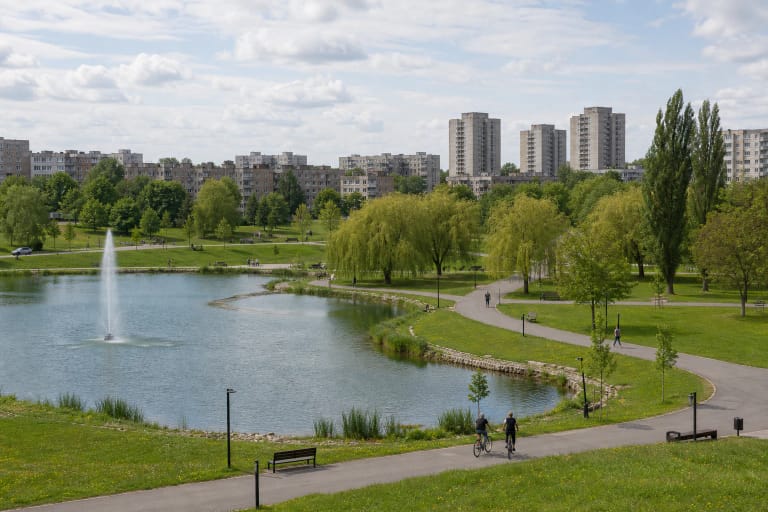
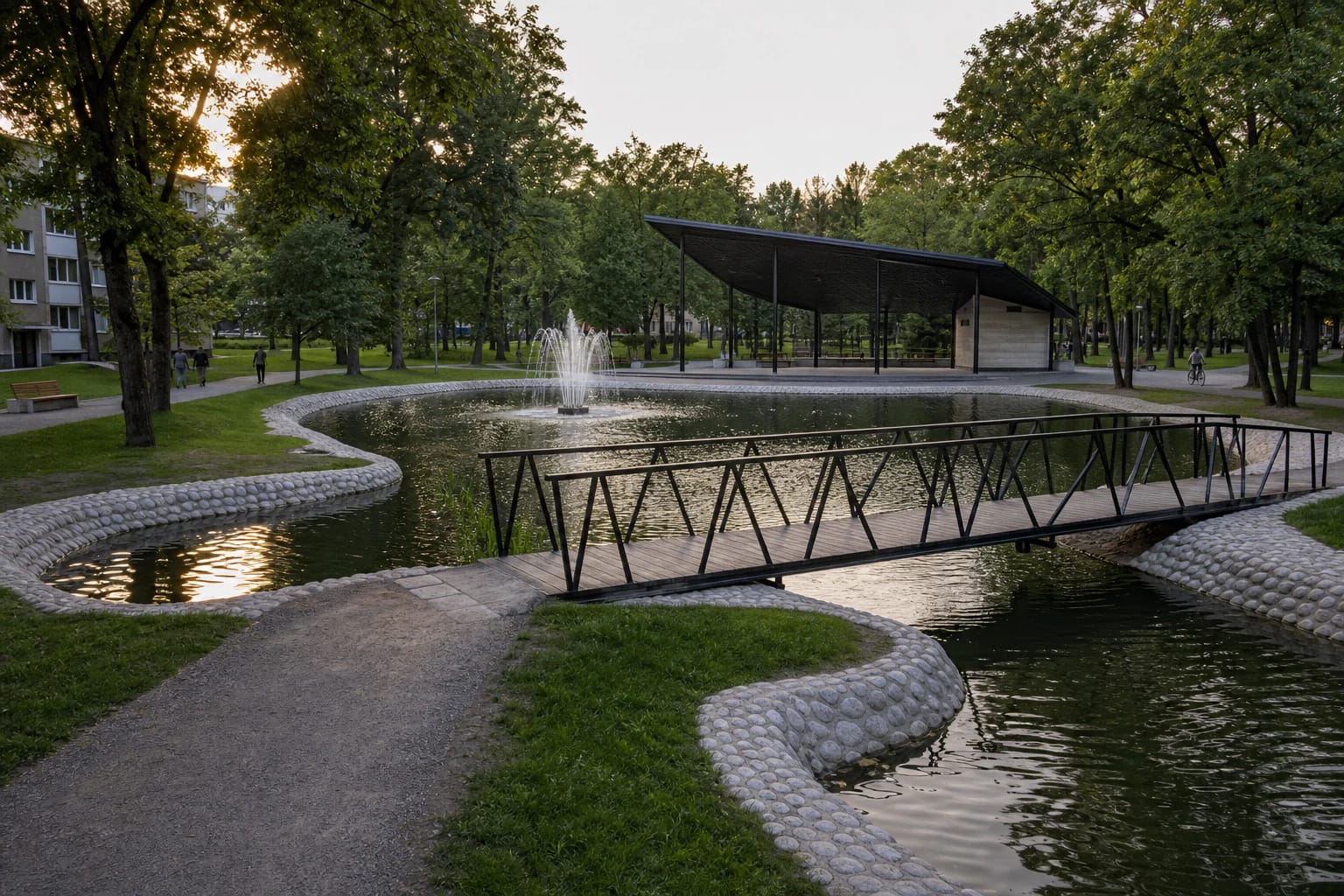
From above, the pond resembles two rounded pools joined by a narrow neck. A short black metal pedestrian bridge crosses this constriction. Pale stone-reinforced banks, dark water, a ring of trees, and the nearby open shelter with its broad sloping roof are the most reliable visual clues for recognising Dainava Park in photographs.
In 2018, Kaunas City confirmed that the pond had been comprehensively renewed and a new pedestrian bridge installed. During construction, the water was drained and the bed prepared for a waterproof lining. The result is the centrepiece of a small neighbourhood park, not a large natural lake.
An illuminated floating fountain was installed in the pond. The project expected it to occupy a noticeable part of the water surface, but operation depends on the municipal fountain season, weather, and maintenance. Official sources do not present the pond as a supervised bathing facility, and the narrow banks and bridge require close supervision of children.
A village, orchard, and greenhouses occupied the site before the park
The Ąžuolynas Library virtual exhibition says that Dainava village occupied the future park site before the Second World War. Before the park was laid out, much of the land held a fruit orchard and a well-planted greenhouse complex with a house and outbuildings. The present greenery therefore overlays both an urban-park history and an earlier horticultural landscape.
Architect Alvydas Steponavičius designed Dainava Park in the 1970s. The library account does not identify a single-day foundation date, so the 1974 date of a sculpture and the park's 1994 legal status should not automatically be presented as the year it opened. The design period and later administrative milestones are the sounder chronology.
The park received the name Dainava in 1990, and its municipal-park status and boundaries were approved in 1994. This explains why the present name is younger than the green space designed in the 1970s. These dates concern naming and formal recognition rather than the reconstruction completed in 2018.
Prie šaltinio and Gabija turn the park into a small sculpture stop
The older of the two works highlighted by the Ąžuolynas Library route is Prie šaltinio, or By the Spring. Sculptor Pranas Bartulis created this granite piece in 1974. The library's decorative-sculpture itinerary begins in Dainava Park, making the work a possible starting point for a much longer walk through eastern and central Kaunas.
Juozas Ruzgas created the bronze Ugnies deivė Gabija, or Fire Goddess Gabija. It was installed in the City Garden fountain in 2006 and moved to Dainava Park in 2021. This is a documented relocation rather than a legend about an old park landmark. Gabija brings a different material, period, and story of urban movement from the granite work of 1974.
To find both sculptures, look beyond the immediate pond circuit toward open lawns and path junctions. They are not simply ornaments within the fountain, so a first-time visitor can miss them. Do not strike or climb on the works, and do not treat their bases as play equipment.
The 2017-2018 reconstruction first addressed flooding, darkness, and failing paths
When the EUR 660,000 project began in 2017, the municipality described a dark park that flooded in spring and autumn, with cracked routes and a metal bridge in poor condition. Stormwater drainage, underground services, and electrical cables came first. Only after this less visible work did crews renew the pond, routes, lighting, and activity grounds.
Some new links followed the routes people had already worn into the grass: near the pond, beside the dog-exercise area, and from V. Krėvės Avenue toward the school stadium. The design also included three small artificial mounds, a renewed central square, three shelters, and two sites for portable toilets. The condition of shelters and the presence of mobile toilets on a particular day are not guaranteed.
The renewed park formally reopened on 19 August 2018, with an open-air film planned for the previous evening. Kaunas City called it the first city park to be completely renewed in several decades. The year 2018 consequently marks completion of the major reconstruction, not the park's original creation.
Children's, sports, and event spaces fit around the short pond circuit
The 2018 reopening notice confirms children's play and sports grounds, new lighting, benches, and paving suitable for walking, cycling, and skating. The earlier design lists gymnastic equipment, table tennis, street basketball, outdoor musical instruments, chess, a children's activity course, and a playground for children with disabilities. The present selection and condition of equipment may differ from the project description.
A roughly 380-square-metre space between a shelter and the pond was designed for neighbourhood gatherings, small events, and dancing. This role is not merely theoretical: concerts, celebrations, exercise sessions, and summer-library activities have taken place in the park. An event can occupy part of the square or a path, so check Dainava district notices when planning a quiet visit.
There is no admission ticket or controlled gate. Principal paved routes are generally practical for a pushchair or wheelchair, but no current access audit covering the complete site was found. Bridge gradients, wet surfaces beside the pond, closed equipment, and maintenance works can alter the easiest route. Drivers must read street signs and avoid blocking access to apartment buildings.