- Place
- Raudondvaris, Kaunas District Municipality
- Region
- Kaunas District
- Type
- Renaissance manor ensemble, park, and cultural space
- Address
- Pilies takas 1, Raudondvaris
- Coordinates
- 54.94310, 23.78300
Raudondvaris Castle Manor, Raudondvaris palace-castle
A Manor on the Nevėžis Bank
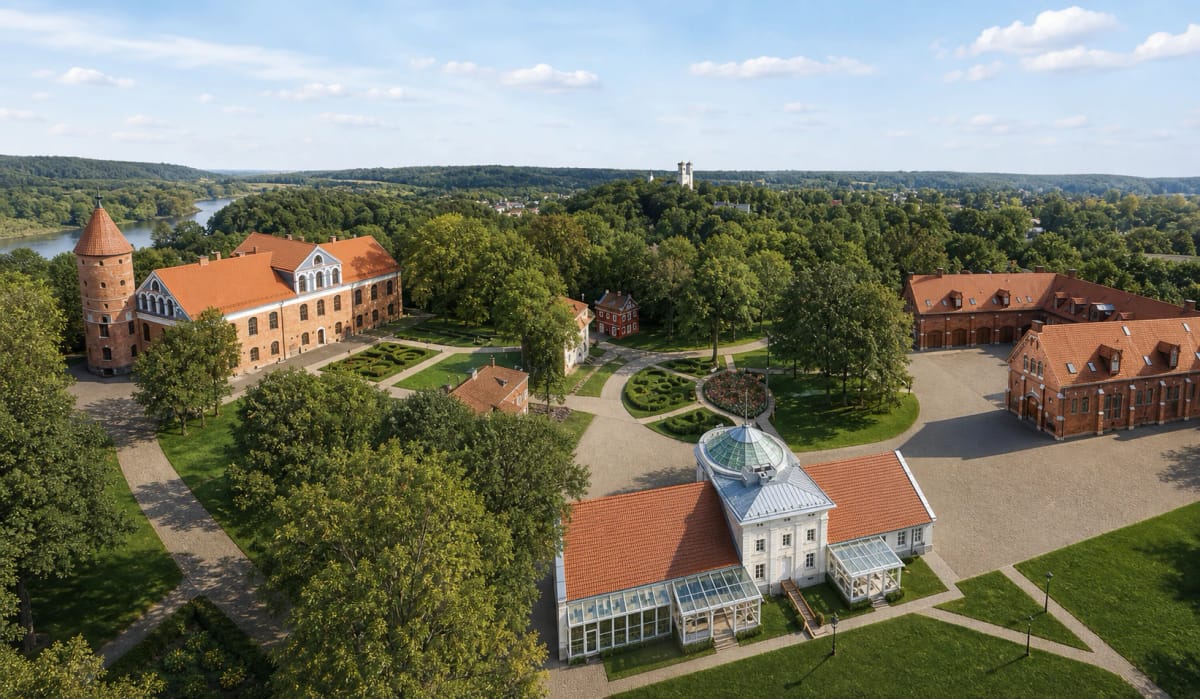
Raudondvaris Manor stands on the upper terrace of the right bank of the Nevėžis, near the confluence of the Nevėžis and Nemunas. The official manor site presents it as an early seventeenth-century Lithuanian Renaissance architectural monument about 9 km from Kaunas toward Jurbarkas.
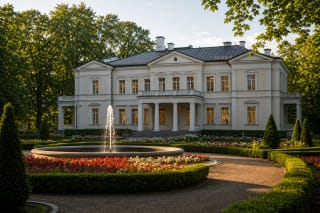
VLE emphasizes the composition of the ensemble: the palace-castle, two Neo-Gothic officinas, granaries, icehouse, orangery, fence with gates, a Classicist steward's house, an English Neo-Gothic stable, and a park. It is therefore not one building but a whole manor landscape.
Red-Brick Palace and Tower
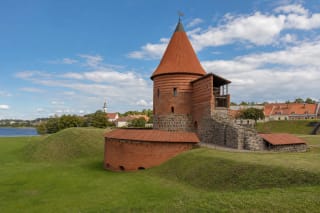
The main building is a red-brick palace with a cylindrical tower. VLE describes the palace as Renaissance with Mannerist features: two storeys, a mezzanine, a four-tier cylindrical tower, and a high conical roof.
The red-brick facades became part of the identity of the place. VLE explains that because of the brick color the locality was called Aukštas raudonas dvaras, or High Red Manor, from which the name Raudondvaris later developed.
Owners: from the Dzevaltauskiai to the Tiškevičiai
The official manor history links the beginning of construction with the Dzevaltauskiai family, which strengthened its influence in the second half of the sixteenth century, and with Kaunas deputy chamberlain Vaitiekus Dzevaltauskas. VLE is more cautious, saying the palace was built in the early seventeenth century, probably by Kaunas deputy chamberlain V. Dziavaltauskas.
In 1652 Vilnius voivode and Grand Duchy of Lithuania hetman Jonušas Radvila bought the manor from Eustachijus Kosakovskis. Later it was owned by the Vorlovskiai, Zabielos, and, from the early nineteenth century, the counts Tiškevičiai, whose traces are especially visible in the present ensemble.
The Tiškevičiai Period and Collections
VLE writes that the Tiškevičiai gathered a large library and art collection in Raudondvaris and created a park and garden. The official manor page also mentions collections of paintings, artworks, rare books, exotic plants, and animals.
The palace burned during the 1831 uprising. In the Tiškevičiai period the interiors were replanned, new buildings were added, and mid-nineteenth-century changes gave the ensemble Neo-Gothic features. It is important not to call the whole complex purely Renaissance: several architectural layers are clearly visible.
Decline, Restoration, and New Life
In 1944 the retreating Nazis burned the palace. VLE states that in 1962-1964, during restoration according to a design by architects S. Čerškutė and V. Jurkštas, its Renaissance appearance was restored.
Today Raudondvaris Manor is an active cultural venue. The official page mentions events, civil wedding ceremonies, conferences, concerts, a restaurant in the orangery, a tourism and business information center in the icehouse, and an arts incubator opened in the stable in 2015.
How to Visit Raudondvaris Manor
The manor is convenient for a short trip from Kaunas: its address is Pilies takas 1, Raudondvaris, and the official contact page gives a map link. Allow at least an hour, or more if you include the park, orangery, or an event.
Start with the palace-castle and tower, then walk through the park toward the orangery, icehouse, and stable buildings. Because the manor is an event space, check the official page before traveling for events, closed areas, or special visiting conditions.