- Place
- Kalnelis, Joniškis District Municipality
- Region
- Joniškis District
- Type
- Semigallian hillfort with outer fortification and foothill settlement
- Address
- Kalnelis village, Joniškis eldership, Joniškis District
- Coordinates
- 56.24685, 23.55549
Sidabrė Hillfort, Sidabra, Kalnelis (Sidabrė) Hillfort
Kalnelis Hillfort and Semigallian Sidabrė
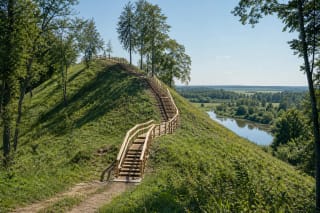
Kalnelis Hillfort is in Kalnelis village, Joniškis District, on the left bank of the Sidabra River, about 3 km west of Joniškis. This is not only a landscape site but a historical one: the Semigallian castle Sidabra, also called Sidabrė, stood here. It is important to say Semigallian, not Samogitian, because these Baltic groups are sometimes confused in translation.
VLE dates the hillfort to the fifth-thirteenth centuries, with a cultural layer about 0.9 m thick. In historical sources Sidabrė is mentioned as one of the strongest and hardest-to-take Semigallian fortresses, a place whose fight against the Livonian Order became a symbol of the end of Semigallian freedom.
The last Semigallian fortress
Sidabrė is mentioned from the late thirteenth century in the Livonian Rhymed Chronicle and Hermann of Wartberge's chronicle. It first appears in documents in 1288, when the Livonian Order unsuccessfully tried to capture it: the foothill settlement was burned, but the castle held.
After the Order took Tērvete and other Semigallian castles, Sidabrė remained the last. VLE writes that in 1289 and 1290 the Teutonic Order attacked the castle, and in 1290, after residents withdrew, it burned it. This ended the conquest of Semigallia, and some inhabitants moved deeper into Lithuania. Later, in 1426, Sidabrė Hill was still mentioned in the Livonia-Lithuania border treaty.
Hillfort form and finds
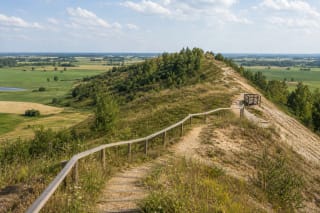
According to VLE, the slopes are 4-6 m high and the oval platform measures about 70 x 45 m. North of it, beyond a ditch, another hill holds an outer fortification with an oval platform about 130 x 40 m. Around the southern and northern foot was a 4 m wide and 2 m deep ditch, now filled; the foothill settlement surrounded the hill from west, south, and east.
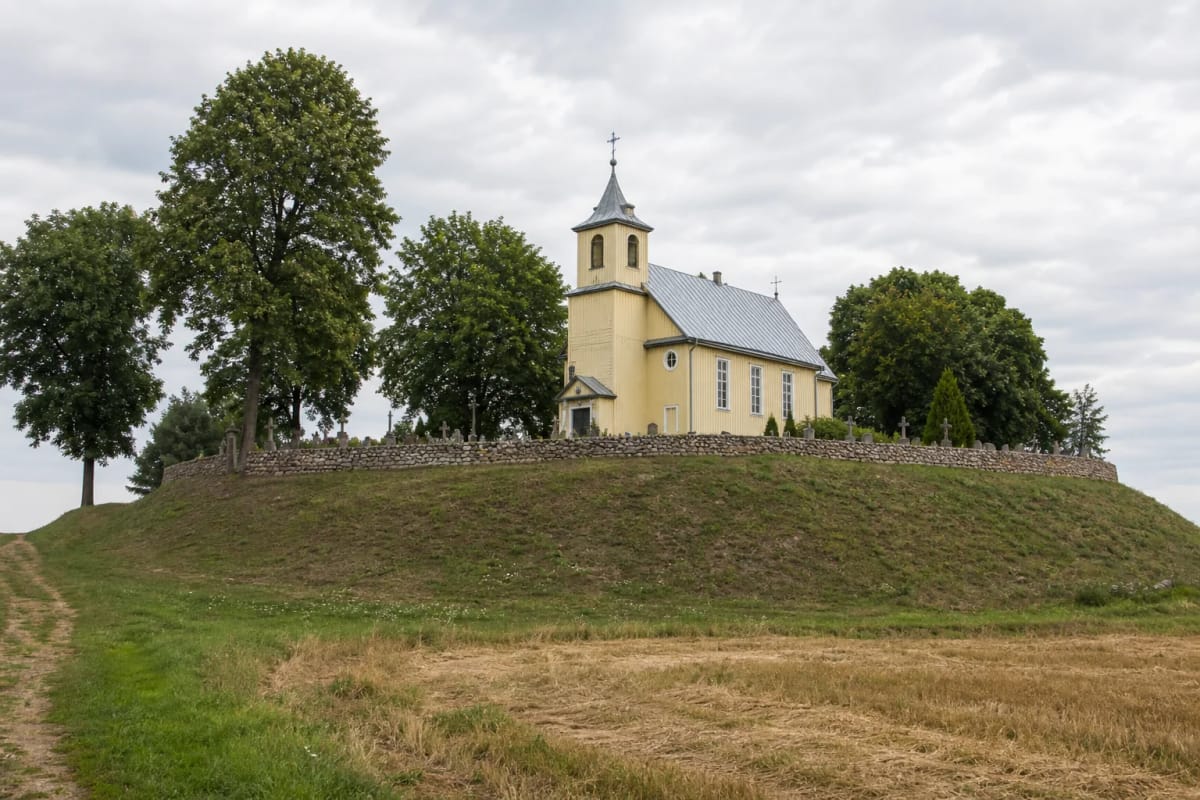
The hillfort was investigated in 1966 by Juozas Šliavas, in 1968 by the Lithuanian Institute of History, and in 1990, when Algimantas Merkevičius researched the foothill settlement. Finds include rough and thrown pottery, a silver ingot, sword-scabbard fittings, a horseshoe brooch blank, knives, spurs, an awl, and even a jeweller's hammer. A wooden church was built on the hill in 1526 and a cemetery was established.
Sidabrė, Joniškis, and visiting
Sidabrė is closely tied to Joniškis self-understanding: the date of its first mention is treated as a symbolic beginning of the region, and the story of Semigallian resistance inspired local people during the national revival. Today a monument to the fortress defenders, Kalnelis chapel, and cemetery stand on the hill, so visit respectfully.
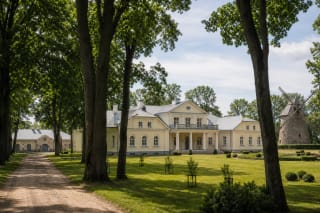
The hillfort is an open site without tickets or opening hours. A visit usually takes 20-40 minutes; walk around the platform and outer fortification and look toward the Sidabra valley. Kalnelis combines well with Žagarė, its manor and esker, and other Semigallia-region sites.