- Place
- Marijampolė Municipality
- Region
- Suvalkija
- Type
- historic market and event square with an outdoor monument to the millennium of Lithuania's recorded name
- Address
- Jonas Basanavičius Square, Marijampolė
- Coordinates
- 54.55731, 23.34944
- Visit duration
- 30-45 minutes for the square and monument; 1.5-2.5 hours with Poetry Park, the basilica and museum
- Best time
- in daylight for the reliefs and surrounding façades; check Marijampolė's event calendar before travelling
J. Basanavičiaus aikštė, Jonas Basanavičius Square, Marijampolė Central Square, Tautai ir kalbai Monument, Monument to the Nation and Language, Lithuania Millennium Monument
The square and monument are connected sites from different periods
Jonas Basanavičius Square is a broad public space in central Marijampolė. The Nation and Language Monument standing within it is an outdoor artwork with no interior. Municipal, cultural, hotel and other central buildings form the square's edges, but each interior has its own function and access conditions.
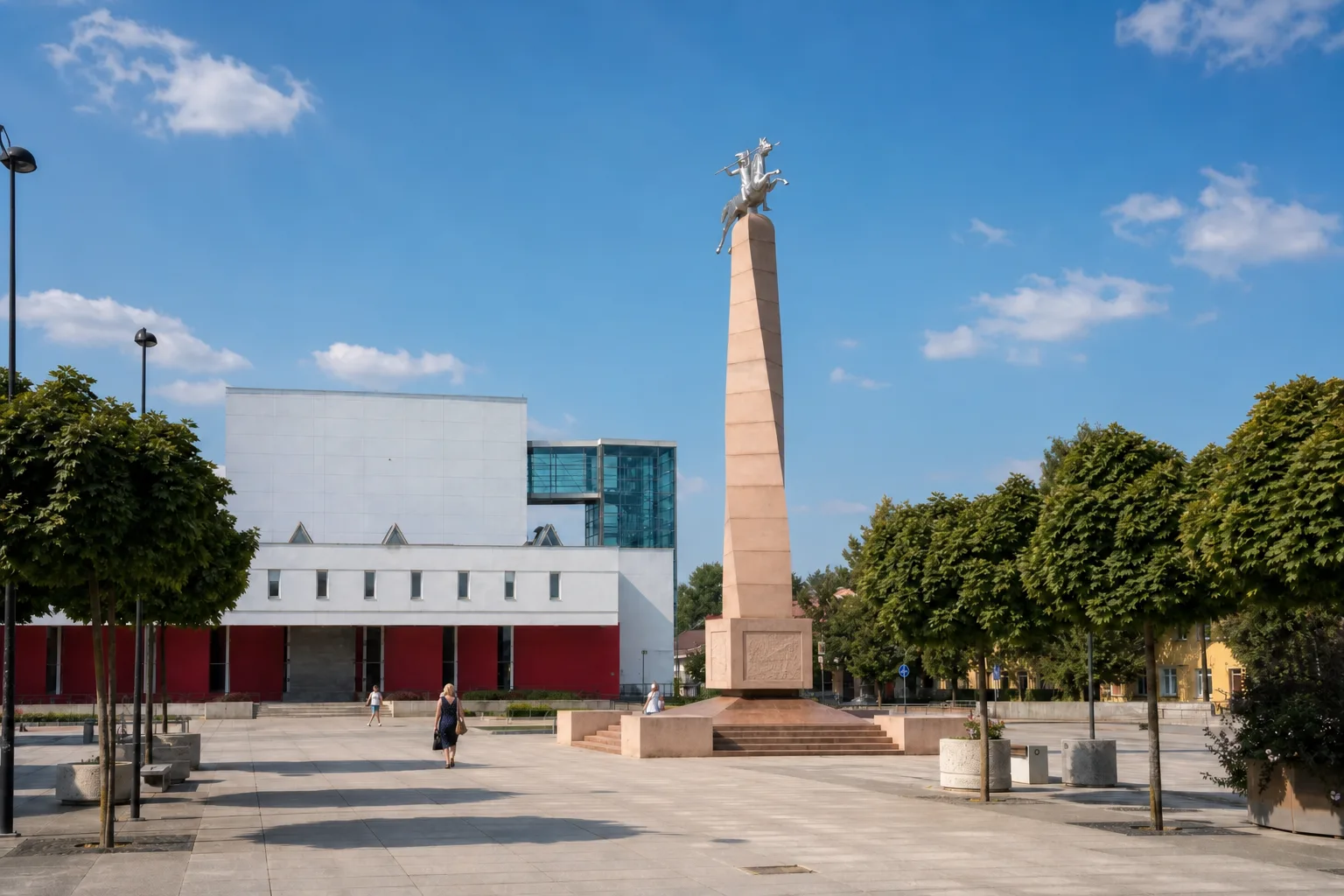
The coordinate 54.557306, 23.349442 marks the monument itself rather than the square's geometric centre, an entrance or a car park. Start by circling the four-sided pedestal, then move back across the plaza to understand how the nearly 20-metre column relates to the scale of the surrounding buildings.
This is not a portrait monument to Jonas Basanavičius. His name belongs to the square; the artwork commemorates the Lithuanian nation, its language and the millennium of the first recorded mention of Lithuania's name. That distinction explains the symbolic horseman at the summit rather than a figure of the square's namesake.
The place changed with Marijampolė from Market Square to Jonas Basanavičius Square
The street-name history compiled by Petras Kriaučiūnas Public Library describes a settlement growing around a triangular square within a radial plan in the sixteenth and seventeenth centuries. After the fire of 1765 it was reorganised on a rectangular plan, and an inventory from 1782 already records a four-sided Market Square. Nineteenth-century plans continued to label it as the Market or Market Square.
Once Marijampolė had two trading squares, the old centre became known as Old Market Square. It was renamed Citizens' Square in 1920, acquired the Jonas Basanavičius name in 1927, and that name was confirmed by the municipal department of the Interior Ministry in 1929. By 1932 the press was discussing the market's relocation and improvements to the square.
The Soviet authorities renamed it K. Požėla Square in 1952. The Jonas Basanavičius name returned on 9 February 1989. The present name therefore carries both interwar and national-revival history; the monument erected in 2009 did not give the square its name.
Kęstutis Balčiūnas's monument opened in 2009 before the square project was complete
The full dedication on the pedestal is rendered as 'To the Nation and Language: Commemorating the Millennium of Lithuania's Name, 1009-2009'. It was unveiled on 6 September 2009, in the year marking a millennium since Lithuania's name appeared in the Quedlinburg Annals. The memorial was a distinct commission even though its construction overlapped with work on the surrounding public space.
Marijampolė Municipality's history and the artist's own list of works credit the monument to sculptor Kęstutis Balčiūnas. The official sources checked do not name a separate architect for the monument. Gintautas Vieversys and participants in the square's unbuilt 2014 ideas workshop must therefore not be reassigned as authors of this 2009 work.
The monument combines pinkish granite and stainless steel. Sources describe it as roughly 19-20 metres high and about 300 tonnes in weight. Its granite base, long faceted column and gleaming metal horseman form one artwork; the plaza paving, planting, lighting and fountain belong to the separate public-realm project.
Read the four reliefs, spiralling column and horseman in sequence
The four sides of the base set out the monument's programme. One carries the dedication; another shows a pagan priest beside an altar and oak, with a symbol-marked stone nearby. A third relief presents Martynas Mažvydas and the first printed Lithuanian book, while the fourth links linguist Jonas Jablonskis with words from Mikalojus Daukša's Postil.
The four corners of the pedestal are interpreted as Lithuania's four ethnographic regions. The tall granite column rises with a slight twist, symbolising the nation's difficult route to survival. Its changing profile is easier to notice from several points across the square than from directly beneath it.
At the summit a stainless-steel horse and rider surge forward with a spear. In the interpretation presented by the tourism centre, the horse represents national drive and movement towards the future, the rider a free nation, and the spear struggle, language and survival. You need both close and distant viewpoints to see the reliefs and the summit clearly.
The 2008-2011 public-space project changed the square, not the monument's authorship
Marijampolė Municipality's history dates approval of the square project to 2008. Its funding agreement followed in 2009, the monument opened that September, and contractor Statybos ritmas completed the wider square and approach works in summer 2011. That sequence accounts for both 2009 and 2011 appearing in descriptions of the present-day space.
The 2011 completion notice lists new paving and lighting, renewed water and sewage services, stormwater drainage, replaced planting, a stage platform, a fountain and an underground public toilet. This is an inventory of what the project installed at completion, not evidence that every facility operates during every present-day visit.
The municipality described the square as a venue for mass events and national commemorations with the monument as its main focus. Current civic calendars continue that role, so a fair, concert, ceremony or stage build can temporarily alter walking routes and obscure the quiet architectural composition.
The plaza is outdoors, but steps and unverified services call for careful planning
There is no general ticket or tourist entrance gate for the public square, and the monument is viewed outdoors. Allow about 30-45 minutes for an unhurried circuit of the reliefs and several wider viewpoints. If you want to enter a surrounding building, use that institution's own current opening information.
Most of the square uses broad hard paving, but the monument stands on a raised base reached by steps. The reliefs can still be seen from the lower plaza level, yet no comprehensive current accessibility audit for the whole space was found; rain, snow and ice can also change surface conditions.
The coordinate does not identify parking. A 2011 source records an underground toilet and fountain, but reliable evidence of their everyday operation in 2026 was not found, so do not plan a visit on the assumption that either service is guaranteed. Check municipal event and traffic notices before a time-sensitive trip.