- Place
- Marijampolė, Marijampolė Municipality
- Region
- Suvalkija
- Type
- a school history museum inside an active historic gymnasium, visited through advance reservation
- Address
- 7 Kauno Street, LT-68175 Marijampolė
- Coordinates
- 54.55996, 23.34921
- Visit duration
- about 45-60 minutes, according to the reserved visit
- Best time
- at a confirmed weekday appointment; on 19 July 2026 the booking calendar offered times within 08:00-17:00
Marijampolė Rygiškių Jonas Gymnasium History Museum, Rygiškių Jonas Gymnasium Museum, Marijampolės Rygiškių Jono gimnazijos istorijos muziejus
The museum operates inside a school, so visits must be booked
This is not a freestanding city museum open for an unannounced circuit. The exhibition occupies part of the active Marijampolė Rygiškių Jonas Gymnasium, and access is organised by the school. Its official museum page sends visitors to a reservation system, while the municipality explicitly describes advance registration as mandatory. Do not plan to walk in without a confirmed appointment.
On 19 July 2026, the official system displayed weekday slots, Monday to Friday, between 08:00 and 17:00 in one-hour calendar blocks. That is a reservation window, not a promise of immutable museum opening hours: the chosen appointment must be available and confirmed. Lesson times printed on the school website are the gymnasium timetable, not public museum hours.
The point at 54.559958, 23.349211 marks the historic school at its current address, 7 Kauno Street, rather than a confirmed museum room or visitor door. The 2007 cultural-property valuation still records 5 Kauno Street; visitors should use the school's current contacts and 7 Kauno Street address.
The museum grew from memory gathered by teachers and former pupils
The idea of a school museum reaches back to the interwar years, when local-history and folklore material was collected, but occupation and war dispersed or destroyed those holdings. The school history particularly records 1944, when the building was turned into a military hospital, and the post-war destruction of the old library and other cultural material. The present museum is therefore better understood as a reconstruction than as an uninterrupted interwar collection.
During the 1960s, the teacher Jonas Kvederaitis corresponded with former pupils and writers including Vincas Mykolaitis-Putinas, Antanas Venclova, and Kazys Boruta. Letters, photographs, and donated books accumulated into the basis of a new collection. As the school's centenary approached, Lithuanian-language teacher Vincas Peckus was placed in charge of establishing the museum in 1965.
The museum opened ceremonially in 1967 during the centenary, and Peckus is remembered as its founder. He was again given special attention when the renewed exhibition opened in 2026 as the person who preserved the school's memory. The present head, Judita Zubavičienė, and the gymnasium community continue both to safeguard that material and to interpret it for visitors.
The gymnasium founded in 1867 became a centre of Lithuanian national revival
A predecessor school had operated in Marijampolė since 1840; in 1867 the Russian imperial authorities converted it into a seven-year gymnasium. Although it belonged to the tsarist education system, Lithuanian was taught here. Around teachers Petras Arminas-Trupinėlis and, from 1881, Petras Kriaučiūnas, pupils developed a Lithuanian cultural consciousness, circulated banned print, and formed self-education circles. Pupils were connected with the clandestine Sietynas society in 1894-1897.
The gymnasium was evacuated to Yaroslavl during the First World War, then resumed work in Marijampolė early in 1918 and switched to Lithuanian as the language of instruction. It was nationalised and named Rygiškių Jonas in 1920. Rygiškių Jonas was a pen name of linguist Jonas Jablonskis, so the school is not named after a second, separate historical figure.
Its best-known pupils included Jonas Basanavičius, Vincas Kudirka, Jonas Jablonskis, Kazys Grinius, Jurgis Matulaitis, and Vincas Mykolaitis-Putinas. Four alumni - Basanavičius, Saliamonas Banaitis, Petras Klimas, and Justinas Staugaitis - signed Lithuania's Act of 16 February 1918. In the museum this is more than a wall of celebrated names: it demonstrates how one school connected with the making of modern Lithuanian culture and statehood.
Documents and portraits now sit within an interactive narrative
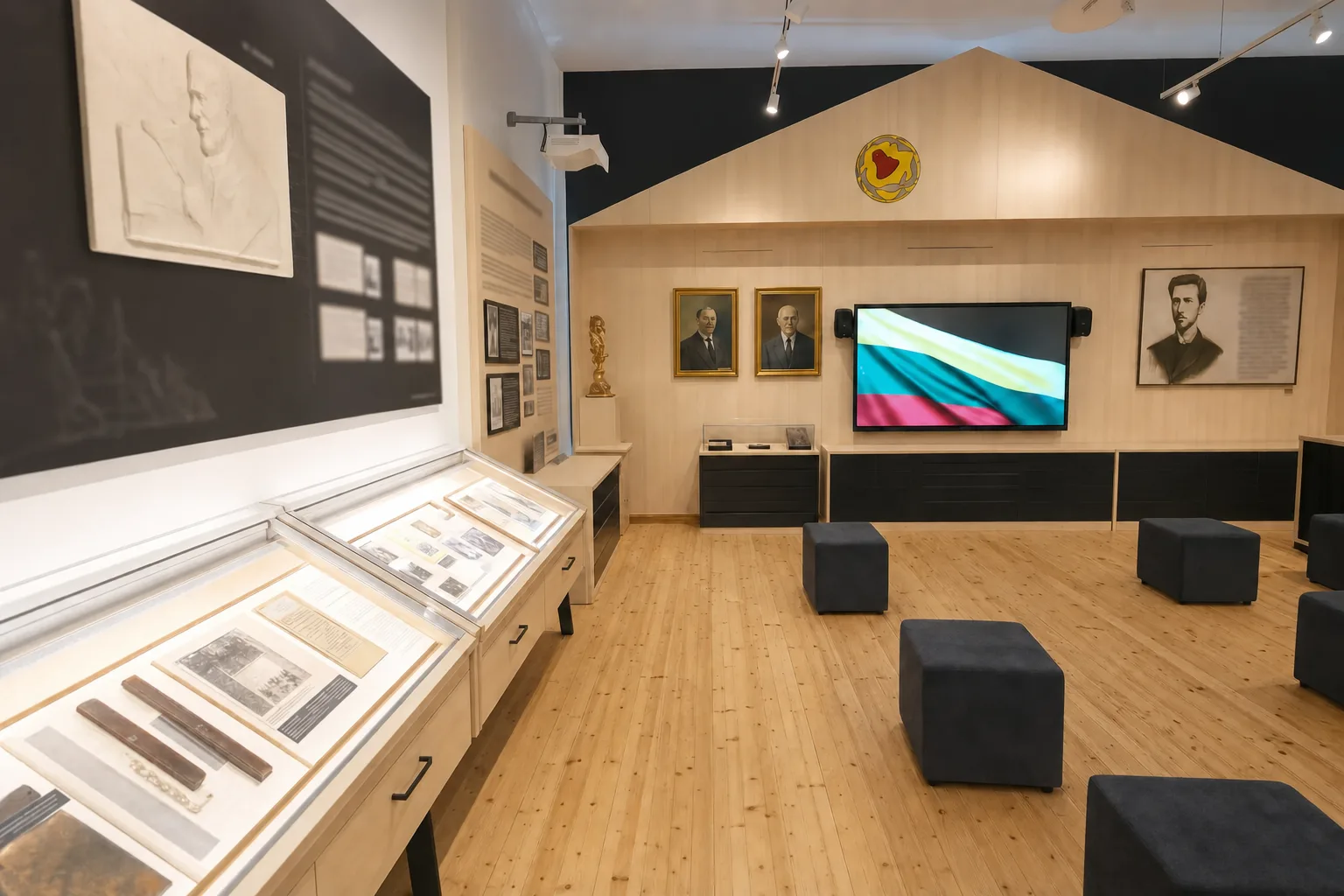
The renewed museum leads from the gymnasium under imperial Russian rule to restored Lithuanian independence. Displays bring together school documents, photographs, publications, and portraits of prominent teachers and pupils. The municipality highlights an interactive 'speaking' Vincas Kudirka and an exhibition intended not only for reading but also for touching, trying, and exploring. Its subject remains the school's history rather than the general history of the whole Marijampolė region.
Published collection totals conflict. The gymnasium's official history page lists nearly 4,000 objects in the main collection and about 3,000 in an auxiliary collection, while the tourism page reports more than 9,500 items. Neither explains whether the discrepancy reflects dates, classification, or collection scope, so the figures should not be added together or presented as one precise current inventory.
The importance of many objects lies as much in provenance as in appearance. Letters from former pupils, donated books, and photographs gathered by the school community preserve relationships between generations. A useful question during the visit is therefore not only who appears in an image, but how a document returned to the school and which teacher, pupil, or historical rupture it helps illuminate.
The 2026 renewal changed presentation without restarting the museum's history
The renewed exhibition was presented to visitors on 23 April 2026. The gymnasium associates the modernisation with Lithuania's Millennium Schools II programme, and credits the HoPro team led by Artūras Lukševičius with implementing the exhibition system. Pale-wood structures, dark interpretive surfaces, screens, and seating now form a contemporary gallery within the historic school.
The opening account brings together headteacher Vilhelmas Petkevičius, museum head Judita Zubavičienė, and founder Vincas Peckus. That emphasis clarifies the chronology: 2026 introduced a new mode of display, but did not establish a new institution. The museum still dates from 1967, and the core of the collection began accumulating earlier.
Digital and interactive elements can change more quickly than historical objects. A particular screen programme, working device, or education session should not be assumed to accompany every appointment. State the nature of your group when booking and ask whether the interpretation you want will be available.
A protected 1870 school and a separate Putinas museum share the address
The cultural-property valuation dates the gymnasium building to 1870 and records reconstruction in 1890, 1960, and 1977. It identifies protected masonry, corridor plans, stairs, facade pilasters, arched windows, and other features, describing the facade in neoclassical terms. VLE instead calls the building an example with early Historicist characteristics, so this page does not force the two descriptions into one uncontested style label.
The Vincas Mykolaitis-Putinas Museum has also occupied the gymnasium building since 2002, but it is a separate branch of the Marijampolė Regional and President Kazys Grinius Museum. Its history, collection, booking, admission, and accessibility information cannot automatically be applied to the gymnasium's own history museum. Say clearly which of the two museums you want when arranging a visit.
Research found no published current admission tariff or precise step-free route for the gymnasium history museum. Ask about price, group size, stairs, the correct door, and any needed assistance before confirming. Bring the reservation details, arrive punctually, and follow the route given by school staff, because the remainder of the building continues to serve as an educational institution.