- Place
- Klaipėda City Municipality
- Region
- Klaipėda
- Type
- natural urban hill, viewpoint, and community winter recreation space
- Address
- Near I. Simonaitytės g. 13, between Vingis and Žardininkai, Klaipėda
- Coordinates
- 55.67360, 21.18580
- Visit duration
- 25-50 minutes to climb, view southern Klaipėda, and walk around the foot of the hill
- Best time
- a dry evening for views or a snowy day for winter recreation, after inspecting the chosen slope
I. Simonaitytė Hill, Simonaitytė Hill
A green rise between Vingis and Žardininkai
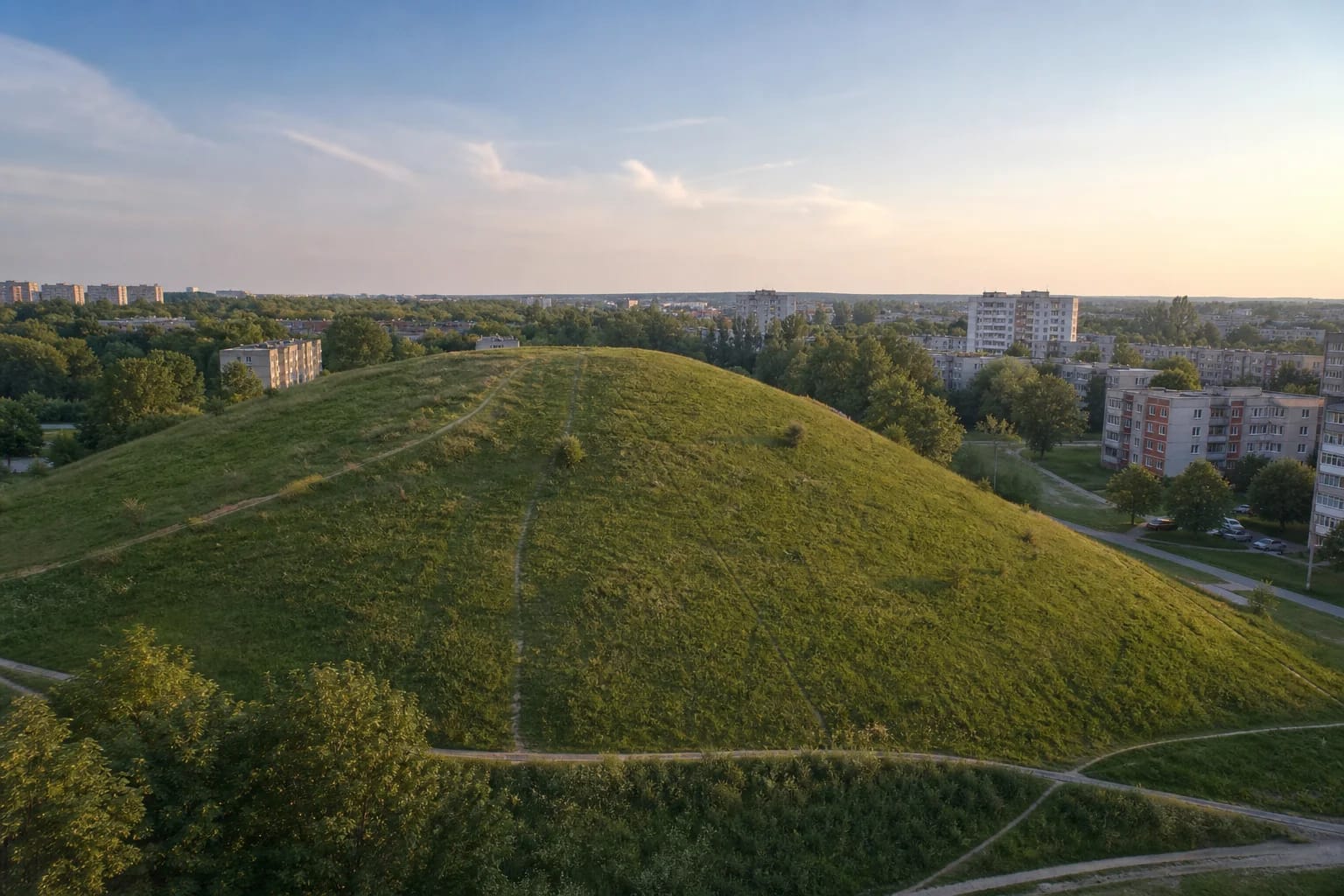
Ieva Simonaitytė Hill rises in southern Klaipėda between I. Simonaitytės Street and the Vingis and Žardininkai residential districts. Klaipėda planning documents mark it as a local landmark and place of interest. It is not a fenced park with one entrance, but a hill integrated into the everyday network of neighbourhood greenery and paths.
The hill is naturally formed, although its surroundings changed as southern Klaipėda and the greenery of Draugystė Park were developed. Reliable public sources do not publish an official elevation or a measured viewing radius, so the panorama should not be promoted with invented distances. The summit simply provides a rare elevated look across an otherwise flat residential cityscape.
The writer's name in the landscape of southern Klaipėda
Ieva Simonaitytė was born at Vanagai in 1897 and is regarded as the foremost Lithuanian prose chronicler of life in Lithuania Minor. She moved to Klaipėda in 1921, worked as a typist, translator, and proofreader, participated in Lithuanian cultural activity, and became a full-time writer in 1936.
She lived in Klaipėda until 1939 and wrote major early works here. Aukštujų Šimonių likimas won the Lithuanian State Literature Prize in 1935, while Vilius Karalius became one of her defining novels. The street and hill names preserve that connection, but there is no writer's museum or biographical exhibition on the hill itself.
What to see from the top
The upper hill looks across the apartment districts of Vingis, Žardininkai, and southern Klaipėda, along with green corridors, street axes, and the broad coastal sky. The best view depends on vegetation, visibility, and which part of the crest you choose. Evening brings softer light, but descend while the uneven slope remains clearly visible.
The visit is short and combines easily with a walk on surrounding Draugystė Park paths or at nearby Sąjūdis Park. Do not create new worn tracks or strip turf from the slope. After rain, grass and clay-rich ground can be slippery even without snow.
A sledging hill, not a ski centre
After snowfall, Simonaitytė Hill attracts children and adults with sledges, sliders, and skis. Klaipėda's participatory-budget material describes it as a popular destination for families from across the city. Popularity does not mean that its slopes are groomed, patrolled, or certified as sports pistes.
Inspect the entire descent from below before every run. A safe line must avoid trees, lighting columns, benches, fences, bare ice, pedestrian paths, cars, and other sledgers. Supervise young children, consider helmets, and never descend towards a street or junction.
A free city space without fixed opening hours
The hill is an open urban green space without a ticket office, gate, or published admission fee. No fixed hours are stated, although daylight is safest. Lighting in the surrounding area does not make every hollow and obstacle equally visible. Events at the foot of the hill may temporarily bring larger crowds or restrictions.
Main paths at the foot can be convenient for wheeled users, but the steep grass slope and summit approach are not reliably step-free. Park only in marked urban spaces without blocking residential access. Allow 25-50 minutes unless you are combining the hill with a longer neighbourhood walk.