- Place
- Šiluva Eldership, Raseiniai District Municipality
- Region
- Dubysa Regional Park
- Type
- a state-protected botanical natural heritage object - an oak
- Address
- Plauginiai Forest, Dubysa Regional Park, Raseiniai District
- Coordinates
- 55.45871, 23.11006
- Visit duration
- 45-90 minutes for the trail, oak, and rest stop
- Best time
- a dry day from late spring to autumn; the leafless season shows the trunk and branch structure best
Gražusis ąžuolas, Gražusis Oak of Plauginiai Forest
Gražusis Oak grows in Plauginiai Forest in Dubysa Regional Park
Gražusis Oak in Plauginiai Forest stands in Šiluva Eldership, Raseiniai District, within Dubysa Regional Park. The current official name is longer than the commonly used Gražusis Oak, so it is useful to search for both forms and save the precise map point before travelling.
The tree's point is approximately 55.458705, 23.110064. This is not the Dubysa Regional Park visitor centre or a general forest-road start, but a particular botanical site. The protected-area description directs visitors from the Raseiniai-Siluva road along a gravel forest road.
The visit begins before the trunk comes into view. The approach crosses a forest edge and a wooded setting, while the final walk lets visitors experience the oak as part of a protected landscape rather than only as a photograph subject.
A 32-metre tree with a trunk circumference of about 5.6 metres
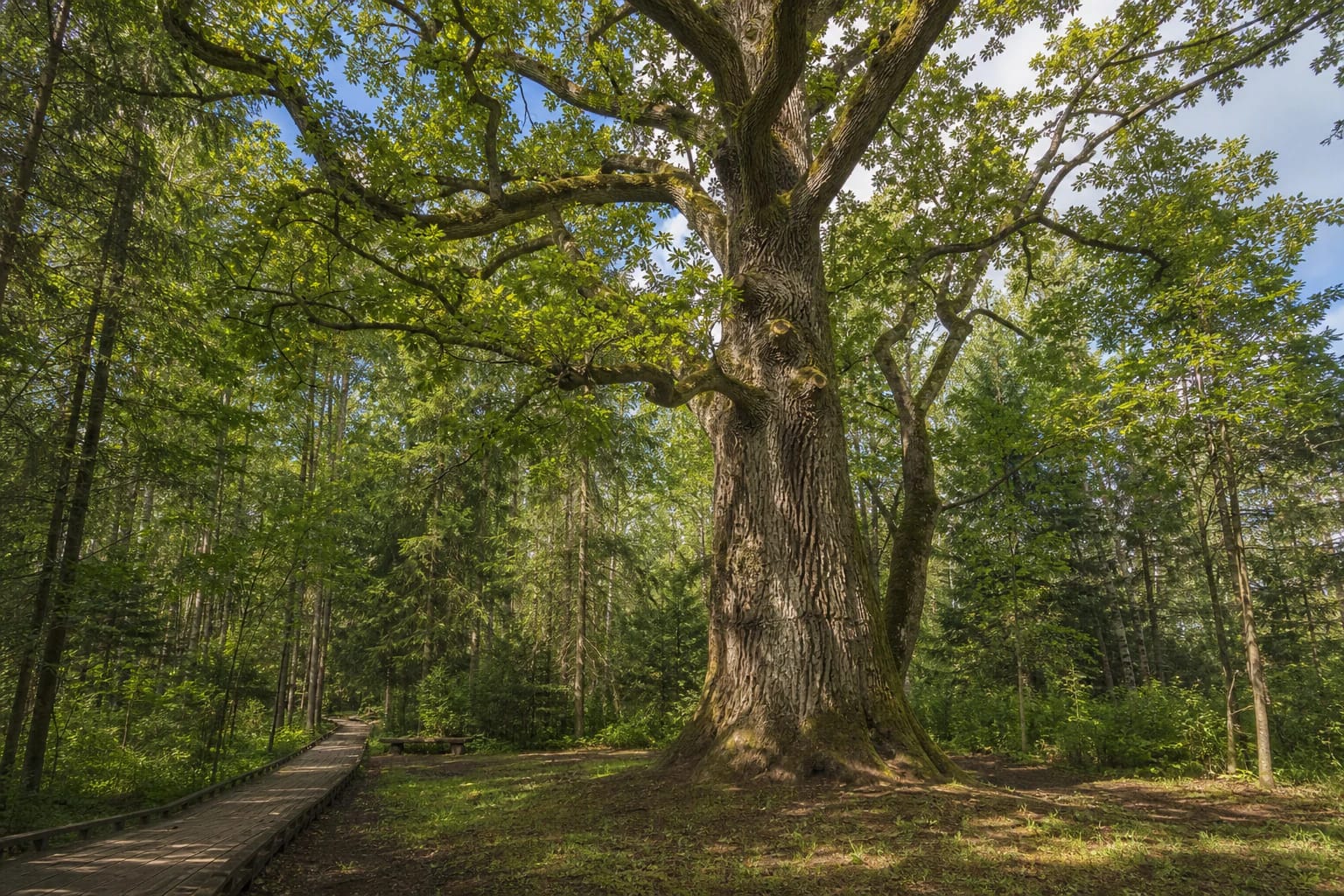
Gražusis Oak is about 32 metres tall, with a diameter of roughly 1.76 metres and a trunk circumference of about 5.6 metres. The numbers establish its scale, but the strongest impression comes from the broad trunk, deeply furrowed bark, and crown rising above the surrounding trees.
The tree's age is usually estimated at about 300 years, but this is an estimate rather than an exact birth date. Measurements and age figures for veteran trees may be rounded differently in different descriptions, so the fairest wording is a centuries-old veteran tree.
Do not only view the trunk straight on from the trail. Step back into the woodland clearing to see how the trunk divides into the crown, how its branches sit above neighbouring trees, and why the root zone and growing place deserve protection along with the visible tree.
A state-protected botanical natural heritage object since 1960
Gražusis Oak has been state-protected since 1960. It belongs to the botanical natural heritage category, whose value may lie in a tree's size, age, form, rarity, and landscape setting. In Dubysa Regional Park it is one of five natural heritage objects.
Protection concerns more than the visible trunk. Leave cars, bicycles, and heavy equipment on a lawful road section or designated place, never drive across the root zone, do not climb the tree, and do not write on its bark. A veteran tree may look robust while its tissues and branches remain vulnerable.
The small rest area mentioned beside the trail gives visitors a place to pause without leaning on the tree. Keep the passage open, take rubbish away, and light no fire where protected-area rules do not allow it.
A nature trail of about 400 metres leads to the oak
A nature trail of about 400 metres leads from the gravel forest road to Gražusis Oak. Older descriptions mention a 350-metre section, so the current waymarks and trail condition matter more on site than measuring every metre against an earlier figure.
The route to the oak combines a timber trail, green woodland, an open space around the tree, and simple rest infrastructure. This is not an urban pavement: roots, wet leaves, mud, or slippery timber may appear. After rain, wear shoes with reliable grip.
Daylight is the most practical time to visit because the approach and trail condition are easier to assess. The official sources checked do not describe a separate ticket desk or opening schedule, but that does not mean the forest road is equally passable in every season or that temporary restrictions cannot apply.
A short stop that rewards a slower look
In spring and summer the oak rises from bright woodland green, while in autumn its crown joins the yellow and brown canopy. The leafless season best reveals the branching structure, old bark, and the relationship between the veteran tree and its neighbours.
Pause quietly beside the trail and notice the habitat as well as the tree. A squirrel or woodland bird may appear in Plauginiai Forest, but wildlife is never guaranteed entertainment. The important thing is not to disturb animals or enter the undergrowth for a better photograph.
Allow about 45-90 minutes for the oak and trail. A longer outing can include other Dubysa Regional Park sites, but give each stop its own time: this page is about one tree, not the whole park route.