- Place
- Paberžė eldership, Vilnius District Municipality
- Region
- Vilnius Region
- Type
- a state-protected pedunculate oak and botanical natural monument
- Address
- Glitiškės Manor park near 1 Liepų Avenue, Glitiškės, Paberžė eldership, Vilnius District
- Coordinates
- 54.98497, 25.22192
- Visit duration
- 20-40 minutes; longer when attending a manor event or exploring the Lake Širvys shore
- Best time
- in daylight from May to October for the crown, or in the leafless season for the trunk structure; avoid storms and strong winds
Glitiškių ąžuolas, Glitiškės Manor Oak, Old Oak of Glitiškės
This is a Vilnius District site, not a place in Panevėžys
Glitiškės Oak grows in the village of Glitiškės, within Paberžė eldership and Vilnius District. Some online lists incorrectly group it with Panevėžys, but VSTT, VLE, Vilnius District Municipality, and the forestry inventory all identify Glitiškės beside Lake Širvys. Navigate to the specific oak point rather than relying on a broad search for a similarly named locality.
The State Forest Service WGS 84 point 54°59'05.9" N, 25°13'18.9" E converts to 54.9849722, 25.2219167. It marks the trunk itself at the edge of the manor park. The exact Google place card, ID ChIJpRbkGvqB3UYR_gxRK6fiCGU, gives 54.9849314, 25.2220196, only a few metres away.
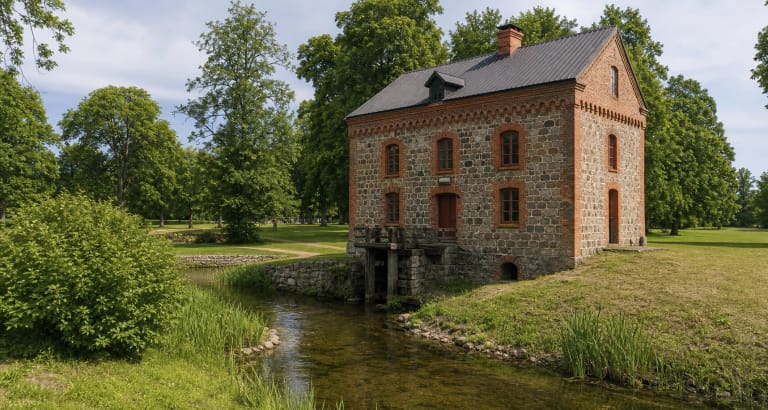
The oak stands beside the restored Glitiškės Manor and the wooded shore of Lake Širvys. Number 1 Liepų Avenue is a useful manor landmark, but a street number is not the tree's exact position. Save the coordinates before setting out because the manor, park, and lakeshore can appear as separate map features.
The 2016 inventory recorded a height of 28 metres and a girth of 7.65 metres
The State Forest Service inspected the oak on 2 June 2016. Its table records a tree height of 28 metres, a trunk circumference of 7.65 metres at the standard measuring height of 1.3 metres, and a crown width of 21.5 metres. The first major limbs began at roughly 4 metres, while the site stood 134 metres above sea level. That last number describes the location, not the tree.
VLE and the VSTT visitor guide publish the older rounded figures of 24 metres in height and 7.4 metres in circumference. The difference need not represent sudden growth: tree height, crown limits, and the circumference of an irregular trunk can vary with the date, measuring point, and method. This page prioritises the dated 2016 inventory while explaining the earlier numbers so that visitors do not mistake them for another oak.
Older descriptions call Glitiškės Oak Lithuania's third-thickest and tallest oak. In the State Forest Service's newer table of the thickest oaks, the Glitiškės oak, with a rounded girth of 7.7 metres, follows Stelmužė, Sandariškiai, and Mingėla oaks, placing it fourth in that dataset. Its 28-metre height remains exceptional, but the same inventory includes oaks reaching 36 and 38 metres, so an absolute tallest-tree title is no longer defensible.
Its exact age is unknown, while the sequence of protection is well documented
The VSTT guide and VLE repeat a local estimate that the oak may be more than 1,500 years old. A current Vilnius District Municipality presentation calls it roughly 600 years old. No published dendrochronological or other individual dating was found in the sources checked, so the honest description is a centuries-old veteran tree, with both figures presented as estimates rather than birth dates.
The tree has been protected since 1960 and was added to the national list of state natural monuments in 1987. VLE states that it has held natural-monument status since 2000 and the status of a botanical natural heritage object since 2003. The current VSTT list for Vilnius District continues to include Glitiškės Oak among the state-protected botanical objects.
Vilnius District Municipality nominated the oak for Lithuania's 2025 Tree of the Year competition, in which it placed third. The competition renewed public attention but neither altered the legal designation nor measured the tree's age. Protection concerns the root zone and the conditions needed for life, not only the monumental visible trunk.
Trunk scars identify the oak, but its condition record is dated
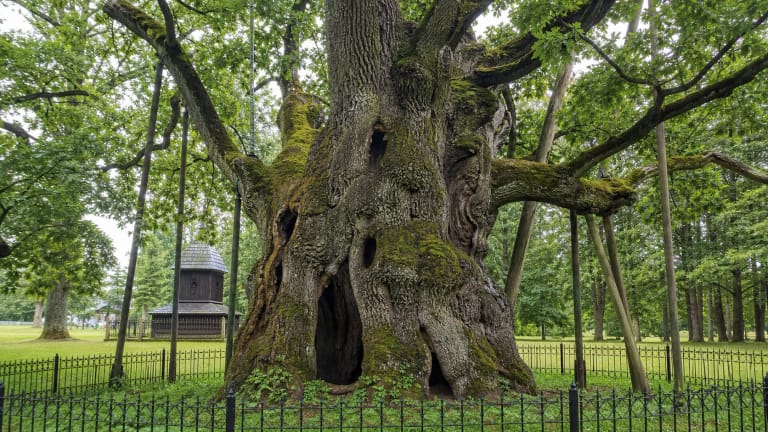
From the manor side, this is not a perfectly symmetrical park oak. A massive, deeply furrowed trunk divides higher up into several heavy upright and lateral leaders, supporting a tall, uneven, partly open crown. Pale lichens, a yellowish area low on the trunk, and old pruning scars make the individual tree recognisable even without its name board.
The 2016 inventory reported that the cut from a thick branch on the western side had closed over and appeared healthy, while decay on the eastern side was forming a cavity about 1.0 by 0.5 metre. This is a visual assessment from one date, not a guarantee for 2026 or a later season. Branches on veteran trees can fail, so never remain beneath the crown during a storm or strong wind.
Local residents see a heart in the shape of the yellowish scar. The 2025 competition profile explains that it formed where a diseased branch was removed, not where lovers carved a symbol. The distinction matters: never cut the bark, attach signs, climb on the roots, or reach into the cavity.
The 1831 insurgents and storks belong to local storytelling
Glitiškės Manor appears in written sources from 1483, and its surviving park and buildings give the oak a historic landscape setting. The manor's first recorded date is not, however, the tree's planting date. Even if the oak was growing during part of that history, the sources provide no planting record linking this individual to an estate owner.
VSTT and VLE say that, according to local accounts, young people from the estate gathered beneath the oak during the 1831 Uprising before marching to Vilnius to join resistance against the Russian Empire. The story requires phrases such as according to tradition or it is said. The checked sources give no participant list, diary, or other primary document that would establish the scene as a precisely documented event.
Another account recorded by VSTT says a pair of white storks nested in the oak for many years. In 1975 they reportedly returned but would not land on the nest, and the branch bearing it broke a few days later. The tale's sense of forewarning belongs to folklore; the physical record confirms only that the veteran tree bears evidence of major limb loss and pruning.
The oak has no separate ticket desk, but visitors must respect the manor grounds
The VSTT, VLE, State Forest Service, and municipal sources checked publish no separate Glitiškės Oak ticket or fixed opening hours. The tree can be viewed outdoors without entering the manor building, although events, grounds maintenance, or temporary restrictions can change the most convenient approach. Visit in daylight and obey signs on site.
The exact Google card marks the trunk, not a guaranteed parking place. A public copy of the listing labels an accessible car park and entrance, but no official description confirms a continuous step-free route all the way to the oak, and the final approach crosses lawn or natural ground. Check gates, surface conditions after rain, and individual mobility requirements before travelling.
On 29 July 2026, a publicly viewable copy of the exact Google card showed an average of 4.9 out of 5 from 54 reviews. That is a strong but changeable visitor rating, not a conservation assessment. Allow 20-40 minutes, never park on the lawn or root zone, do not climb the tree, and stand far enough away to fit its high crown into a photograph.