- Place
- Vilnius District Municipality
- Region
- Vilnius Region
- Type
- Geographical Centre of Europe marker and monument
- Address
- Golfo St 6, Girija village, Vilnius district
- Coordinates
- 54.90652, 25.31898
Centre of Europe, Geographic Centre of Europe, Geographical Center of Europe
What Is Marked Here
The Geographical Centre of Europe is a place in Vilnius district, near Purnuškės village, 26 km north of Vilnius, marking the point calculated in 1989 by France's National Geographic Institute (IGN). VLE states that the calculation was made by IGN scientist Jean-George Affholder using refined European continent contours and a centre-of-mass method; the stated point is at 54°54′ north latitude and 25°19′ east longitude.
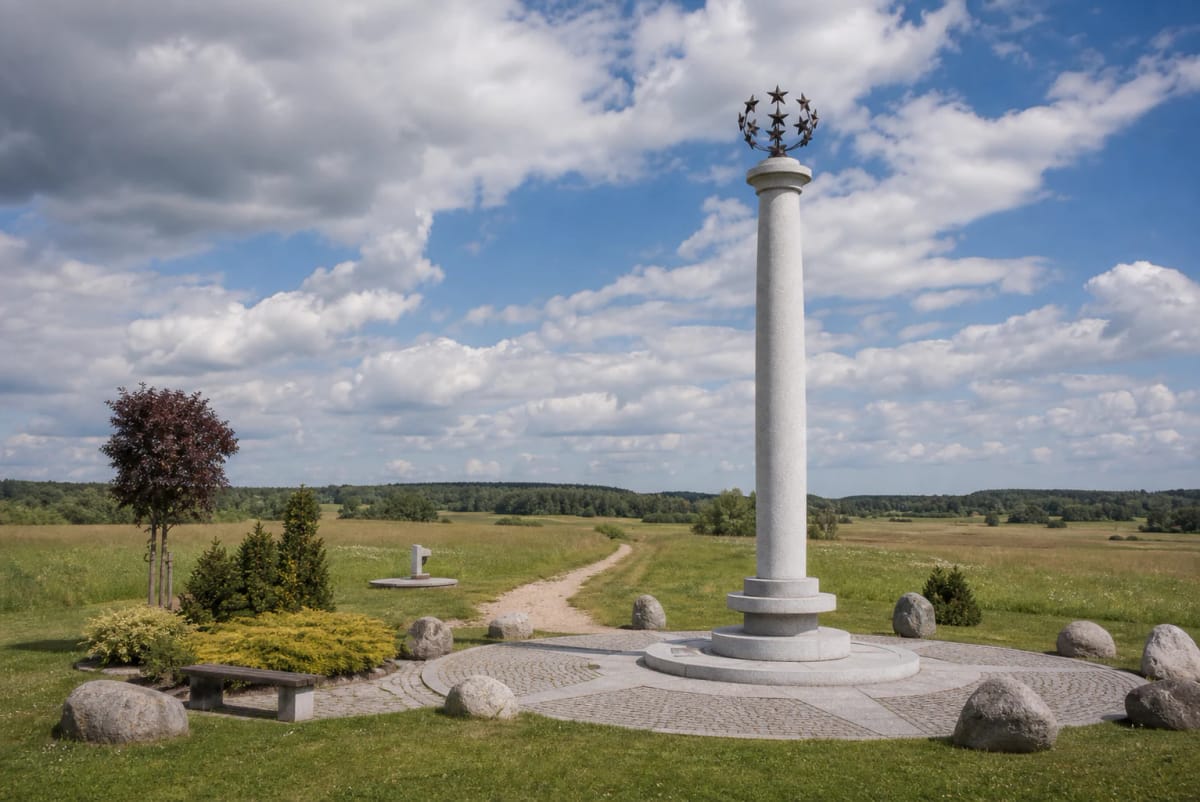
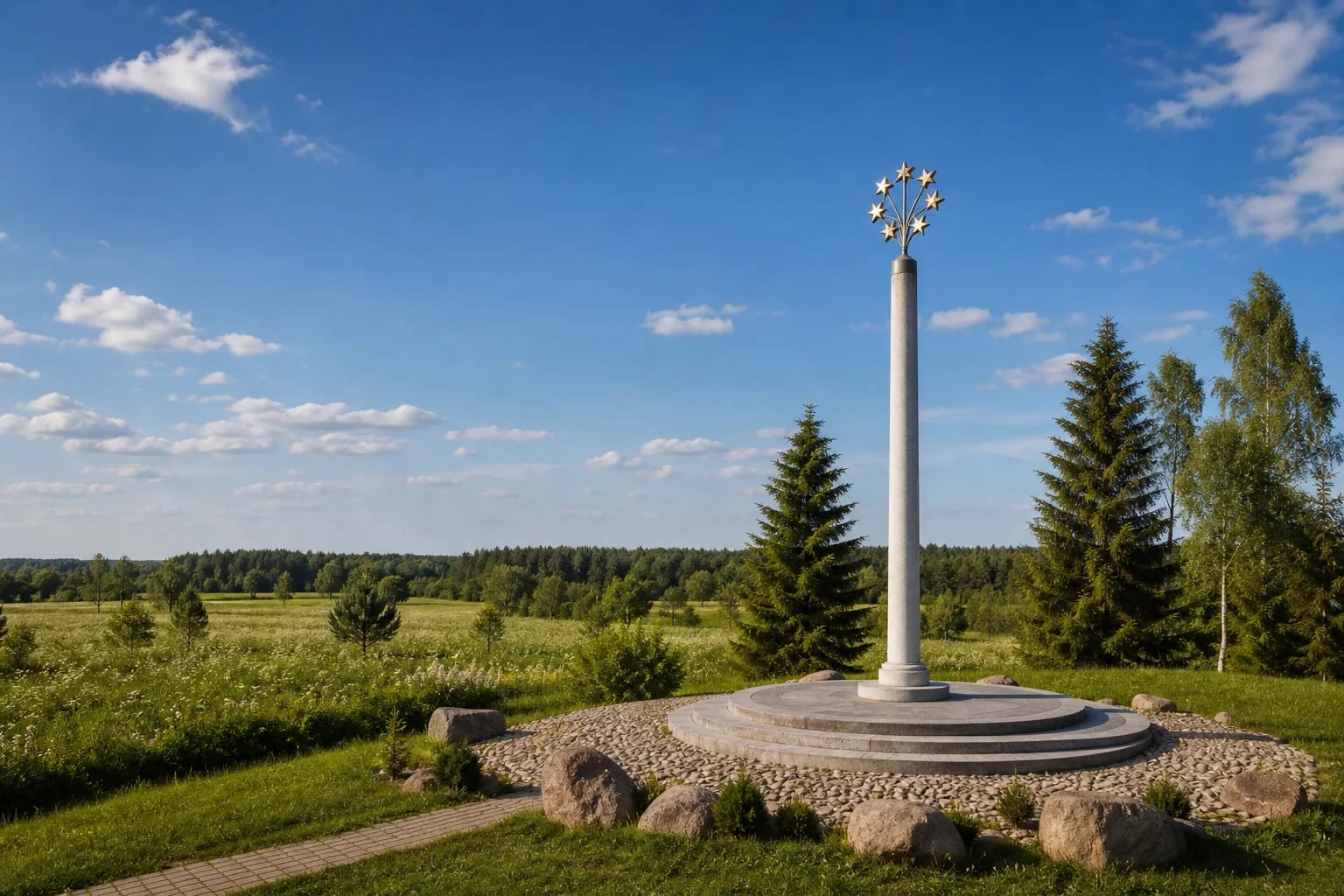
This is not a city centre or an EU administrative symbol, but a geography calculation. The point is the only Geographical Centre of Europe entered in the Guinness Book of Records. Visitors find an open area, a white granite column with a crown of stars, and a quiet field landscape; since 1992 the surroundings have been protected as Girija Reserve.
Why Several Europe Centres Are Mentioned
The Europe-centre question depends on method: how Europe's boundaries are defined, whether islands are included, and what geometry is used. VLE notes that the first known report about a centre of Europe was published as early as 1775 in Poland (Suchowola), and later centres were marked in Slovakia, Ukraine (Dilovė), Belarus (Polotsk), Estonia (Saaremaa island), and elsewhere.
The Lithuanian marker rests on the 1989 IGN calculation, making it the best-known and most officially presented version in Lithuania. VLE also notes that IGN scientists refined the coordinates in 2004, placing them slightly farther south near Pašiliai, but the monument was not moved.
The Monument
The first stone marking the Geographical Centre of Europe here was unveiled on 24 May 1997. The site's most prominent marker today is a white granite column with a crown of stars, erected in 2004 by sculptor Gediminas Jokūbonis. The design marks a coordinate while using European symbolic language.
The open setting matters. In photographs, the horizon and sky are part of the experience, giving the place the feeling of a geographic point rather than a conventional city monument.
Girija Reserve and the surrounding landscape
The complex is surrounded by Girija Landscape Reserve, established in 1992. Lake Girija, Bernotai Hillfort, and an ancient sacred hill lie nearby, so a short stop at the column can become a broader nature-and-heritage route.
The monument itself stands in an open meadow landscape. The wider setting helps explain why the place works not only as a coordinate on a map but also as a symbolic travel destination.
Geographical Centre and Europos Parkas
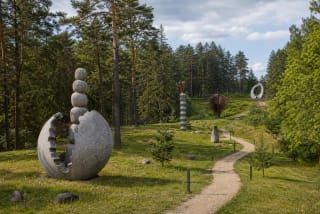
The Geographical Centre of Europe and Europos Parkas are often mentioned together, but they are not the same. The geographical centre is a coordinate-and-monument site; Europos Parkas is an open-air contemporary art museum.
If you have time, visit both. The first gives the geographic fact; the second gives a cultural interpretation.
What to Do on Site
The site is small. Visitors stop to see the monument, take photographs, read information, and walk briefly around the area. It is not a half-day object unless combined with Europos Parkas.
It works best for travellers who like symbolic points, coordinates, and map stories: the simple claim of having stood at the centre of Europe.
How to Arrive
The Geographical Centre of Europe is in Girija village, Vilnius district, 26 km north of Vilnius. Its official address is Golfo St 6. It is easiest to reach by car via the A14 road towards Molėtai. Go Vilnius also lists public-transport options, but check the current timetable before travelling.
The monument and its surroundings are outdoors, and Go Vilnius lists admission as free. In 2026, Vilnius District Municipality listed seasonal visitor services from 1 May to 1 October, Wednesday-Sunday from 10:00 to 17:00, excluding public holidays. Check the official page before travelling if you want visitor services or the symbolic certificate confirming your visit to the centre of Europe.
Choose the Geographical Centre of Europe in navigation if you want the column. Europos Parkas is a separate nearby attraction.
Nearby
The closest thematic combination is Europos Parkas. You can also connect the site with Verkiai Regional Park, the Green Lakes, or northern Vilnius routes.
For a Vilnius trip, this stop adds a geography and symbolism layer to the usual old town, museum, and panorama route.