- Place
- Zarasai District Municipality
- Region
- Zarasai District
- Type
- Lithuania's oldest oak, a botanical natural heritage object
- Address
- Stelmužė village, Imbradas Eldership, Zarasai District Municipality
- Coordinates
- 55.82990, 26.21739
Stelmužės ąžuolas
A symbol of Lithuanian oaks
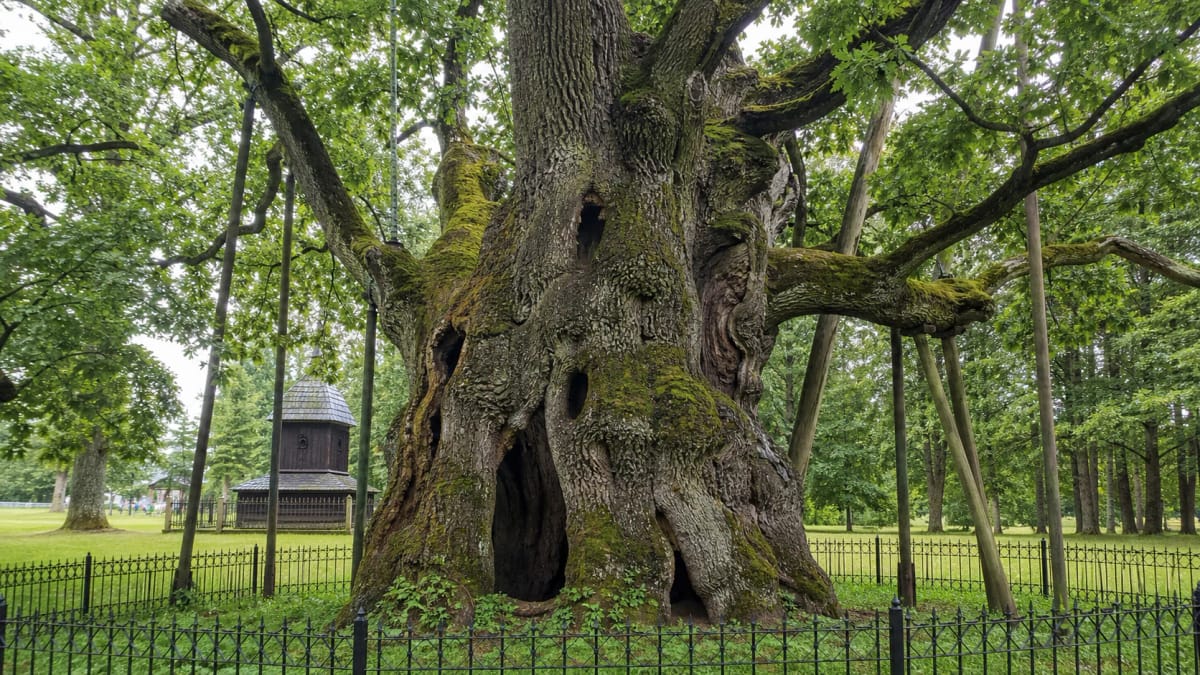
Stelmužė Oak is one of those places where scale is best understood only by standing nearby. Photographs show a thick trunk and supports, but in person you see how much time, damage, care, and respect can be held in a single tree.
VLE presents it as a state-protected pedunculate oak in Stelmužė village, Imbradas Eldership, Zarasai District. It is a botanical natural heritage object and natural monument, so the most important visitor rule is to look rather than touch or approach the trunk closely.
Age and measurements
The most often given age for Stelmužė Oak is about 1500 years, although VLE also mentions another estimate of about 2000 years. The safest wording is therefore to call it Lithuania's oldest oak and one of the oldest in Europe, without pretending to know one exact number.
VLE gives precise measurements: height 23 m, thickness about 3.5 m, trunk circumference at 1.3 m height 9.58 m, and circumference near the roots about 13 m. These numbers explain the tree's scale better than any epithet.
Protected natural monument
Stelmužė Oak has been protected since 1960; in 1987 it was included in the list of state natural monuments of republican significance, in 1999-2003 it was treated as a natural landscape object, in 2000 it became a natural monument, and since 2003 it has been listed as a botanical natural heritage object. VLE also notes that in 2016 it was chosen as Lithuania's Tree of the Year and in 2017 took part in the European Tree of the Year competition.
These statuses matter in practice. The protective fence, supports, and limited access are not formalities: for an old tree, extra soil compaction, root damage, or climbing into hollows can be harmful.
Condition and care
VLE states that the tree is in poor condition: infections, fungi, mosses, a hollow trunk, and supported branches all affect it. Parts of the trunk were covered in places to protect the tree from further decay.
Since 2005, the condition of Stelmužė Oak has been studied by Czech arborist Martin Nemec. VLE also mentions a 2021 incident when one branch broke after new supports were installed. This is a reminder that the tree is not a frozen monument: it is still alive, but very vulnerable.
Legends and older memory
At Stelmužė Oak people often speak about the older Baltic worldview, the oak as a sacred tree, and the memory of an offering place. VLE phrases this cautiously: it is thought that an offering place may have been near the oak.
That caution matters. We can reliably speak about the protected tree, its measurements, and its care history; the ritual layer should be presented as possible cultural memory, not as a precisely documented fact.
What to see on site
The main object is the trunk itself: hollows, bark relief, supports, and root zone. Do not rush straight to a distant photograph. First walk around at the permitted distance and see how different the oak looks from different sides.
Next to the oak stands Stelmužė Church of the Holy Cross, one of Lithuania's oldest surviving wooden churches, built in the seventeenth century and known for its folk Baroque interior and carved altars. Stelmužė is therefore a rare place where a millennium-old tree and one of the country's oldest wooden-architecture examples can be viewed together.
If time is short, the oak and church can be a brief stop; if you are travelling in the Zarasai region, plan them with lakes, manor sites, and Aukštaitija nature routes. The oak grows in an open area, is freely accessible, and can be visited year-round.
How to visit responsibly
Respect the fence, do not step on the roots, and do not touch the hollows. An old tree lives not only in its trunk but in a sensitive root zone, so even well-meant closeness can do damage.
For photography, soft light after rain or on an overcast day is best: bark relief, moss, and the depth of the hollow trunk are clearer. Harsh midday sun often creates hard shadows on the old trunk.