- Place
- Maišiagala, Vilnius District Municipality
- Region
- Vilnius District
- Type
- hillfort with outer ward and foot settlement
- Address
- Algirdo g., Maišiagala, Vilnius district
- Coordinates
- 54.87200, 25.06300
Bona's Castle
A Castle That Guarded Vilnius
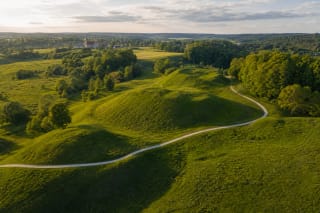
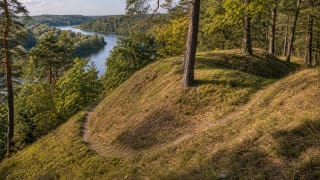
Maišiagala Hillfort stands on the edge of Maišiagala, on the right bank of the Dūkšta River, with steep 14-18 m slopes. Locally it is called Bona's Castle, a folk name without a real historical connection to Queen Bona Sforza.
In the fourteenth century a wooden castle stood here as part of the inner ring of castles protecting Vilnius from the north. The hillfort had earlier use in the first millennium, was later abandoned, and was reworked again at the beginning of the second millennium, when the platform was enlarged. This reflects a long history of the site spanning several millennia.
Castle History and Teutonic Attacks
The wooden castle of Maišiagala is mentioned in documents in 1365 and 1390. In late August 1365, a Teutonic Order army marching from Vilnius attacked and burned it. After the fire, the castle was strengthened: the foot ditch was deepened and the platform covered with a clay layer up to 2 m thick.
In 1390 the castle was attacked by the Order again. Maišiagala was also important as a town: it appears in Teutonic route descriptions, and in 1387, during Lithuania's Christianization, one of the first parishes of the Grand Duchy of Lithuania was founded here.
Algirdas and the 2002 Monument
Maišiagala is strongly linked with Grand Duke Algirdas. According to historical sources, in 1377 Algirdas was cremated according to old Lithuanian rites in a forest near Maišiagala. The exact place remains debated; some sources link it with Maišiagala, others with Vilnius' Šventaragis Valley, so present this as tradition rather than proven fact.
At the foot of the hillfort stands a 2002 stone-composition monument by sculptor Domas Čiapas, created to mark the 625th anniversary of Algirdas' death. The tradition should not be read as proof that Algirdas died on the hillfort itself.
Dimensions and Research
The hillfort platform is oval, about 40 x 65 m. It was defended by a major system: a 360 m long, 30 m wide, 4 m deep ditch at the foot, and beyond it a 270 m long, 4 m high rampart. An outer ward existed to the northeast, and a foot settlement of about 1 ha lay to the north and southwest.
Systematic excavations in 1971-1973 were led by archaeologist Regina Volkaitė-Kulikauskienė. A cultural layer up to 5.4 m thick was found, with three horizons from early first-millennium brushed pottery to fourteenth-century burn layers from the Teutonic attack. The finds are kept at the National Museum of Lithuania.
How to Visit
Stairs lead to the top, where there is a viewing platform and rest area. With the Algirdas monument, 30-60 minutes is usually enough. The site is open and freely visited.
Extend the visit with Maišiagala town heritage: the nineteenth-century church, the Classicist Houvalt manor palace (now a branch of the ethnography museum), and the priest Józef Obrembski museum nearby.